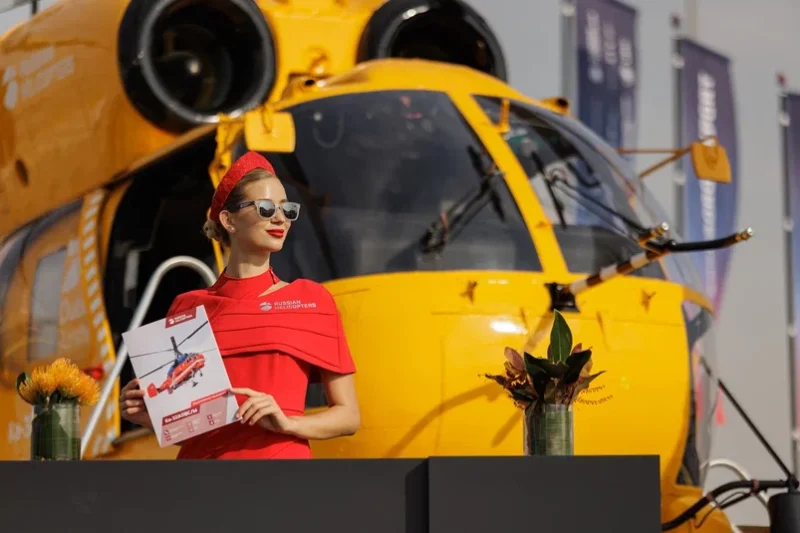
Rostec State Corporation’s Russian Helicopters Holding Company returned to the United Arab Emirates for the Dubai Airshow 2025, held from November 17 to 21. This year, the holding company utilized its static display area to field two distinct platforms: a medical evacuation variant of the light multi-purpose Ansat and the heavy-duty Ka-32A11M firefighting helicopter. While the company traditionally maintains a presence at this biennial event, the 2025 exhibition serves a specific strategic purpose. It functions as the first international presentation of the fully “import-substituted” Ansat, a move that signals the manufacturer’s shift toward domestic component sourcing in response to prolonged sanctions.
Nikolai Kolesov, CEO of Russian Helicopters, described the event as a critical platform for the holding company. He noted that the airshow facilitates discussions on future cooperation with foreign partners and potential customers in the Middle East and beyond. The debut of the modified Ansat represents a concerted effort to demonstrate industrial autonomy, as the airframe now relies exclusively on Russian-manufactured systems.

The Ansat-M: Engineering Autonomy
The Ansat displayed at the show is an export-oriented version of the Ansat-M. This light multirole helicopter has undergone extensive re-engineering at the Kazan Helicopter Plant to eliminate reliance on Western suppliers. The most substantial technical alteration is the powertrain. Previous iterations of the Ansat relied on Pratt & Whitney Canada PW207K engines. The new export variant integrates VK-650V engines, manufactured by the United Engine Corporation (also part of Rostec). This substitution addresses the critical supply chain restrictions faced by the Russian aerospace sector over the last several years.
Beyond the power plant, the modernisation affects the flight control systems. Engineers replaced all imported components within the control loops and autopilot with domestic alternatives. The aircraft now features a completely new starting and DC power generation system. Structurally, the fuselage received modifications that incorporate a higher percentage of composite materials. This adjustment improves the strength-to-weight ratio, directly impacting operational range.
According to the manufacturer, these aerodynamic and structural changes increased the helicopter’s range to 660 km. With the installation of an auxiliary fuel tank, the operational radius extends to 800 km. Russian Helicopters confirmed that this fully export-configured aircraft completed its maiden flight recently, on September 2, 2025. The aircraft is currently in the preliminary testing and system debugging phase, preparing for final certification.
Medical Configuration and Capabilities
The specific unit showcased in Dubai is configured for air ambulance duties. The Ansat platform is widely utilised for Helicopter Emergency Medical Services (HEMS) due to its cabin volume, which allows for a modular medical interior. The display model features a medical module designed to allow a single medical professional to load and transport patients without disconnecting life support systems—a critical factor in maintaining continuity of care during transit.
The onboard suite includes a defibrillator and other resuscitation equipment, enabling in-flight emergency procedures. Additionally, the helicopter supports an optional isolation box certified for the Ansat. This unit is essential for transporting patients with high-consequence infectious diseases, such as Ebola or COVID-19, or for extracting victims from chemically or biologically contaminated zones.
Operational specifications for the Ansat include a service ceiling of 3,500 meters and the ability to operate in ambient temperatures up to +50°C, a necessary capability for the Middle Eastern market. The global fleet of 140 Ansats has logged over 150,000 flight hours, providing a baseline of reliability data for the new variant.
Ka-32A11M: Specialized Aerial Firefighting
Alongside the light utility Ansat, Russian Helicopters displayed the Ka-32A11M, the latest iteration of the Kamov Ka-32 family. This aircraft is renowned for its coaxial rotor design, which eliminates the need for a tail rotor. This configuration directs all engine power to lift and provides exceptional stability in hover, particularly in turbulent wind conditions often found near large fires or in urban canyons.
The Ka-32A11M is optimised for firefighting and search and rescue (SAR). It features a new fire extinguishing system capable of carrying 4,000 litres of water and 400 litres of foam agent. A unique engineering feature of this system is the electrically heated water bucket flaps. This innovation allows the aircraft to conduct firefighting operations in temperatures as low as -15°C, a capability the manufacturer claims is a world first. This is particularly relevant for winter operational environments where icing typically grounds water-bombing fleets.
For urban operations, the helicopter can utilise a water cannon, allowing it to combat fires in high-rise buildings where precision is required. The “M” variant also introduces updated avionics. New radio navigation equipment is designed to reduce pilot workload during Instrument Flight Rules (IFR) conditions. Furthermore, the cockpit is compatible with night vision goggles (NVG), expanding the operational window to include low-altitude night missions. Like the Ansat, the Ka-32A11M is presented as a fully localised product, with all systems and components produced by Russian manufacturers.
Market Implications
The presence of these two aircraft at the Dubai Airshow 2025 illustrates the current trajectory of the Russian aerospace industry. By showcasing the Ansat with VK-650V engines and the modernised Ka-32A11M, Rostec is attempting to prove that its production capabilities remain intact and that it can offer viable alternatives to Western rotorcraft for specialised missions like EMS and heavy-lift firefighting. The effectiveness of these import-substituted platforms will likely be determined as they move from certification to active service with international operators.