


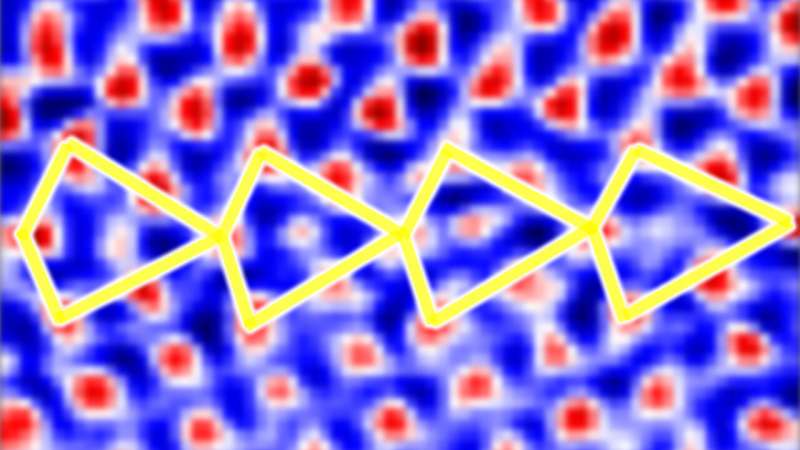
To develop advanced materials, a deep understanding of their underlying microstructure and chemistry is necessary. Knowing how defects influence the interplay between microstructure and chemical composition is crucial, as they are the entry gate for material’s failure due to corrosion or crack initiation.
Scientists of the Max-Planck-Institut für Eisenforschung (MPIE) have now developed a workflow and code to analyze and interpret two-dimensional defects, known as grain boundaries, in steels. They identified that certain ordered atomic motifs, the smallest structural hierarchical level in materials, govern the most important chemical properties of grain boundaries. Engineering those atomic motifs paves the way to more durable, tailor-made materials. The MPIE researchers published their results in Nature Communications.
Atomic motifs govern chemical properties of grain boundaries
“The main two challenges in analyzing grain boundaries down to their atomic scale is firstly, the huge amount of parameters that must be controlled in order to understand the effect of each parameter on the material’s properties. And secondly, the difficulty in observing light elements with transmission electron microscopy,” explains Dr. Xuyang Zhou, first author of the publication and deputy head of the Atom Probe Tomography group at MPIE.
“We developed a workflow and code for transmission electron microscopy that involves growing bicrystals of an iron-boron-carbon alloy with the same crystal orientation but changing grain boundary planes. This way, we were able to control the interfering parameters. To interpret the data, I developed a code that helps seeing light elements like boron and carbon in the iron grain boundaries. That is actually the first time we have been able to observe light elements in the grain boundaries of heavy metals, like iron.”
The researchers showed that even the mere tilt in the grain boundary plane with identical misorientation impacts the chemical composition and atomic arrangement of the microstructure and makes the material more or less prone to failure.
“Until now, it was not possible to image the light and heavy elements in the atomic motifs of grain boundaries in steel. Especially, the open space in ordered atomic structures, so called interstitial sites determine the solubility of light elements in a grain boundary. This will in future enable the targeted design and passivation of the chemical state of grain boundaries to free them from their role as entry gates for corrosion, hydrogen embrittlement, or mechanical failure,” explains Prof. Gerhard Dehm, co-author of the publication and director of the MPIE Structure and Nano-/Micromechanics of Materials department.
The scientists also used machine learning to analyze the grain boundary composition in data gained through atom probe tomography. The tomography shows how different elements are distributed in the grain boundary, offering the possibility to generate statistical analysis of the structure-composition correlation.
Next steps: Simulations and in-situ testing
The researcher team is now working together with the Computational Materials Design department at MPIE to use the developed code and experimental data for simulating how light elements like boron, carbon or hydrogen behave in materials.
Moreover, Zhou and his colleagues are developing set ups for in-situ heating and tensile tests in transmission electron microscopes to further analyze the grain boundary behavior under changing external conditions. This study provides direct experimental evidence for understanding the chemical nature of grain boundaries on the basis of their atomic-scale structural properties.
More information:
Xuyang Zhou et al, Atomic motifs govern the decoration of grain boundaries by interstitial solutes, Nature Communications (2023). DOI: 10.1038/s41467-023-39302-x
Provided by
Max Planck Society
Citation:
Seeing light elements in a grain boundary: Revealing material properties down to the atomic scale (2023, August 1)
retrieved 2 August 2023
from https://phys.org/news/2023-08-elements-grain-boundary-revealing-material.html
This document is subject to copyright. Apart from any fair dealing for the purpose of private study or research, no
part may be reproduced without the written permission. The content is provided for information purposes only.


