
• Business
  • Markets
  • Politics
  • Crypto
  • Finance
  • Intelligence
    • Policy Intelligence
    • Security Intelligence
    • Economic Intelligence
    • Fashion Intelligence
  • Energy
  • Technology
  • Taxes
  • Creator Economy
  • Wealth Management
  • LBNN Blueprints
  • Business
  • Markets
  • Politics
  • Crypto
  • Finance
  • Intelligence
    • Policy Intelligence
    • Security Intelligence
    • Economic Intelligence
    • Fashion Intelligence
  • Energy
  • Technology
  • Taxes
  • Creator Economy
  • Wealth Management
  • LBNN Blueprints

Retina cells cultured on nanofiber scaffolds could help treat blindness

Simon Osuji by Simon Osuji
July 28, 2023
in Technology
0
Retina cells cultured on nanofiber scaffolds could help treat blindness
0
SHARES
1
VIEWS
Share on FacebookShare on Twitter

Retina cells cultured on nanofiber scaffolds could help treat blindness
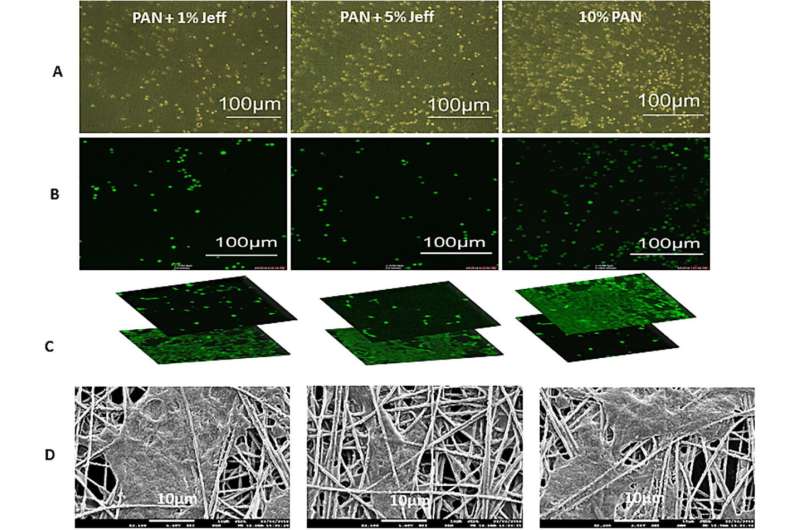
Representative images of unstained and fluorescently stained live ARPE-19 cells in culture with FA- treated ENS. Shown are unlabeled cells observed 5 minutes after seeding (A), labeled cells observed 30 minutes after seeding (B). Using confocal microscopy, cells infiltrated the PAN/Jeff series, while cells on PAN remained on the surface (C). Panel (D) shows SEM images of ARPE-19 cells cultured 24 h on FA- treated ENS. Credit: Materials & Design (2023). DOI: 10.1016/j.matdes.2023.112152

Scientists have found a way to use nanotechnology to create a 3D “scaffold” to grow cells from the retina—paving the way for potential new ways of treating a common cause of blindness.

Related posts

TotalEnergies, Mozambique announce restart of nation’s LNG activities – EnviroNews

TotalEnergies, Mozambique announce restart of nation’s LNG activities – EnviroNews

January 30, 2026
Japan backs UNESCO with $50,000 to boost flood resilience in Niger – EnviroNews

Japan backs UNESCO with $50,000 to boost flood resilience in Niger – EnviroNews

January 30, 2026

Researchers, led by Professor Barbara Pierscionek from Anglia Ruskin University (ARU), have been working on a way to successfully grow retinal pigment epithelial (RPE) cells that stay healthy and viable for up to 150 days. RPE cells sit just outside the neural part of the retina, and when damaged, can cause vision to deteriorate. Their work is published in Materials & Design.

It is the first time this technology, called “electrospinning,” has been used to create a scaffold on which the RPE cells could grow, and could revolutionize treatment for one of age-related macular degeneration, one of the world’s most common vision complaints.

When the scaffold is treated with a steroid called fluocinolone acetonide, which protects against inflammation, the resilience of the cells appears to increase, promoting growth of eye cells. These findings are important in the future development of ocular tissue for transplantation into the patient’s eye.

Age-related macular degeneration (AMD) is a leading cause of blindness in the developed world and is expected to increase in the coming years due to an aging population. Recent research has predicted that 77 million people in Europe alone will have some form of AMD by 2050.

AMD can be caused by changes in the Bruch’s membrane, which supports the RPE cells, and breakdown of the choriocapillaris, the rich vascular bed that is adjacent to the other side of the Bruch’s membrane.

In Western populations, the most common way sight deteriorates is due to an accumulation of lipid deposits called drusen, and the subsequent degeneration of parts of the RPE, the choriocapillaris and outer retina. In the developing world, AMD tends to be caused by abnormal blood vessel growth in the choroid and their subsequent movement into the RPE cells, leading to hemorrhaging, RPE or retinal detachment and scar formation.

The replacement of the RPE cells is among several promising therapeutic options for effective treatment of sight conditions like AMD, and researchers have been working on efficient ways to transplant these cells into the eye.

Study author Professor Barbara Pierscionek, Deputy Dean (Research and Innovation) at Anglia Ruskin University (ARU), said, “This research has demonstrated, for the first time, that nanofiber scaffolds treated with the anti-inflammatory substance such as fluocinolone acetonide can enhance the growth, differentiation, and functionality of RPE cells.

“In the past, scientists would grow cells on a flat surface, which is not biologically relevant. Using these new techniques. the cell line has been shown to thrive in the 3D environment provided by the scaffolds.

“This system shows great potential for development as a substitute Bruch’s membrane, providing a synthetic, non-toxic, biostable support for transplantation of the retinal pigment epithelial cells. Pathological changes in this membrane have been identified as a cause of eye diseases such as AMD, making this an exciting breakthrough that could potentially help millions of people worldwide.”

More information:
Biola F. Egbowon et al, Retinal pigment epithelial cells can be cultured on fluocinolone acetonide treated nanofibrous scaffold, Materials & Design (2023). DOI: 10.1016/j.matdes.2023.112152

Provided by
Anglia Ruskin University

Citation:
Retina cells cultured on nanofiber scaffolds could help treat blindness (2023, July 27)
retrieved 28 July 2023
from https://phys.org/news/2023-07-retina-cells-cultured-nanofiber-scaffolds.html

This document is subject to copyright. Apart from any fair dealing for the purpose of private study or research, no
part may be reproduced without the written permission. The content is provided for information purposes only.


Source link

Previous Post

‘The Mic Is On’ Music Series

Next Post

Zion Williamson, along with mother and stepfather, sued over a loan

Next Post
Zion Williamson, along with mother and stepfather, sued over a loan

Zion Williamson, along with mother and stepfather, sued over a loan

Leave a Reply Cancel reply

Your email address will not be published. Required fields are marked *

RECOMMENDED NEWS

The World’s First Crispr Drug Gets a Slow Start

The World’s First Crispr Drug Gets a Slow Start

1 year ago
VeChain Working With United Nations in Sustainability Campaign

VeChain Working With United Nations in Sustainability Campaign

2 years ago
US authorities return antiquities valued at $10m to India

US authorities return antiquities valued at $10m to India

1 year ago
M-Pesa Foundation Boosts Maternal Health in Migori and Nyamira

M-Pesa Foundation Boosts Maternal Health in Migori and Nyamira

4 months ago

POPULAR NEWS

  • Ghana to build three oil refineries, five petrochemical plants in energy sector overhaul

    Ghana to build three oil refineries, five petrochemical plants in energy sector overhaul

    0 shares
    Share 0 Tweet 0
  • The world’s top 10 most valuable car brands in 2025

    0 shares
    Share 0 Tweet 0
  • Top 10 African countries with the highest GDP per capita in 2025

    0 shares
    Share 0 Tweet 0
  • Global ranking of Top 5 smartphone brands in Q3, 2024

    0 shares
    Share 0 Tweet 0
  • When Will SHIB Reach $1? Here’s What ChatGPT Says

    0 shares
    Share 0 Tweet 0

Get strategic intelligence you won’t find anywhere else. Subscribe to the Limitless Beliefs Newsletter for monthly insights on overlooked business opportunities across Africa.

Subscription Form

© 2026 LBNN – All rights reserved.

Privacy Policy | About Us | Contact

Tiktok Youtube Telegram Instagram Linkedin X-twitter
No Result
View All Result
  • Home
  • Business
  • Politics
  • Markets
  • Crypto
  • Economics
    • Manufacturing
    • Real Estate
    • Infrastructure
  • Finance
  • Energy
  • Creator Economy
  • Wealth Management
  • Taxes
  • Telecoms
  • Military & Defense
  • Careers
  • Technology
  • Artificial Intelligence
  • Investigative journalism
  • Art & Culture
  • LBNN Blueprints
  • Quizzes
    • Enneagram quiz
  • Fashion Intelligence

© 2023 LBNN - All rights reserved.