


As the most abundant energy source on earth, solar energy is a promising alternative in the pivot toward clean energy. However, current commercial solar cells are only 20% efficient in converting light into usable energy.


Tandem solar cells, in which multiple solar cells are stacked on top of each other, are potentially more efficient. Each cell layer is sensitive to different wavelengths of light, enabling the capture of energy that might otherwise be lost.
The top layer of the tandem solar cell typically allows certain bands of light energy to pass through and be captured by the bottom layer. Fabricating the top layer with a type of material known as perovskite has been found to improve solar cell efficiency far beyond the current 20% threshold.
Dr. Xue Hansong from the Singapore University of Technology and Design (SUTD) explains that perovskite solar cells “can be tailored to have outstanding optoelectronic properties, including a high absorption coefficient, high defect tolerance, and a tunable bandgap.”
These cells can be challenging to design and fabricate. Maximizing their efficiency often comes at the price of increasing material costs.
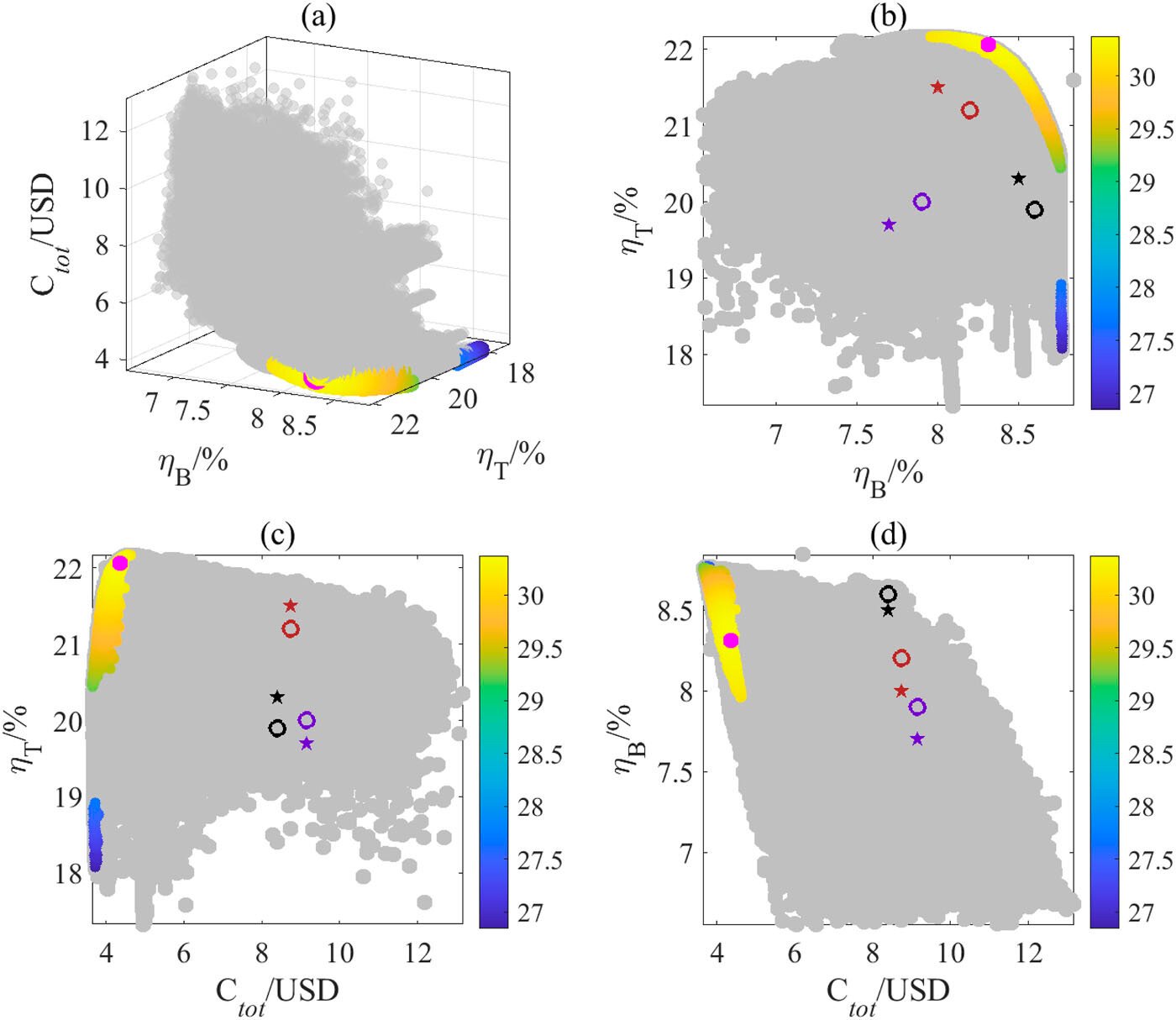
To design perovskite solar cells that balance efficiency with cost-effectiveness, the Pareto front optimization method is used, whereby optimal solutions are identified based on their trade-offs between the two parameters of efficiency and cost. But this method can be extremely time-consuming due to the sheer complexity of the calculations involved.
To address this, Dr. Xue collaborated with researchers from the National University of Singapore and the University of Toronto to incorporate machine learning in the Pareto front optimization method.
Specifically, the team turned to neural network learning for their study published in the journal APL Machine Learning, titled “Exploring the optimal design space of transparent perovskite solar cells for four-terminal tandem applications through Pareto front optimization”.
Dr. Xue and his team first generated a set of data using an opto-electronic-electric model to calculate the efficiencies for different configurations of four-terminal (4T) perovskite copper indium selenide tandem solar cells. With this data, they then trained a neural network so that it could quickly simulate and predict the efficiency of any 4T tandem solar cell under various parameters.
Using the neural network to predict efficiency vastly reduced the time needed to perform Pareto front optimization. “The neural network took only 11 hours to predict the efficiencies of 3,500 different devices. Performing the same simulation with the original opto-electronic-electric model would have taken approximately six months,” said Dr. Xue.
With the time saved, the team could quickly analyze different simulations and determine the optimal configuration of a 4T tandem solar cell that maximizes efficiency at minimal cost. In fact, the optimal configuration predicted by the neural network exhibited an increased efficiency of 30.4% while also reducing material costs by 50%. Comparing this design with existing experimental ones also provided the researchers with new insights.
“The predicted optimal cells show thinner front contact electrodes, charge-carrier transport layers, and back contact electrodes,” said Dr. Xue. The implications of this finding cannot be understated—they pointed at charge-carrier transport possibly being a critical factor in optimizing perovskite tandem cells.
For Dr. Xue, the success of the novel neural network model is only just the beginning in improving solar cell efficiency. Through the use of design, AI and technology, the fabrication of solar cells can become more efficient, cost-effective, and versatile, contributing significantly to the advancement of renewable energy solutions.
The team is also looking to build onto their neural network by integrating diverse material data. These include the use of various materials for the charge-carrier transport layer as well as perovskite compounds with different characteristics.
There are also plans to expand their approach to a wider range of tandem device architectures, such as all-perovskite, perovskite-on-organic, and perovskite-on-silicon tandem solar cells.
More information:
Hu Quee Tan et al, Exploring the optimal design space of transparent perovskite solar cells for four-terminal tandem applications through Pareto front optimization, APL Machine Learning (2024). DOI: 10.1063/5.0187208
Singapore University of Technology and Design
Citation:
Researchers use machine learning to optimize the design of perovskite tandem solar cells (2024, August 6)
retrieved 6 August 2024
from https://techxplore.com/news/2024-08-machine-optimize-perovskite-tandem-solar.html
This document is subject to copyright. Apart from any fair dealing for the purpose of private study or research, no
part may be reproduced without the written permission. The content is provided for information purposes only.


