


As global temperatures continue to rise, maintaining the quality and yield of crops adapted to lower temperatures will increasingly become a challenge.
One crop known to be affected by higher nighttime temperatures during the ripening phase is rice, which can exhibit a condition known as “chalkiness” due to heat stress.
Chalkiness is when the rice granule is less compact due to the decreased concentration of starch. This can result in lower milling yields, cooking quality and overall market value.
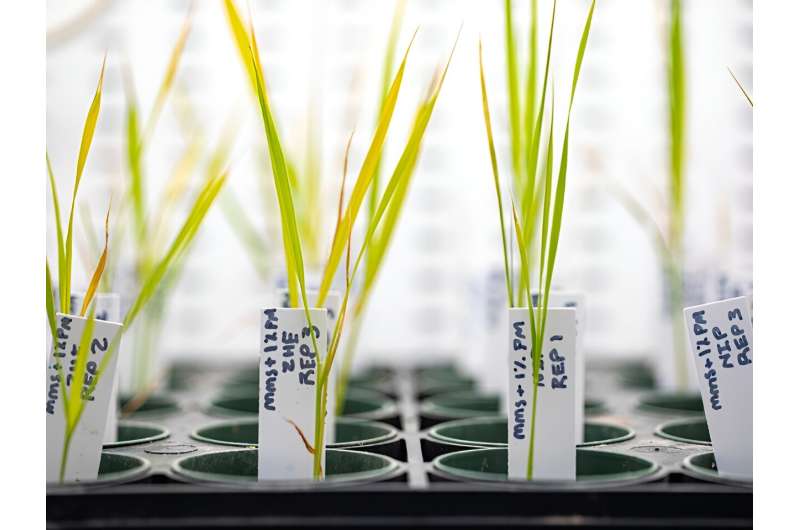
A paper published in Plant Journal by researchers at the University of Arkansas and the University of Arkansas System Division of Agriculture, or UADA, may offer a remedy to both heat-induced and genetic chalkiness. The paper, “Targeted mutagenesis of the vacuolar H+ translocating pyrophosphatase gene reduces grain chalkiness in rice,” details how the team was able to gene edit a strain of japonica rice to reduce chalkiness.
The researchers specifically targeted a gene that encodes the vacuolar H+ translocating pyrophosphatase (V-PPase), an enzyme known to play a role in increasing grain chalkiness. Using CRISPR-Cas9 gene-editing technology, the team was able to reduce the expression of V-PPase by editing a promoter element, which controls how much it is expressed.
The mutated rice lines resulted in a seven- to 15-fold decrease in chalkiness, depending on the strain of rice, with a consequent increase in grain weight. The results held up even under increased nighttime temperatures. Overall, the mutated lines were characterized by more compact packing of starch granules and formation of translucent (as opposed to chalky) rice grain, showing a clear improvement in rice quality.
The process was novel enough that the paper’s first author, Peter James Icalia Gann, a Fulbright Scholar in the Cell and Molecular Biology Program, and co-author, Vibha Srivastava, a professor in the Department of Crop, Soil and Environmental Sciences who has a joint appointment with the U of A and the UADA, filed for a provisional patent.
“If we want to sustain life on our planet, it is really important to identify solutions to problems in our food systems that are coming with increasing average temperatures,” Gann said. “We were really excited to share our findings that utilized gene-editing in rice to improve grain quality that remains consistent—even under heat stress.”
More information:
Peter James Icalia Gann et al, Targeted mutagenesis of the vacuolar H+ translocating pyrophosphatase gene reduces grain chalkiness in rice, The Plant Journal (2023). DOI: 10.1111/tpj.16317
Provided by
University of Arkansas
Citation:
Research shows gene editing improves grain quality and reduces heat stress in rice (2023, July 28)
retrieved 28 July 2023
from https://phys.org/news/2023-07-gene-grain-quality-stress-rice.html
This document is subject to copyright. Apart from any fair dealing for the purpose of private study or research, no
part may be reproduced without the written permission. The content is provided for information purposes only.


