Important regulatory changes in the agriculture sector are in the pipeline or at various stages of implementation, covering local government reforms, carbon emissions targets, changes to the Firearm Control Amendment Bill, and measures on water, land, and agricultural remedies.


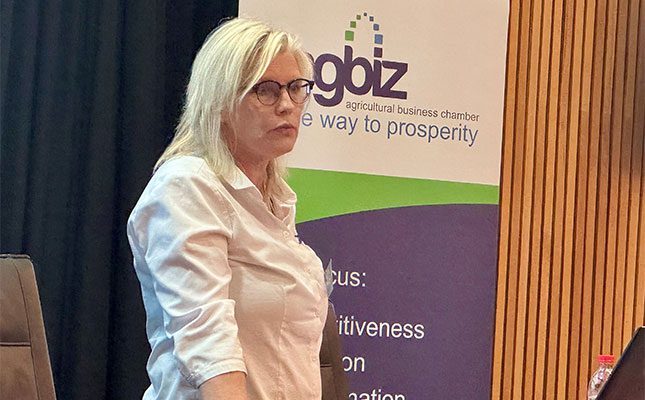
Photo: Magda du Toit
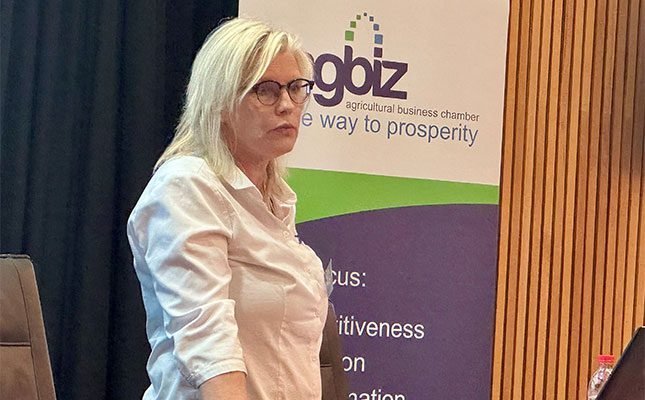
During the Agbiz Media Day held recently in Pretoria, Annelize Crosby, head of legal intelligence at Agbiz, sketched the impact these changes might have on the sector. “A great deal is happening at the moment in the regulatory and policy space,” she said.
With regard to the Expropriation Act (No. 13 of 2024), Crosby noted that it remains a contentious and controversial topic, adding that a member of the MK Party recently tabled a proposal in Parliament to do away with the protection of private property rights altogether.
“It shows there is still an appetite in certain circles and within certain political parties to change the property clause,” she added.
If passed, the proposed amendments to Section 25 of the Constitution would allow for the expropriation of land without any compensation and scrap the protection of private property rights entirely.
“Government recently acknowledged that Section 19 of the Expropriation Act is likely unconstitutional. This section deals with disputes about compensation and the role of the court in such disputes,” Crosby said.
She also referred to a case set to be heard in the Constitutional Court in February 2026, concerning land ownership after the Ekurhuleni municipality expropriated a property without compensation to test the limits of Section 25 of the Constitution. The landowner is contesting the compensation.
Mistaken beliefs about agricultural remedies need clarification
Referring to misconceptions about agricultural remedies and their potential impact on production, Crosby said a concerted effort was needed to address them.
She pointed out that NGOs have been campaigning hard for the banning of all highly hazardous pesticides and have also been involved in protest action and presentations in Parliament.
“Agbiz recently presented to the Portfolio Committee on Agriculture on the responsible use of agricultural remedies. It is important to come up with a realistic, science-based framework for the use of agricultural remedies crafted for South Africa’s climatic conditions specifically,” she explained.
Crosby said the misconceptions included:
- That farming can be successful without using pesticides and herbicides
- That there is insufficient regulation of the registration and use of these remedies
- That there will be no impact on food security if these remedies are discontinued
- That our situation and climatic conditions are similar to those in Europe, for example
She mentioned that one of the recommendations by the NGOs is that all substances banned elsewhere in the world should be banned in South Africa, and that safer alternatives should be promoted.
“Although the agriculture [sector] agrees that crop protection substances should be used responsibly and with caution, it is important to remember that changes cannot happen overnight. If certain substances are banned, there may not be substitute products, or alternative options will not be available overnight. It takes years to develop and register new products.”
Crosby said a final report with recommendations will go to Minister of Agriculture John Steenhuisen.
Water-use regulations
In a water-scarce country such as South Africa, water use will always be a contentious issue. Here, if you own land and have access to a water resource, you do not automatically have the right to use that water.
According to the National Water Act (No. 36 of 1998), or the NWA, users need approval from the Department of Water and Sanitation (DWS) by general authorisation or by obtaining a water-use licence to use water from natural sources.
In November 2023, the DWS published proposed amendments to the NWA, and Cabinet approved the National Water Amendment Bill on 6 August 2025.
Crosby explained that the proposed changes in the latest version of the Bill include:
- A 30m setback from the source in water source areas;
- The prohibition of water trading or transfer of a water-use entitlement from one person to another;
- Water reallocation by the minister of water and sanitation between sectors, provinces, and catchments. This will codify the ‘use-it-or-lose-it’ principle. The minister can reallocate any authorised water use left unused for a set period;
- The prioritisation of the redress of past racial and gender discrimination when issuing a licence or general authorisation; and
- Requiring Water User Associations to include a detailed strategy for achieving racial and gender transformation in all components of the association, with constitutions approved by the minister before establishment.
Crosby added that, according to a 2018 Water Research Commission report, irrigation supports between 25% and 30% of agricultural production on a national level.
“It is estimated that irrigation is responsible for up to 90% of the production of high-value crops, including vegetables and fruit; and 25% to 40% of the production of industrial crops, including sugar cane and cotton. About 90% of our fruit and wine is produced under irrigation.
“Any uncertainty regarding access to irrigation water is likely to have an impact on investment in the sector, farm values, and agricultural production of commodities produced under irrigation,” she concluded.