


By Pauline Soy
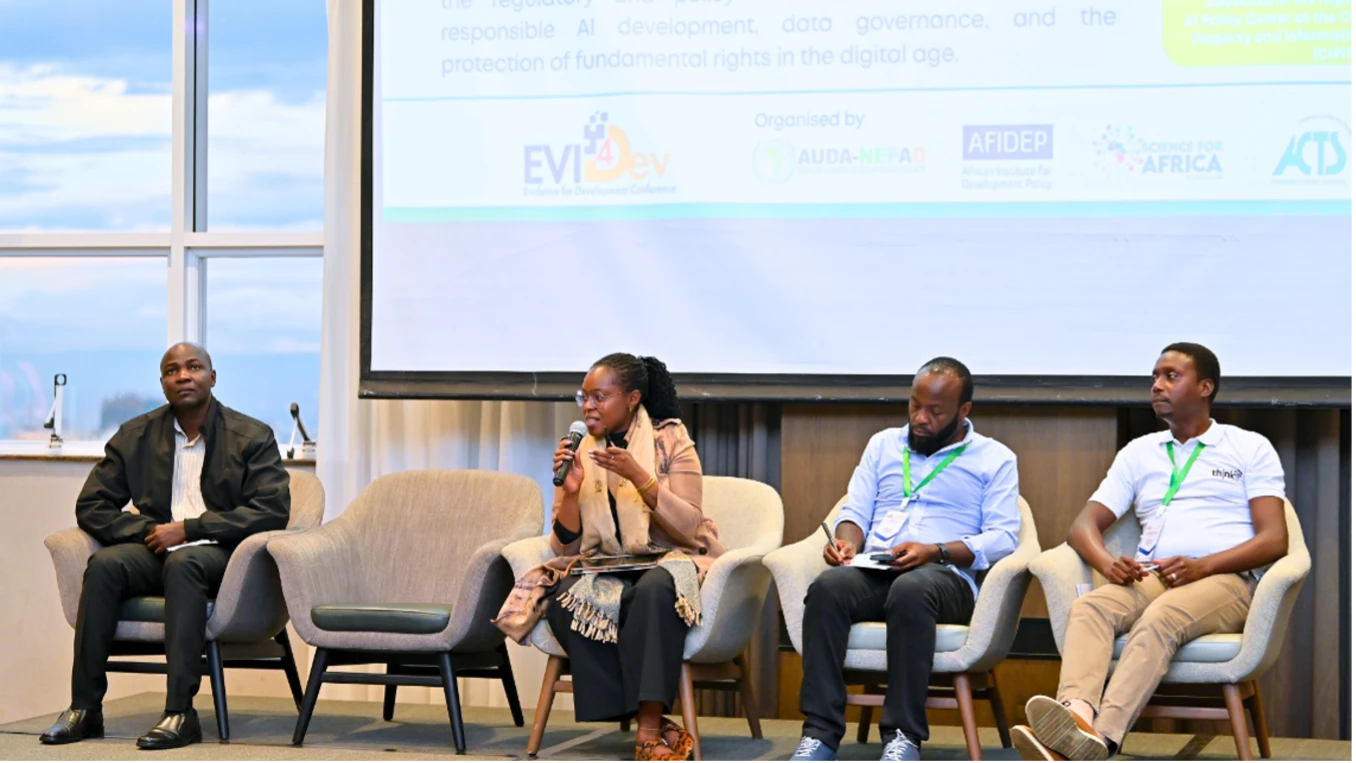
From left: Dr. George Musumba, Ms. Florence Anyango Ogonjo, Dr. Lawrence Nderu, and Mr. Brian Omwenga, in a panel discussion at the Evi4Dev conference side session on AI
A recent dialogue, hosted by the ACTS AI Institute (ACAII), revealed that there is a troubling paradox on Artificial Intelligence (AI) development in Africa, in that, while innovators are actively developing AI systems every day, only a small percentage are being implemented and scaled. The dialogue, held on the 6th of May, 2025, brought together policymakers, researchers, developers, civil society organisations, vendors and the media, to reflect on the promises and perils of AI innovations in Africa and to provide a practical balance between ethics, regulation and innovation.
AI presents a transformative opportunity for Africa to significantly boost its economies, governance systems, and public services. Despite the low deployment rate on the continent, access is still expanding. According to McKinsey, the current adoption rate of AI could unlock between $61 billion and $103 billion in additional economic value across various sectors in Africa. However, AI innovations provide both benefits and risks, which greatly impact their development and adoption on the continent. Hence, as technology continues to evolve, stakeholders across the continent are calling for a conscious and deliberate approach to how AI is developed, adopted and deployed.
AI innovation and ethics: Where is the balance?
While discussing the benefits and risks of AI, Dr. Winston Ojenge, Principal Research Fellow and the Head of the ACAII at the African Centre for Technology Studies (ACTS), highlighted that platforms like “Beyond” allow users in rural areas, even those with basic feature phones, to access large language models such as ChatGPT. This is a necessary breakthrough for bridging the digital divide and ensuring inclusivity.
However, while the opportunities are immense, so are the risks. Incidences where AI failed and posed risks are grim reminders of the dangers of unregulated AI. Examples of these include the 2023 incident in South Korea where a mis-calibrated sensor led to a robot killing a human worker, and accidents involving Tesla vehicles.
At the continental level, the impact of automation on employment is a more critical concern for African economies. While countries with aging populations may welcome labor-replacing AI, in Africa, where youth unemployment is already high, unregulated automation could lead to massive job losses. There is a need for African leaders to proactively develop policies that balance productivity with social protection. Essentially, AI should not come at the cost of deepening inequality or aggravating unemployment.
“These incidents and potential impacts make regulation not optional, but essential. However, regulation should not stifle innovation,” he stressed, adding that, “there is no doubt that AI-driven automation will arrive in Africa, the question is: are we prepared for it?”
Ms. Florence Anyango, Research Fellow for the AI Policy Center at the Center for Intellectual Property and Information Technology Law (CIPIT), added that ethics exists to provide order and in this case to ensure that the development and use of AI does not spiral out of control, but instead serve the common good.
“…policy is not just about regulation; it is about guiding values like fairness, accountability, and inclusivity. We need strong ethical frameworks, backed by clear governance systems, to ensure that AI benefits everyone, not just a few,” she emphasised.
UNESCO’s AI ethics principles offer a starting point to responsible AI development, placing emphasis on AI systems that are responsible for their actions, ensure fairness, transparency, and properly safeguards against misuse. The ACAII, through the AI4D-SRAIS project is using the GIZ Ethics of AI tool to mentor innovators across African hubs implementing these ethical frameworks in real-world contexts. The team is also working to develop an Africanized toolbox that will provide context-specific frameworks, as a result of gaps already realized in the current tool.
Africa’s unique potential for contribution to AI development
As AI continues to reshape industries, economies and societies, Africa cannot afford to be passive adopters of the technology. The continent must actively engage in its development with a strategic focus on regulation, collaboration, and responsible deployment to safeguard against its risks.
Hon. John Kiarie, Kenya’s Member of Parliament representing Dagoretti Constituency, and the Chair of the Parliamentary Committee on Communication, Information, and Innovation, recognised ethics as Africa’s opportunity for entry into the AI revolution. He emphasised that Africa’s ethical frameworks should be rooted in authenticity, cultural values, and a people-first philosophy in a future-facing context.
“The risk is not just that Africa will miss out. The real danger is that, if we do not shape AI development ourselves, we risk reducing our people to digital plantations, where we remain consumers rather than producers,” he noted, adding that “our principles, ways of thinking, traditions, and heritage are our strengths.”
The inclusion of marginalised groups in AI development can draw the continent closer to realising its potential. Currently, less than 30% of the workforce in data and AI-related jobs are women. This calls for more inclusive educational programs and conducive working environments for women in technology. Notably, ACAII has been at the forefront in championing the inclusion of African women in AI development through scholarships to enhance their knowledge and skills.
Partnerships for responsible AI development
The current regulation landscape is a major challenge to the development and scaling of AI solutions in Africa. While a few countries like Kenya have developed an AI strategy, the broader policy landscape remains fragmented. Furthermore, various institutions have their own scattered regulations or frameworks that lack cohesion or national and regional guidance. This makes it hard to regulate and promote AI development in a unified way.
Speaking at the event, Prof. Tom Peter Migun Ogada, ACTS Executive Director, mentioned that for over three decades, the Centre has played a pivotal role in shaping forward-looking policies in science, technology, and innovation. He underscored that this has been made possible by sustained collaboration between research institutions and governments.
In particular, the relationship between ACTS and the Parliament of Kenya, through the Chair of the Parliamentary Committee on Communication, Information, and Innovation has steered forward the conversation on responsible AI within the policy space. A notable impact is the UK-Kenya AI Challenge fund which brought together AI innovators from both countries to shape responsible AI innovation.
Dr. George Musumba mentioned that another challenge to the adoption and scaling of AI innovations is the weak link between academia and industry.
“Stronger partnerships and collaborations could lead to more innovations being adopted. When industry players understand what is happening in academia, they will be more likely to invest in and scale promising research,” he stressed.
At the end of the session, participants called for a multidisciplinary approach where different experts, such as marketing specialists, ethics scholars, and developers collaborate to ensure that AI innovations are not only market-ready but also ethically sound.
For more information, contact: acaii[@]acts-net.org
Related resources
- Evi4Dev Conference Side Session: Balancing Breakthroughs and Risks of AI in Africa – ACTS | African Centre for Technology Studies
- ACTS Kicks off the Mentorship Program on Scaling Responsible Artificial Intelligence Solutions – ACTS | African Centre for Technology Studies
- How Kenya and the UK are Shaping Responsible AI Innovation through Strategic International Partnership – ACTS | African Centre for Technology Studies
- AI4D Reports


