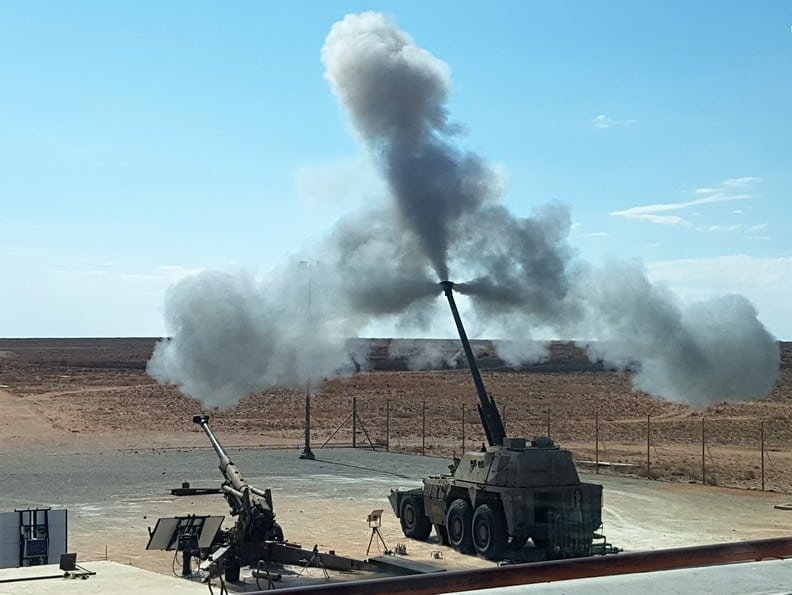

Rheinmetall Denel Munition (RDM) has successfully integrated its latest generation 155 mm Assegai artillery ammunition with the South African National Defence Force’s (SANDF’s) G5 and G6 45 calibre howitzers following verification firings at the Alkantpan test range.
The company said Fire Control Interface (FCI) verification firings of the Assegai ammunition suite were carried out between 3 and 6 November. The verification firings were conducted in close collaboration with the SA Army, the Logistics Support Formation, Denel Landward Systems, Armscor, and RDM.
The achievement “marks not only a successful integration effort but a significant step forward in upgrading and future-proofing the SANDF’s long-range firepower, ensuring the artillery corps remains aligned with modern operational requirements,” according to RDM.
Multiple Assegai variants were validated during the trials, including:
- M1712 – JBMoU 155 mm IHE with boat-tail (BT)
- M1711 – JBMoU IHE with base-bleed (BB)
- M2000 – JBMoU standard high-explosive (HE)
- M1 – ERFB nubbed variant, currently in service
Using the M64 and M67 propelling charges in service with Denel’s 45 calibre howitzers, the trials demonstrated full operational compatibility across the ammunition-to-weapon interface — confirming both the adaptability and technical maturity of the Assegai family, RDM said.
The Assegai range delivers a substantial performance upgrade over the legacy M1 ERFB shells, offering a lethal area of 152 m² and generating up to 11 300 natural fragments. The newly integrated M1711 and M1712 also bring enhanced logistical and launcher-safety benefits to own forces due to their insensitive munition characteristics — a key requirement in modernising artillery ammunition systems, RDM emphasised.
“This success demonstrates RDM’s technical excellence and steadfast commitment to supporting the SANDF’s transition to modernised, enhanced prime-mission equipment,” said Dr Frank Dirksen, Chief Executive Officer at RDM. “These firings confirm that South Africa can field world-class artillery ammunition that integrates seamlessly with existing 45 calibre systems, while opening clear pathways for future capability growth.”
RDM said it remains focused on delivering practical, deployable solutions that extend range, improve lethality and precision, and enhance reliability for the South African National Defence Force. “The Alkantpan verification is not the conclusion — it is the launch point for further range-table validation, operational trials and continued cooperation with our defence partners to ensure the SANDF is equipped for today’s operational demands and tomorrow’s emerging threats.”
The G5 towed howitzer and G6 self-propelled howitzer use 45 calibre barrels, able to fire Extended Range Full Bore (ERFB) projectiles in two main versions: standard boat-tail (ERFB-BT) and base bleed (ERFB-BB). Maximum range from a 45 calibre barrelled howitzer is 31 and 41 km respectively for the boat-tail and base bleed projectiles.
The Assegai projectile suite consists of ballistically matched High Explosive, Practice, Insensitive Munition High Explosive, Illuminating, Infrared Illuminating, Smoke, Pre-formed Fragmented (PFF) and Rocket-Assisted (V-LAP) projectiles. Rounds are compatible with 39 to 52 calibre weapon systems and designed according to JBMoU principles; the Assegai family can be fired from any NATO STANAG-compatible artillery system, including the PzH 2000 self-propelled howitzer. With a barrel length of 39 calibres, an Assegai base bleed projectile attains a range of over 30 kilometres. Fired from a 52-calibre barrel, the range can exceed 40 kilometres (a 2019 record shot reached 76 km with a V-LAP round).
The tactical modular charges of the Assegai series are fine-tuned to the customer’s specific weapon systems and artillery shells for maximum effectiveness, RDM said. Their modular design simplifies logistics and makes handling in self-propelled artillery systems easier. They also offer other advantages: Assegai charges reduce barrel wear and produce lower muzzle flash; the former results in longer barrel life, the latter makes the artillery system harder for the enemy to detect.