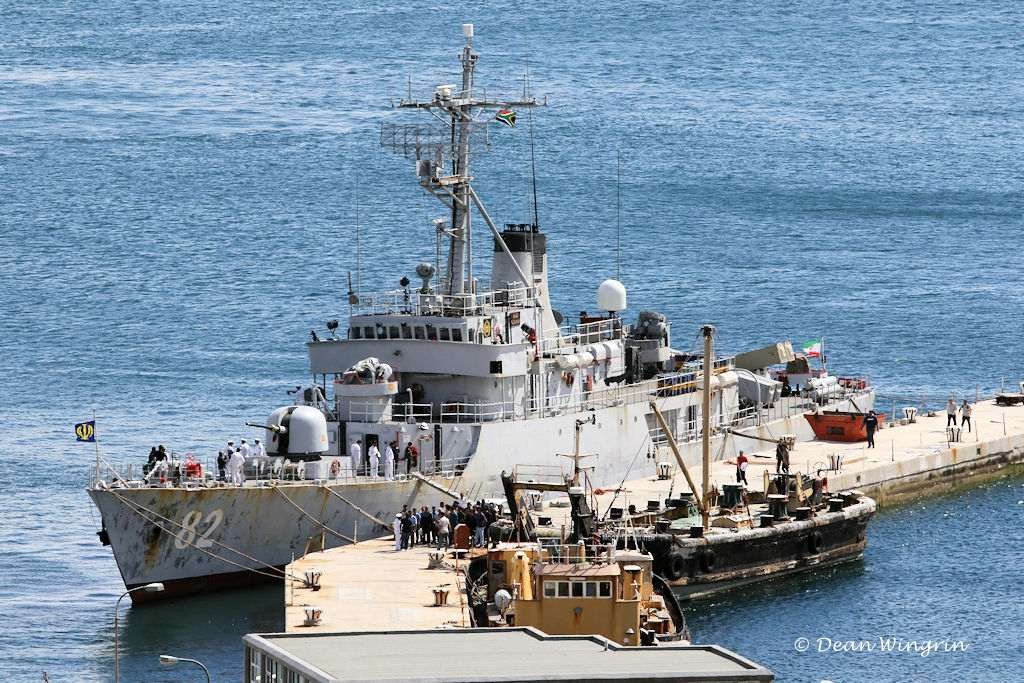

President and Commander-in-Chief Cyril Ramaphosa must deal decisively with Defence Minister Angie Motshekga for her role in allowing Iran to participate in the Will for Peace naval exercise, the Democratic Alliance (DA) maintains.
Chris Hattingh, DA Spokesperson on Defence & Military Veterans, said in a statement on Friday that Ramaphosa’s admission last Wednesday that the process for Exercise Will for Peace 2026 was flawed makes this a chain-of-command failure, not merely an operational issue.
“It has emerged that Iranian warships participated despite credible reports of a presidential instruction to exclude them; official explanations shifted repeatedly; communications were deleted,” Hattingh said, adding “independent analysis confirms a serious breakdown in command, control, and civilian oversight.”
Despite announcing a Board of Inquiry, Motshekga has not appointed it or published its terms of reference. Siphiwe Dlamini, military spokesperson, told City Press the terms of reference for the board have
been finalised but consultations are still taking place on who will serve on the board.
“Accountability cannot wait on a process that does not exist. The President must now step in, assert control, and make clear to Parliament and the public what corrective action will be taken, by whom, and on what timeline,” Hattingh said.
The DA is calling for a judicial inquiry to establish who authorised what, who knew when, and who failed to act, as well as an urgent parliamentary debate that must be matched by decisive action from the President and the transparent disclosure of his plan to restore civilian oversight and command integrity.
City Press on the weekend reported that according to two senior government sources, the South African National Defence Force (SANDF) was told from November that Iran should not participate in Will for Peace, indicating “blatant defiance” by SANDF leadership.
China was the lead nation in organising Will for Peace, which saw naval vessels from Russia, China, and the United Arab Emirates arrive in Simons Town earlier this month. Iran’s participation was controversial as it came at the same time as violent anti-government protests that led to the deaths of thousands of civilians.
Iran brought three vessels to South Africa for the exercise, and following their participation in Will for Peace, Motshekga on 16 January announced a Board of Inquiry to establish why President Cyril Ramaphosa’s order was not carried out.
Defence expert Helmoed Heitman believes the attacks on the SA Navy and SANDF are “premature and probably not justified.” In an opinion piece for Business Day, he writes that Ramaphosa raised the Iran issue with China, which as the lead nation issued the invitations.
“Apparently, the chief of the SANDF met Chinese and Iranian officers or diplomats, with the defence minister in the loop, after which the joint operations headquarters directed that the exercise proceed, presumably with the concurrence of the minister. If there was any disconnect, it must be looked for at this level. That is what should be determined by the board of inquiry,” Heitman stated.
For the SA Navy, exercising with foreign countries, such as China, Iran and Russia, makes sense as it provides learning opportunities and experience.
However, he cautions that with Iran and Russia, “both countries are detested by most neighbours, and both are economically and strategically irrelevant to South Africa. More importantly, both are viewed negatively by Europe and the US, which, in turn, are key economic partners, major sources of foreign investment and countries with which we have a positive balance of trade. Antagonising them to curry favour with countries of little relevance is more than a little unwise.”
“The exercise made military sense, but the inclusion of Iran and Russia was contrary to the national interest. Then again, our foreign policy is equally contrary to South Africa’s national interest. Perhaps that is where we need to start,” Heitman concluded.
Ofentse Donald Davhie, a Research Associate for the Centre for Risk Analysis, said that South Africa’s foreign policy decision-making is increasingly becoming a reputational risk for the country, particularly its relationship with Iran.
“Starting 2026 with naval exercises off the shores of the Western Cape with China, Russia, and Iran foreshadows a doubling-down in neglecting the founding values of democratic South Africa, in favour of the ideological values of the African National Congress (ANC),” he wrote for The Daily Friend. Iran “ offers no value to South Africans and does not pursue constitutional national interests,” he stated.