

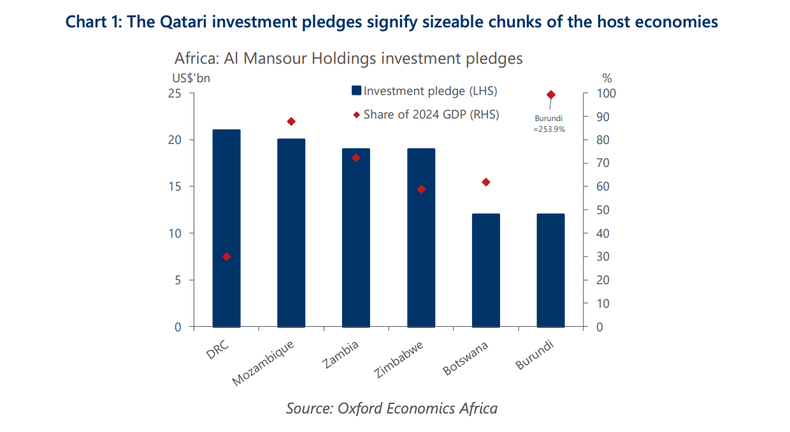
Oxford Economics Africa reports that the Democratic Republic of the Congo will receive the largest share at $21 billion, targeted for mining, hydrocarbons, agriculture, and 12 other sectors.
- Mozambique: $20 billion into agriculture and energy.
- Zambia and Zimbabwe: $19 billion each, spanning oil, gas, and 11 additional sectors.
- Botswana and Burundi: $12 billion apiece.
Botswana’s package stretches across infrastructure, diamond processing, tourism, cybersecurity, and defence. Burundi’s deal focuses on energy, farming, and infrastructure.
Why This Matters
Africa has long exported raw resources with little domestic value addition. Analysts say Qatar’s pledges could help change that, especially in economies heavily reliant on mining exports.
In Botswana, the funding may help reduce the country’s reliance on volatile diamond cycles. In the DRC and Zambia, the capital could unlock vast reserves of critical minerals essential for the global green transition transition with lithium and cobalt projects leading the pack.
Still, Oxford Economics warns that global diamond prices remain weak, and poor infrastructure continues to hinder mineral development.
The Al Mansour deal is part of a bigger wave of Gulf capital targeting Africa. According to Oxford Economics, investments from GCC investments in Africa’s energy and minerals are accelerating, hit $2.2 billion in African critical minerals in the first half of 2025. Abu Dhabi’s International Resources Holding acquired Zambia’s Mopani copper mine for $1.1 billion last year, while DP World and AD Ports are expanding aggressively in African ports.
This comes as U.S. protectionism rises under Donald Trump’s second term, leaving many African states seeking alternative partners. Gulf nations are stepping into the gap with both money and political leverage.
For Doha, the $103 billion is about more than short-term returns. Oxford Economics says it fits into Qatar’s strategy to reduce dependence on hydrocarbons and lock in access to food, minerals, and new markets.
But execution will be tough. Large-scale projects require strong governance, transparency, and effective management, qualities that are in short supply in places like the DRC and Zimbabwe.
“Securing capital is only the first step,” Oxford Economics warned in its briefing. “Implementation is the true test.”
The Bottom Line
But Africa has seen big promises before. Whether this $103 billion translates into infrastructure, factories, and jobs or remains stuck in announcements will decide if Doha’s Africa bet is a turning point or just another headline.


