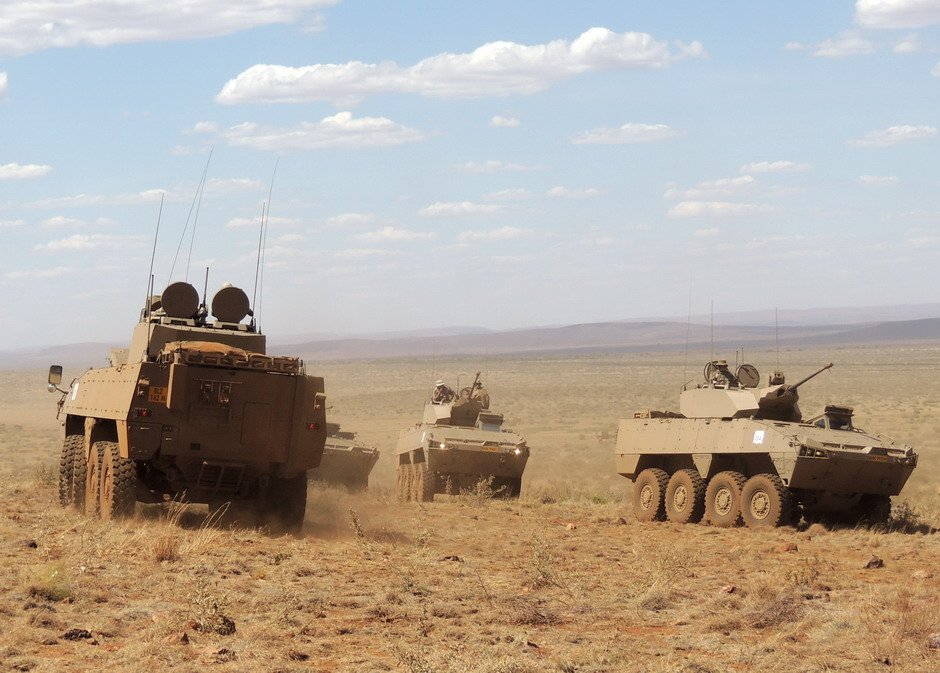

Denel will only complete product baseline development of the six main variants of the Badger infantry fighting vehicle (IFV) by the end of 2027 and production will proceed, with help from the broader industry, but details are still being finalised with the Department of Defence (DoD), Armscor, and the South African National Defence Force (SANDF).
On 26 November, Denel gave a briefing to the Portfolio Committee on Defence and Military Veterans (PCDMV) on the status of Project Hoefyster and its way forward. The company explained that a contract for the development and delivery over 66 months of five combat variant engineering development models (EDMs) including logistics, ammunition and simulators was placed in May 2007, with a value of R1 billion.
Denel explained the original requirement from the SA Army was for 264 vehicles to supplement the Ratel fleet (taken into service in 1974) but the funded requirement was 244 Badger vehicles: 97 Section Variants, 52 Command Variants, 14 Fire Support Variants, 14 Missile Variants, 29 Mortar Variants, 8 Ambulance Variants, 13 Signal Variants, 12 Basic Observation Artillery Variants (Mortar Variant based) and 5 Tactical Command Post Variants (Command Variant based).
The contract’s first phase (development) was supposed to be fulfilled by May 2012. However, Denel was unable to meet the deadline. This was supposed to be followed by phase two industrialisation and production, with deliveries scheduled for 2019, then end 2023.
These deadlines have slipped, with Denel saying delays included financial challenges experienced by Denel from 2016, technical complexities, underestimation of the software qualification process/effort, extensive re-testing and development cycles etc. Other issues were high turnover of Denel and Armscor staff, lack of stakeholder oversight, cost escalation etc.
The bottom line, according to Denel’s presentation to the PCDMV, is the “current acquisition plan is not executable”.
Denel is, however, recording slow progress establishing product baselines for the Badger under Phase 1 development. For the Section Variant, product baseline was completed in July 2025, but before this variant can go into industrialisation/production, Denel proposes obsolescence, stock usability, landmine tests, software optimisation and unfinished work be addressed between January and July 2026.
The Fire Support Variant and Command Variant product baselines are estimated to be completed by end of April 2026 and June 2026 respectively at Denel. Missile Variant and Mortar Variant product baslines are estimated to be completed by the end of April 2027 and June 2027 respectively, whereas the final Logistics baselines are estimated to be completed by November 2027.
To date, R7.7 billion has been paid for Project Hoefyster, and a further R6.6 billion is needed to complete production. However, “Available on the DoD Financial Management System is R1 927 383 538,” Denel said.
The scope, schedule and funding of Phase 2 industrialisation/production is under review between Armscor, Denel and the Department of Defence. The Armaments Acquisition Council (AAC) convened a meeting on 10 July to make a decision and give guidance on the way forward for Project Hoefyster and came to the conclusion that the requirement for the vehicle remains valid “and aligned with the strategic capability enhancement objectives of the SANDF.”
“In light of the substantial investment already committed towards fulfilling this operational need, the project is to proceed with the completion of Phase 1 Development and Phase 2 Industrialisation and Production,” Denel stated.
“Armscor and Denel Project members continue to assess the impact of the delays on the project and explore alternative avenues to advance and expedite the project, while ensuring alignment with strategic priorities.”
Denel told the PCDMV a Ministerial Task Team has been convened for the exploration of avenues to advance project industrialisation and production. This team includes the Secretary for Defence, Chief of the SANDF, and CEOs of Armscor and Denel, amongst others.
Denel will investigate potential partnerships and collaborative initiatives with a prioritisation of local industry participation to move Project Hoefyster forward. On 19 November, Denel sent out a request for information (RFI) to suppliers/original equipment manufacturers of 8×8 vehicles to gather information on product specifications, costs, and collaborations.
“The scope, schedule and funding of Phase 2 Industrialisation/Production is still under review between Armscor, Denel and DoD. A proposed phased approach to deliver the three battalions of vehicles as funding is secured is being explored,” Denel said.