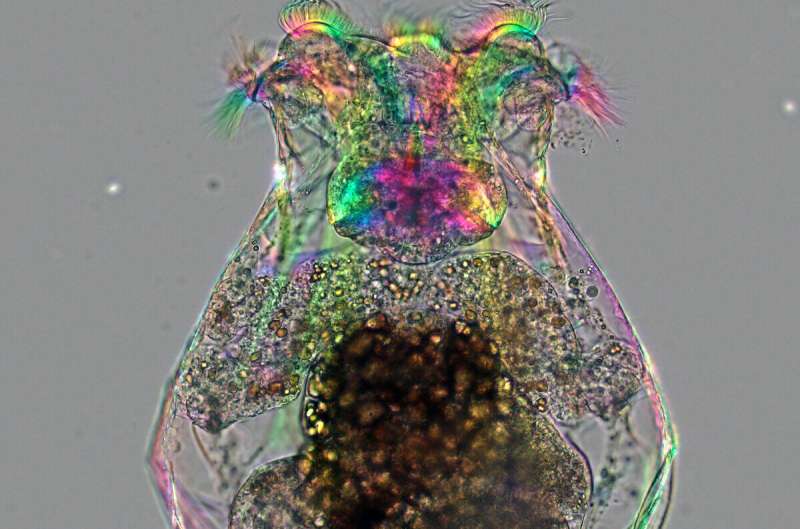
Much about tiny, swimming rotifers makes them ideal study subjects. Although barely visible to the naked eye, these transparent animals and their innards are readily viewed under a microscope. What’s more, they grow readily in laboratory culture, offering scientists an otherwise difficult-to-obtain perspective from their corner of the animal kingdom.


However, while rotifers have been used experimentally for more than a century by many research groups, scientists have so far lacked the ability to readily manipulate rotifers’ genetics, placing a hard limit on the experiments they can run with these animals.
A joint effort by Kristin Gribble and David Mark Welch at the Marine Biological Laboratory (MBL) has overcome this challenge by devising a method for precisely altering the rotifers’ genomes using the gene editing system CRISPR-Cas9. In experiments described in PLOS Biology, their team edited two genes and added a genetic sequence to produce changes that the rotifers passed down through generations.
“Our method turns out to be a very practical way to generate a large number of genetically altered rotifers fairly quickly,” said Mark Welch, a senior scientist at MBL and director of the Josephine Bay Paul Center for Comparative Molecular Biology and Evolution.
Not only will this advance benefit his lab and Gribble’s, which use rotifers to study the biology of aging, DNA repair mechanisms, and other fundamental questions, it will “open the field to allow more people to work with these animals,” Mark Welch said.
Developing a microscopic, water-dwelling lab animal
Certain living things—the bacterium E. coli, fruit flies, and mice, for example—have become well established as model organisms that scientists routinely use in research. Taken together, however, they don’t adequately represent the full diversity of life.
The MBL team aims to add rotifers to this group of genetically tractable organisms because, as tiny invertebrates with close ties to the ancestors of modern animals, they offer an important perspective on evolution, development, and other aspects of biology.
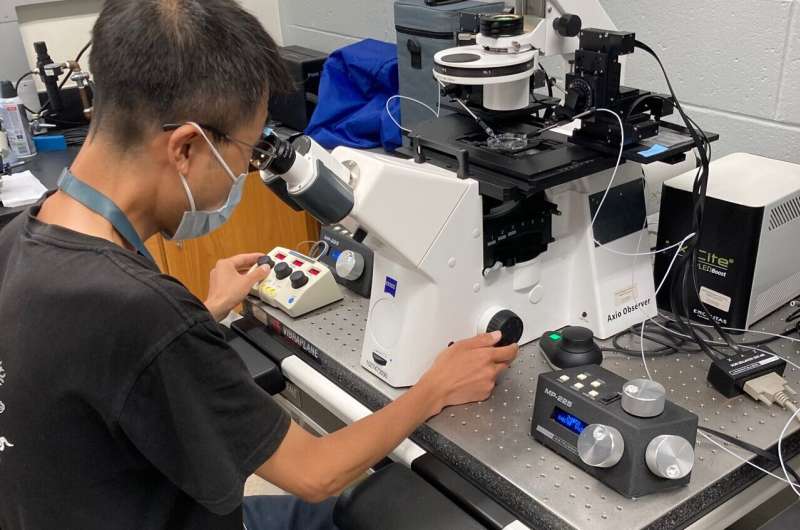
To develop rotifers as model organisms, researchers need the capacity to tweak these animals’ genomes. In 2017, MBL Interim Director Melina Hale of University of Chicago provided Gribble and Mark Welch with funding to devise a method for doing so using CRISPR-Cas9. The goal of cultivating a greater variety of model organisms later became formalized as MBL’s New Research Organisms initiative.
Now widely employed in research, CRISPR-Cas9 makes precise cuts within DNA, which researchers use to shut down or alter genes. First, however, they must get the CRISPR system into the animals.
Fine-sawdust-sized specks darting about in water, rotifers make for unusually challenging targets. After many unsuccessful attempts to hold them still, first author Haiyang Feng, then a postdoctoral scientist at MBL, devised a solution: By immersing them in a high-viscosity solution and administering a low level of an anesthetic, he slowed the animals enough to grab them one at a time with light suction through a hollow needle.
With the animal, always a female, in place, he injected the gene editing system into the part of its body that supplies nutrients to the eggs. The offspring that hatched from these eggs then carried the mutations, which they passed on to their offspring.
In this way, the team inactivated vasa, a gene crucial to animal development, causing the rotifers to stop reproducing after a few generations. By turning off a second gene, mlh3, they prevented the rotifers from producing male offspring. And, finally, by adding a section of genetic code containing “stop” instructions into mlh3, they achieved the same effect.
New possibilities for rotifer research
Both researchers intend to use the CRISPR-based method to genetically alter rotifers for their own research. As part of her work exploring how mothers’ age can affect the traits of their offspring, Gribble, an associate scientist at MBL, is investigating the role of mitochondria, the energy-producing component of cells. The new approach will allow her to tag or alter mitochondria. Mark Welch, meanwhile, plans to use it to explore the molecular mechanisms behind one rotifer species’ ability to revive after completely drying out, including how they repair damage to their DNA.
Studies like these are only the beginning. “This new tool, along with the ease of raising rotifers in the lab, will make it possible to use them to answer lots of questions we aren’t even thinking about yet,” Gribble says.
More information:
Haiyang Feng et al, Highly efficient CRISPR-mediated gene editing in a rotifer, PLOS Biology (2023). DOI: 10.1371/journal.pbio.3001888
Provided by
Marine Biological Laboratory
Citation:
Powerful gene editing approach boosts rotifers in pantheon of laboratory animals (2023, August 4)
retrieved 4 August 2023
from https://phys.org/news/2023-08-powerful-gene-approach-boosts-rotifers.html
This document is subject to copyright. Apart from any fair dealing for the purpose of private study or research, no
part may be reproduced without the written permission. The content is provided for information purposes only.