

From Pope Francis to former U.S. Vice President Dick Cheney, this year saw the deaths of some significant figures in world affairs. Foreign Policy considered their lives and legacies with in-depth analysis and commentary.
Below are five notable obituaries from 2025.
From Pope Francis to former U.S. Vice President Dick Cheney, this year saw the deaths of some significant figures in world affairs. Foreign Policy considered their lives and legacies with in-depth analysis and commentary.
Below are five notable obituaries from 2025.
1. Jean-Marie Le Pen Embodied France’s Dark Side
By Michele Barbero, Jan. 7
“In February 1984, Jean-Marie Le Pen appeared for the first time on France’s biggest political TV show, L’Heure de Vérité (The Hour of Truth),” Paris-based journalist Michele Barbero writes, and reporters asked about “the avowed antisemites and former SS members who filled his party’s ranks” and “his support for the dictatorships of Francisco Franco and Augusto Pinochet.”
But in Barbero’s telling, these efforts to expose Le Pen’s darkest views fell flat. Instead, hundreds of people lined up the next day outside the National Front party’s offices, and “[a] populist star was born.”
Barbero follows Le Pen’s journey along the acceptable limits of French politics. Le Pen showed just how far right European opinion could go, but his party’s biggest success only came after its founder was expelled as part of his daughter’s post-fascist makeover. As Barbero concludes, “Jean-Marie Le Pen is dead, but his heirs are doing just fine.”
2. Pope Francis Led Catholics Through a Time of Crisis
By Christopher White, April 21
“In his first public appearance, Pope Francis appeared on the loggia of St. Peter’s Basilica wearing a simple white cassock instead of the traditional, lavish red velvet mozzetta—a clear signal that a new era had begun,” Vatican correspondent Christopher White writes. “He seemed to revel in the surprise he caused, wryly remarking that his brother cardinals had gone to the ‘ends of the earth’ to find him.”
White discusses Francis’s rise and impact, including his efforts to confront the church’s history of sexual abuse and to build a church “for the poor.” He offers a personal picture of the Argentine pope, showing his humility and, at times, stubbornness. Francis “shunn[ed] the trappings of power,” White writes. “But while such gestures hinted at the more substantial reforms he dreamed of achieving, those changes remain incomplete.”
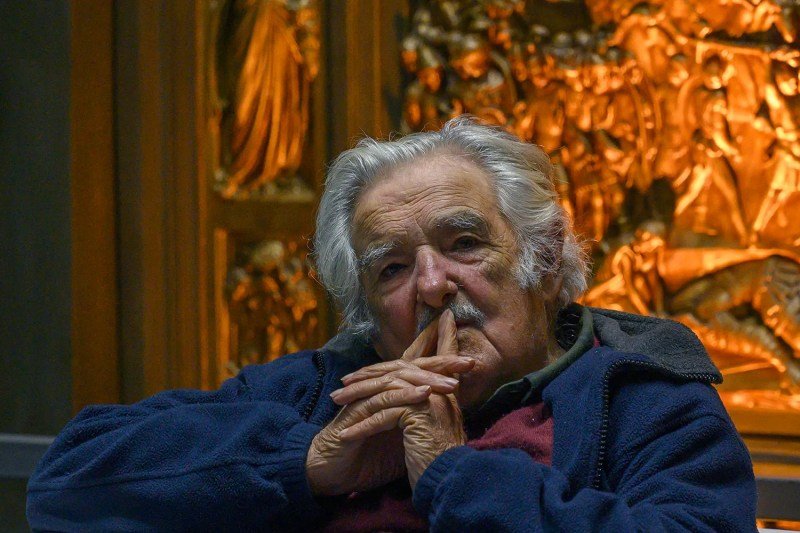
3. Uruguay’s José Mujica Aimed to Change the World
By Guillermo Draper, May 13

Former Uruguayan President José Mujica attends a presentation of the Emmaus International poverty report in Montevideo on May 13, 2022.Pablo Porciuncula / AFP via Getty Images
Author and journalist Guillermo Draper chronicles José Mujica’s rise from armed left-wing guerilla to elected president of Uruguay, then shows him wrestling with the contradictions of power. “Mujica’s life journey took many unexpected turns—he escaped prison twice and came perilously close to death on at least one occasion—but he eventually became one of South America’s more respected national leaders,” he writes.
Draper ends with Mujica’s own reflection that “[t]here is nothing like democracy. When I was young, I didn’t think like that, it’s true. I made a mistake. But today I fight for it.”
4. Despite Good Intentions, Muhammadu Buhari Failed Nigeria
By Ebenezer Obadare, July 14
“Muhammadu Buhari … was one of two leaders of Nigeria, along with Olusegun Obasanjo, to rule the country both as military dictator and as civilian president. He was a human rights disaster in the first role and largely inept in the second,” writes Ebenezer Obadare, a senior fellow at the Council on Foreign Relations.
Obadare offers an uncompromising judgment on Buhari’s legacy, arguing that as dictator, even when he displayed a “germ of good intention,” it ended in unrelenting repression. As president, Buhari proved unable to tackle crime, poverty, and a growing Boko Haram insurgency. His failures, Obadare concludes, offer “proof that good intentions and proclamations of moral rectitude, while desirable, are not enough.”
5. Dick Cheney, Architect of the War on Terrorism, Dies
By Jeffrey A. Engel, Nov. 4
“Soft-spoken and supremely confident in his own judgment, [Dick] Cheney’s career epitomized the transformational possibilities—and crippling anxieties—of his country’s ever-evolving role in the world,” Jeffrey A. Engel, a historian at Southern Methodist University, writes in an obituary of the former U.S. vice president.
Cheney “embodied Washington’s fearful and aggressive reaction to the 9/11 terrorist attacks, and ultimately, in pursuit of perfect security in a chaotic world, helped orchestrate the 2003 invasion and occupation of Iraq that surely ranks among the worst strategic decisions in U.S. history,” he writes.
Engel looks back at how Cheney climbed the rungs of power in Washington before assessing his role as vice president. He ultimately offers a harsh verdict on Cheney’s faith in torture, disregard for the law, and failure to anticipate the nightmare that he unleashed in Iraq.


