In a pioneering move, leading South African Contractor Tau Pele Construction has taken delivery of a cold recycling train from Wirtgen South Africa – the first of its kind in Africa. The arrival of the cold in-situ (in-place) recycling train, deployed on the Schoemanskloof stretch of the N4 road upgrade, is the culmination of a collaborative effort between the contractor and other key stakeholders in the project – the client, Trans African Concessions (TRAC), and the engineer, KBK Engineers – ushering in a new era in road rehabilitation in South Africa.
The construction industry must move fast to adopt new technologies to overcome chronic productivity, safety, and efficiency challenges, with the aim of reducing project delays, material waste, and cost overruns. This is the view of Wimpie Janse van Rensburg, Executive Manager: Engineering and Technical at TRAC, a concession that manages one of the most important highways in South Africa, the 580-km N4 Toll Route starting from Solomon Mahlangu off ramp in Tshwane, Gauteng, to the Maputo Harbour in Mozambique.
Based on this understanding, TRAC has joined hands with Tau Pele Construction, the main contractor on the Schoemanskloof road upgrade, and the relevant engineer, KBK Engineers, to deploy the first Wirtgen cold in-place recycling train in South Africa on this important project. Having first seen the technology at Bauma 2025 in Germany, the three parties were immediately impressed by its value proposition, prompting discussions with Wirtgen South Africa to bring the technology to South Africa.
Fast-forward to a year later, the first train is now hard at work on a crucial project in Mpumalanga, where Tau Pele Construction is contracted to upgrade the 68-km Schoemanskloof stretch of the N4 highway. According to Frans Bouwer, MD of Tau Pele, the scope of the project entails 50 km of additional lanes, in addition to the rehabilitation of the existing road and overlaying the entire project.
Train in detail
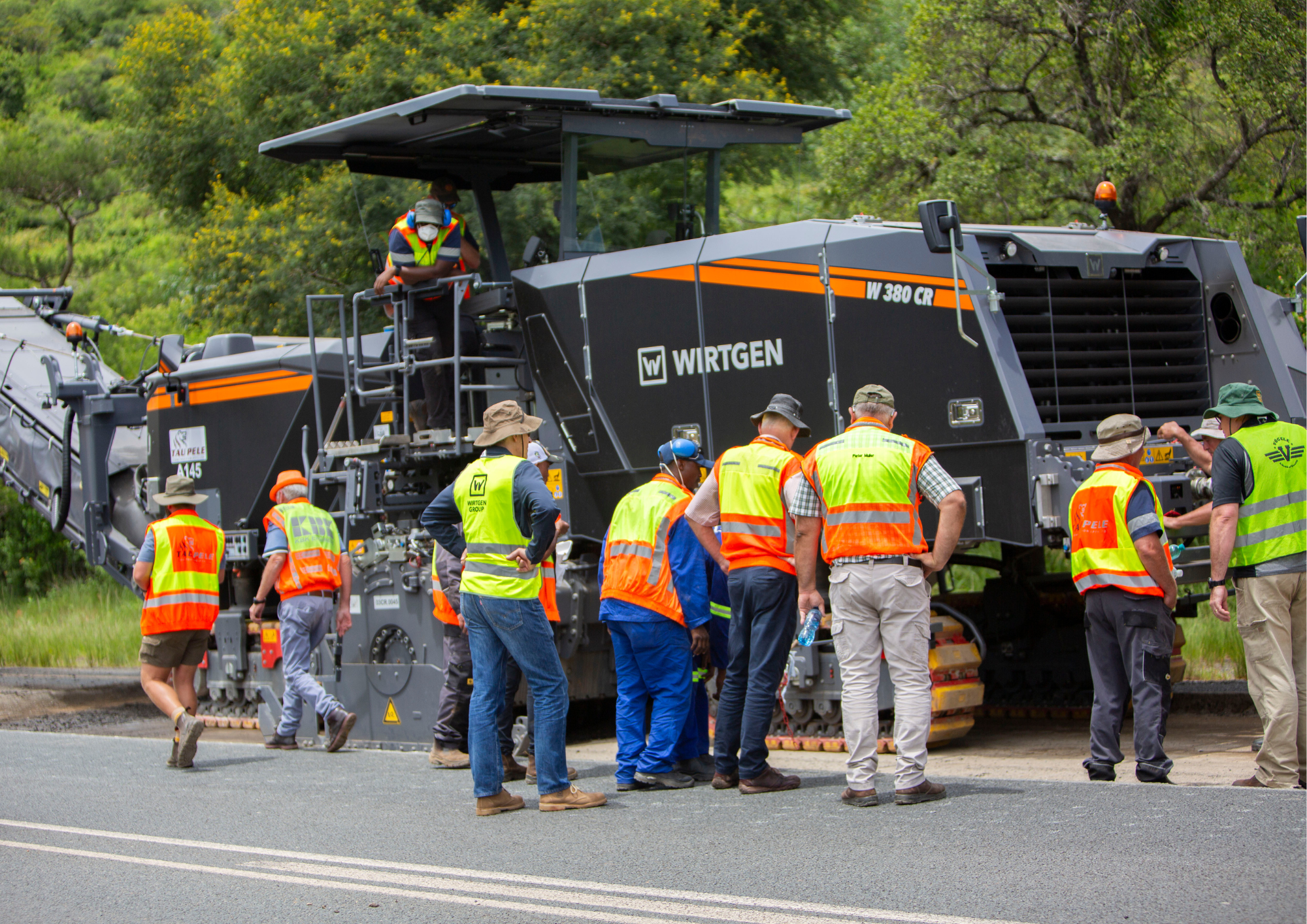
W380 CR Cold Recycler
The new Wirtgen cold in-place recycling train comprises six machines – the W 380 CR cold recycler, the VÖGELE SUPER 1900-5X paver, the 12-tonne (t) Hamm HD+ 120 VV tandem roller, the 12-t Hamm HD+ 120 VO tandem roller and two 24-t Hamm HP 280 pneumatic rollers.
Waylon Kukard, Sales Manager at Wirtgen South Africa, explains that the in-place (in situ) road rehabilitation system mills, mixes, and paves old asphalt in a single pass. Offering working widths up to 3,8 m, the W 380 CR cold recycler – the cornerstone of the train – granulates the material and transforms it into a homogeneous material mixture by adding a binding agent, foamed bitumen in this particular instance.
“With a mixing capacity of up to 800 tonnes/hour, the W 380 CR cold recycler feeds recycled material into the VÖGELE SUPER 1900-5 X paver using its swivel-mounted and height-adjustable discharge conveyor at the rear. This makes it possible to complete long stretches of road in a single day of work,” explains Kukard. “The paver then paves the material back, to slope, to thickness and to the required width. The two Hamm tandem rollers are then deployed for optimal compaction of the material, before the two pneumatic rollers seal the layer.”

Time factor
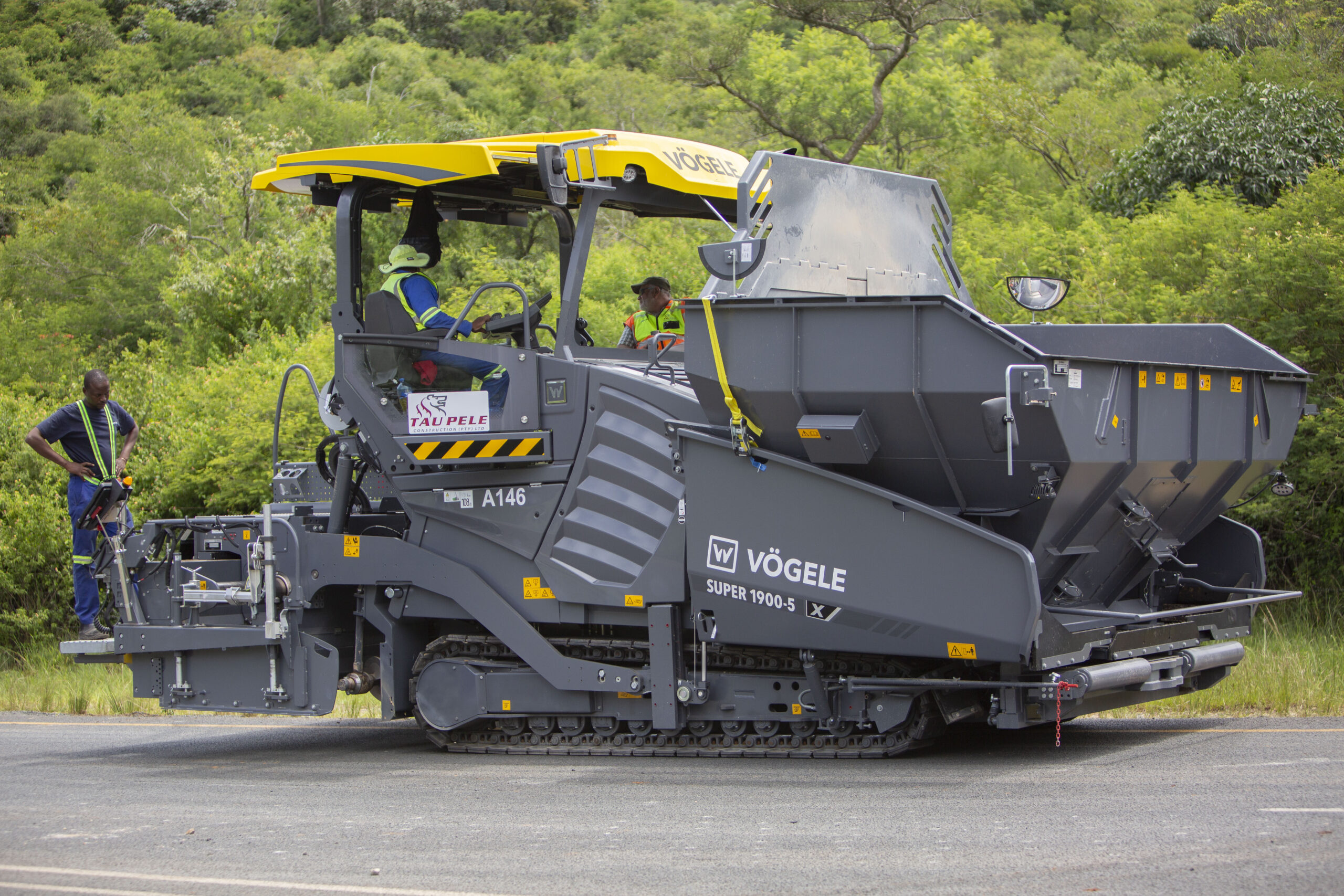
Vogele S1900-5 X Paver
While this technology is new to South Africa, Heinrich Schulenburg, MD of Wirtgen South Africa, says that it has already proven itself in other parts of the world. Cold recycling, he says, particularly with foamed bitumen, is popular with road authorities and construction companies in regions such as Europe and South East Asia.
One of the major benefits of this technology is time savings. “Given that this technology – which is not just a train but a process plant in its own right; by combining milling, mixing and paving in one pass, the rehabilitation process is accelerated. The foamed bitumen is processed in-place with the existing material, enhancing strength by increasing cohesion and durability. The newly laid bitumen-stabilised material provides a solid base, making the road immediately available to traffic after compaction, thus reducing traffic disruption,” says Schulenburg.
In fact, this was one of the major drivers in the decision to deploy this technology on the Schoemanskloof project. TRAC’s Van Rensburg notes that the N4 generally experiences high traffic volumes, with more than 2 000 heavy vehicles running on the road every day. This road serves as a vital artery connecting South Africa’s industrial heartland (Gauteng) to the deep-water Port of Maputo in Mozambique, enabling efficient, cost-effective transport of goods, including agricultural produce and minerals.
“Given that the N4 is one of the most important trade routes in the region, reduced interruption to traffic is of utmost importance. The ‘stop-and-go’ traffic control system associated with conventional road rehabilitation techniques generally halves the normal capacity of the road for long periods, causing severe backups and bottlenecks. By milling, mixing and paving in one pass, the cold in-place recycling system allows the road to be reopened almost immediately, thus reducing traffic congestion and delays,” says Van Rensburg.
More benefits abound
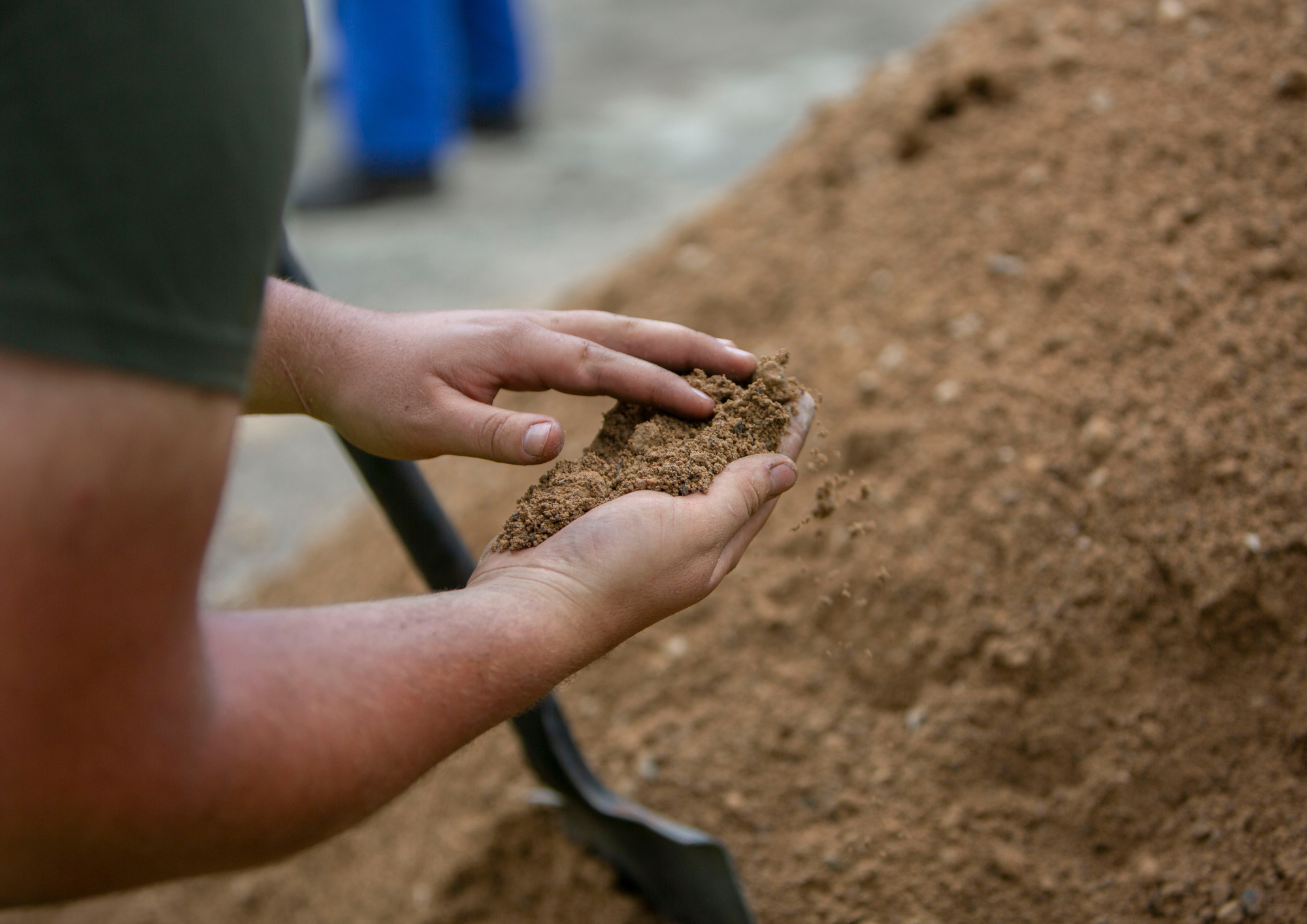
Foam Bitumen Stabilised Material
Apart from the savings in time, Joe Deetlefs, Director at Tau Pele, highlights the cost efficiency of this technology as another major driver in the purchasing decision. The Wirtgen cold in-place recycling train saves on project costs by reducing the need for new materials, reducing transport costs and allowing for faster, more efficient construction. Depending on the project, savings in material costs can be anything up to 50%, says Kukard, Sales Manager at Wirtgen South Africa. In addition, reuse of 100% of existing asphalt eliminates landfill waste and reduces the need for new raw materials by up to 90%, thus maximising environmental sustainability. By eliminating up to 90% of truck transport for material removal and delivery, the system allows for a significant reduction in CO₂ emissions associated with the construction project.
Jaco Markam, Contract Engineer at KBK Engineers, says reusing existing materials is “the next big thing” in road rehabilitation. As natural materials become scarcer globally, using reclaimed asphalt pavement (RAP) on site allows for faster, cheaper and greener road repairs.
“All project stakeholders in the construction value chain must work together to use what we have. Reusing in-place materials eliminates the need to purchase virgin materials and pay for transporting them to the site. The technology is already available and I am glad that, together with TRAC and Tau Pele, we have made a pioneering decision to deploy the first ever Wirtgen cold in-place recycling train in Africa,” concludes Markam.