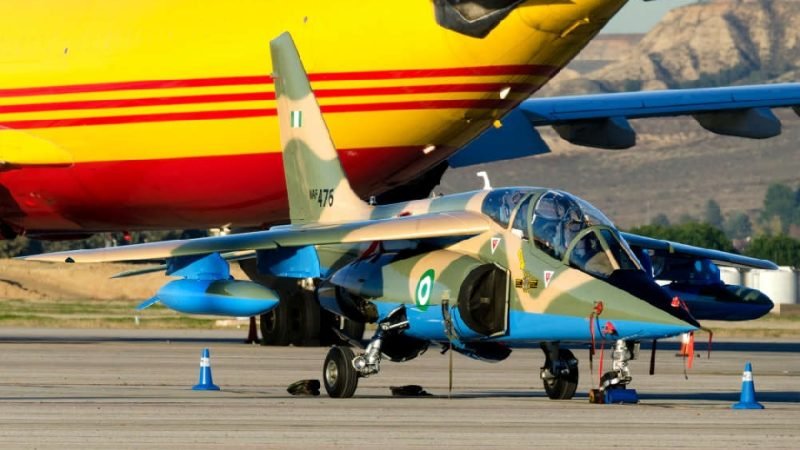
The Nigerian Air Force (NAF) has reported the loss of a Dassault-Dornier Alpha Jet following an accident in Niger State on December 6, 2025. The aircraft went down near the Karabonde community in Borgu Local Government Area, close to the force’s primary air power hub in the region, NAF Base Kainji. Both pilots successfully ejected from the stricken airframe and were recovered without life-threatening injuries.
This incident, which occurred during a functional check flight (FCF), draws renewed attention to the operational challenges of maintaining high-tempo sorties with a legacy fleet while simultaneously transitioning to modern platforms.
The Incident at Kainji
According to a statement released by NAF Director of Public Relations and Information, Ehimen Ejodame, the crash was precipitated by an in-flight emergency shortly after takeoff. The aircraft was undergoing a post-inspection test flight—a critical procedure conducted to verify systems following heavy maintenance or repairs before an aircraft is cleared for combat duties.
Flight crews conducting FCFs face elevated risks compared to routine operational sorties, as they are often the first to push the aircraft’s envelope after engineering interventions. Ejodame noted that the pilots manoeuvred the jet away from populated areas in Karabonde before initiating the ejection sequence. The successful egress of both crew members underscores the reliability of the Martin-Baker Mk 10 ejection seats fitted to the Alpha Jet, a system that has been a focal point of recent maintenance contracts.
The Chief of the Air Staff (CAS), Air Marshal Sunday Kelvin Aneke, commended the crew for their discipline and directed the immediate constitution of a Board of Inquiry to determine the technical cause of the failure.
A Workhorse Under Pressure
The Alpha Jet has been the backbone of the NAF’s light attack and advanced training capabilities since the early 1980s. The first batch of 24 aircraft was delivered in 1982, serving a dual role: training pilots for the supersonic MiG-21 (and later the F-7Ni) while providing close air support (CAS) for ground troops.
The fleet has seen extensive usage in counter-insurgency (COIN) operations against Boko Haram and ISWAP in the Northeast, and more recently against armed bandits in the Northwest. This high operational tempo accelerates airframe fatigue, necessitating rigorous sustainment efforts.
To keep the ageing fleet viable, the NAF has pursued a strategy of incremental upgrades and procurement of used airframes for cannibalisation. In 2011, four aircraft received avionics upgrades and improved weapon systems. The Goodluck Jonathan administration acquired four additional unarmed ex-US Alpha Jets in 2015 to bolster numbers. By 2020, nine previously mothballed airframes were reactivated, bringing the active service number to approximately 11 by 2023.
The Sofema Refurbishment Program
Recognising the urgent need for spares and airworthy hulls, the NAF awarded a contract to Sofema, a specialist in reconditioned military equipment, to rehabilitate ex-French Air Force Alpha Jets. Deliveries began in April 2024, with the NAF receiving at least four of the twelve contracted aircraft.
The structure of the Sofema deal reflects the reality of operating out-of-production aircraft. Of the twelve jets sourced, six were designated for restoration to operational status, while the remaining six were acquired specifically to be harvested for spare parts. This practice is essential for maintaining the existing fleet, particularly for hard-to-find components related to the twin SNECMA Turbomeca Larzac turbofan engines. Sofema’s mandate included a target to double the NAF’s operational Alpha Jet fleet within six to twelve months of the contract start.
Additionally, Nigeria sought technical support from regional partners. In September 2024, during the Egypt International Air Show, the NAF signed a pilot training and maintenance agreement with the Egyptian Air Force, another long-time operator of the Alpha Jet. This partnership aims to leverage Egypt’s deeper industrial depot-level maintenance (DLM) capabilities to conduct Periodic Depot Maintenance (PDM) on Nigerian airframes locally.
Shift to the Northwest Theatre
The crash comes at a time when the Alpha Jet fleet is being aggressively postured to combat new threats in Nigeria’s Northwest. In late 2024, the NAF established a new air component presence at Umar Musa Yar’adua Airport in Katsina.
On 18 November 2024, Minister of Defence Mohammed Badaru Abubakar inspected the new facility, which hosts a composite detachment of two newly acquired Turkish Aerospace T-129 ATAK helicopters, two King Air 360ER Intelligence, Surveillance, and Reconnaissance (ISR) aircraft, and two Alpha Jets. These assets operate as part of the Air Component of Sector 2, Operation ‘Fansan Yamma’, a dedicated task force set up to dismantle criminal gangs and bandit networks that have superseded the threats previously managed under Operation ‘Hadarin Daji’.
The Alpha Jet’s unguided rocket pods and gun packs remain effective against soft targets in these environments, but the operating environment is hostile. The fleet has suffered combat losses previously; in July 2021, an Alpha Jet was downed by intense ground fire from non-state actors at the boundaries of Zamfara and Kaduna States. On March 31, 2021, the Nigerian Air Force authorities lost radar contact with an Alpha jet in the late hours of Thursday, 31 of March during an attack run against jihadist forces in Maiduguri, the Borno State capital. Another was lost to an accident in May 2013 while supporting peacekeeping operations in Niamey, Niger.
The Replacement Horizon: M-346 Master
While maintenance crews work to keep the Alpha Jets flying, the NAF is in the advanced stages of a generational leap in capability. The service is set to receive 24 Leonardo M-346 Master aircraft in a deal estimated at €1.2 billion.
The M-346 is a transonic advanced jet trainer and light combat aircraft that offers vastly superior avionics, reliability, and aerodynamic performance compared to the Alpha Jet. It features a digital glass cockpit, helmet-mounted displays, and the ability to simulate sensors and threats, bridging the gap between basic training and the NAF’s JF-17 Thunder multi-role fighters. The arrival of the M-346 will likely allow the NAF to retire the most fatigued Alpha Jet airframes, reducing the burden on maintenance units.
Chasing the 90% Serviceability Target
The backdrop to the recent accident is an ambitious serviceability drive initiated in mid-2025. Former Chief of the Air Staff, Air Marshal Hasan Bala Abubakar, set a target to achieve 90% aircraft serviceability by the fourth quarter of 2025. At the time of the announcement, the rate stood at 72%—a respectable figure for a combat air force but one that required improvement to meet concurrent security challenges across multiple geopolitical zones.
Speaking at the 2025 Aircraft Engineering Conference in Abuja, leadership emphasised that achieving this target relies on a “strong maintenance culture” and strategic partnerships like those with Sofema and Leonardo. The strategy involves heavy investment in predictive maintenance technologies, modern ground support equipment, and digital logistics documentation to reduce turnaround times.
The Dec 6 crash serves as a stark reminder of the risks inherent in flight operations, particularly during the testing phase, where maintenance quality is validated. While the loss of an airframe is a setback for the serviceability target, the survival of the pilots validates the NAF’s investment in safety equipment and emergency training.