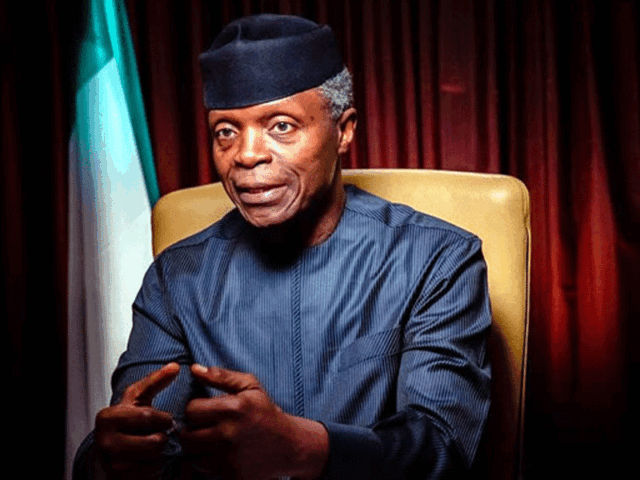


Former Vice President Yemi Osinbajo recently argued that Nigeria’s path toward accessible housing and environmentally sound urban expansion, particularly in the Southwest, requires a return to proactive, government-led planning and development driven by robust infrastructure.
Osinbajo delivered these remarks at Wemabod Limited’s Real Estate Outlook 2026 event, held in Lagos at the Oriental Hotel. The theme of the event was “Unlocking Land and Infrastructure for Inclusive Housing: A Regional Agenda for Sustainable Urban Growth.”
Referencing the historical Bodija Estate in Ibadan, Osinbajo emphasized that its success wasn’t accidental but the result of deliberate planning within a comprehensive regional development strategy. This strategy encompassed initiatives like free education, expansion of the civil service, and proactive economic planning.
He stated that the housing demand in Bodija was anticipated, carefully planned for, and strategically shaped, instead of simply reacting to population increases.
Osinbajo clarified that Bodija was designed as a holistic community, exceeding a mere collection of houses. Its planning incorporated a well-defined hierarchy, enforced building setbacks and plot ratios, maintained low-density construction, and included green spaces.
He highlighted that the estate balanced profitability with factors like comfortable living, privacy, and community integration. Its strategic placement near employment hubs, services, and important institutions, rather than on the city’s outskirts, was key.
According to Osinbajo, this approach shortened commute times and firmly integrated the estate into the city’s economic and social fabric, enabling Ibadan to evolve organically around it.
A pivotal accomplishment of Bodija, he noted, was its conscious effort to foster social diversity. The estate offered housing options ranging from modest bungalows for lower-income families to semi-detached homes for middle-income earners and larger residences for professionals, all without segregation.
“Teachers resided near civil servants, and skilled workers shared streets with professionals,” he explained. “Social integration was a deliberate design element, not a coincidental outcome.”
Osinbajo also emphasized the “infrastructure-first” strategy employed in Bodija. Essential amenities like roads, drainage, water, electricity, schools, and community centers were established before residents moved in.
Infrastructure was viewed as a public asset, indirectly subsidizing affordability by lessening the financial burden on residents, who didn’t need to independently provide basic services.
He described infrastructure as a hidden bedrock of affordable housing, arguing that affordability becomes unattainable when households are solely responsible for providing water, roads, and flood control measures.
However, the former Vice President lamented that Bodija’s failure stemmed from not replicating its success across the Southwest region.
Osinbajo argued that if regional governments had consistently developed similar large-scale, mixed-income estates every decade since the 1960s, the Southwest would now possess a network of integrated neighborhoods with shorter commutes, reduced transportation expenses, and stronger social unity.
He also noted that Bodija’s planning intrinsically addressed sustainability issues well before climate change became a pressing global concern.
Its compact layout, low-rise buildings, optimal building orientation, tree cover, and close proximity to workplaces reduced energy consumption and the risk of flooding. Even after more than half a century, its design and land values have remained robust, despite infrastructure degradation caused by increased density, commercialization, and prolonged underinvestment common in many government-owned estates.
Contrasting Bodija with modern housing projects, Osinbajo explained that financial challenges, structural adjustments, and rapid urbanization from the late 1980s prompted governments to step away from direct housing provision, leaving private developers and public-private partnerships to fill the void.
This shift, he said, resulted in gated, exclusive estates catering to specific income brackets, often situated far from employment centers and inadequately served by public transportation.
The resulting consequences included lengthier commutes, higher transportation costs, diminished productivity, increased carbon emissions, and urban sprawl.
Osinbajo stated that in many instances, infrastructure has been privatized at the household level, driving up housing costs and accelerating physical deterioration.
He added that many well-constructed estates intentionally exclude low- and middle-income households through design, pricing strategies, and location.
While acknowledging positive aspects of modern private estates, particularly the renewed focus on infrastructure, Osinbajo pointed out that they remain costly because infrastructure expenses are factored into house prices, fundamentally preventing inclusivity.
The fundamental difference between Bodija and contemporary estates, he stressed, resided in institutional and ideological approaches. Bodija followed a clear order: planning, then infrastructure, followed by housing.
It capitalized on public land acquisition, a centralized planning authority, and shared infrastructure expenses borne by the government.
Modern estates, conversely, institutionalize exclusion via pricing, location choices, and gated communities, he stated.
Osinbajo pinpointed land and infrastructure as the two major obstacles to inclusive housing.
He asserted that land scarcity is more institutional than physical, fueled by fragmented ownership, speculative land investments, high transaction costs, and inadequate coordination.
Similarly, housing affordability is linked to the overall cost of living, not merely construction expenses.
He advocated for carefully structured public-private partnerships where governments provide land, bulk infrastructure, expedited approvals, and enforced inclusionary zoning, while private developers contribute capital and project execution expertise.
He emphasized that inclusionary zoning should be mandatory in large estates to guarantee a consistent supply of affordable and social housing.
He also urged states to act as land assemblers and master planners, enhance housing finance options to align with actual incomes, incorporate informal workers through adaptable repayment schemes, and digitize land records to minimize disputes and delays.
Rejecting the idea that governments are incapable of providing housing, Osinbajo referenced Borno State, which built nearly 15,000 housing units in just three and a half years, despite limited financial resources.
He concluded that inclusive housing is attainable with sufficient political will.
“It is entirely possible,” he affirmed. “It is a matter of priority and political will.”