
• Business
  • Markets
  • Politics
  • Crypto
  • Finance
  • Intelligence
    • Policy Intelligence
    • Security Intelligence
    • Economic Intelligence
    • Fashion Intelligence
  • Energy
  • Technology
  • Taxes
  • Creator Economy
  • Wealth Management
  • LBNN Blueprints
  • Business
  • Markets
  • Politics
  • Crypto
  • Finance
  • Intelligence
    • Policy Intelligence
    • Security Intelligence
    • Economic Intelligence
    • Fashion Intelligence
  • Energy
  • Technology
  • Taxes
  • Creator Economy
  • Wealth Management
  • LBNN Blueprints

‘Optical neural engine’ can solve partial differential equations

Simon Osuji by Simon Osuji
June 10, 2025
in Artificial Intelligence
0
‘Optical neural engine’ can solve partial differential equations
0
SHARES
0
VIEWS
Share on FacebookShare on Twitter


New 'optical neural engine' solves partial differential equations
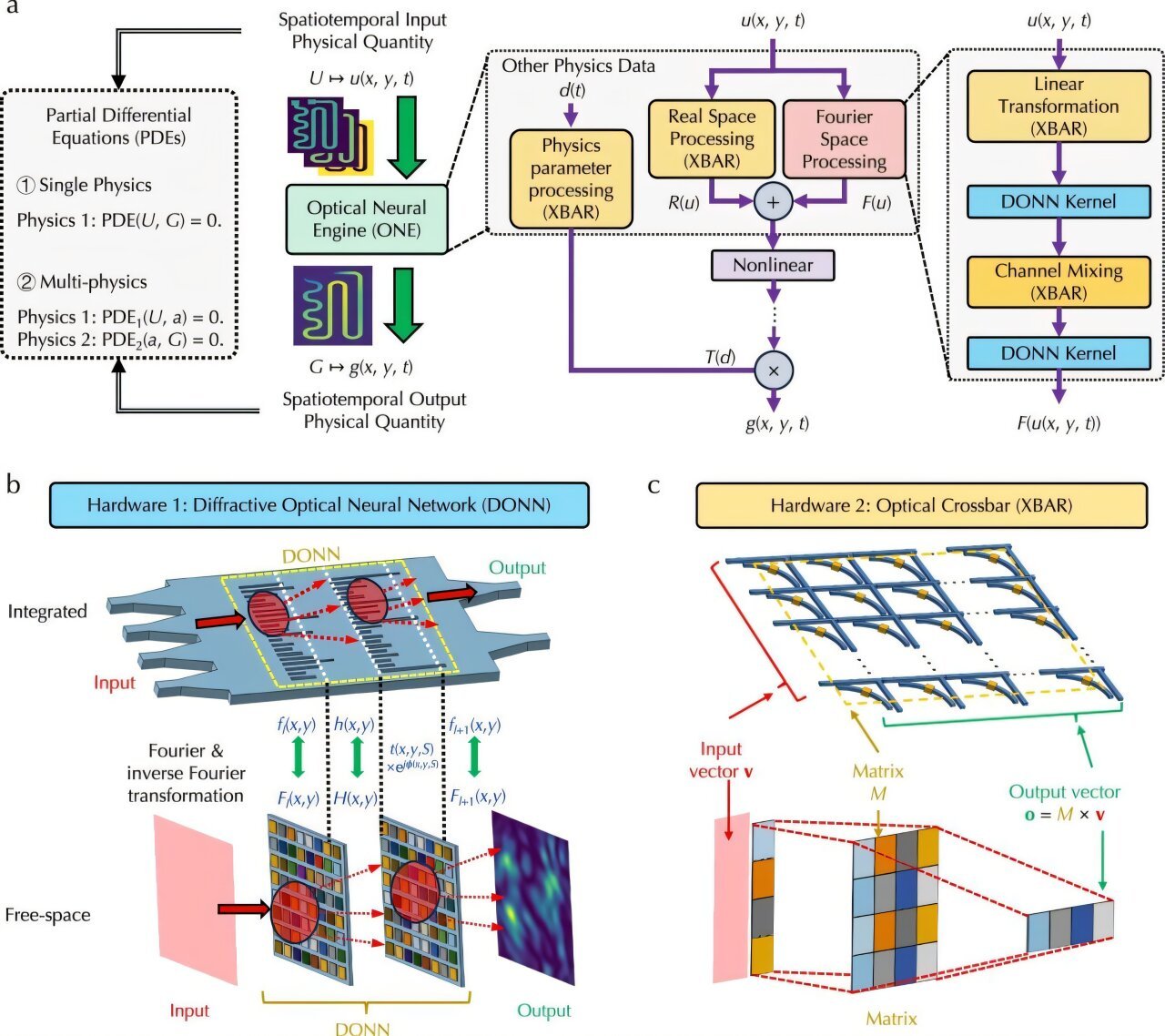
The researchers’ device applies principles of neural networking to an optical framework. As a wave encoded with a PDE passes through the ONE’s series of components, its properties gradually shift and change, until they ultimately represent the solution to the given PDE. Credit: Gao lab, University of Utah

Partial differential equations (PDEs) are a class of mathematical problems that represent the interplay of multiple variables, and therefore have predictive power when it comes to complex physical systems. Solving these equations is a perpetual challenge, however, and current computational techniques for doing so are time-consuming and expensive.


Related posts

For $4,550, Would You Buy a Single Premium Watch or a Swarm of Affordable Ones?

For $4,550, Would You Buy a Single Premium Watch or a Swarm of Affordable Ones?

February 8, 2026
The Shoes and Brooms Transforming Curling at the 2026 Winter Olympics

The Shoes and Brooms Transforming Curling at the 2026 Winter Olympics

February 8, 2026

Now, research from the University of Utah’s John and Marcia Price College of Engineering is showing a way to speed up this process: encoding those equations in light and feeding them into their newly designed “optical neural engine,” or ONE.

The researchers’ ONE combines diffractive optical neural networks and optical matrix multipliers. Rather than representing PDEs digitally, the researchers represented them optically, with variables represented by the various properties of a light wave, such as its intensity and phase. As a wave passes through the ONE’s series of optical components, those properties gradually shift and change, until they ultimately represent the solution to the given PDE.

The research was led by Weilu Gao, assistant professor in the Department of Electrical & Computer Engineering, and Ruiyang Chen, a Ph.D. candidate in Gao’s research group. They published a study demonstrating this optical neural engine in the journal Nature Communications.

“Partial differential equations are a powerful computational tool to simulate physics problems instead of performing expensive and time-consuming real-world experiments,” Chen said. “However, the current numerical simulation method is slow and requires a lot of computing resources, and even electronic machine learning techniques are not fast enough.”

The machine learning techniques and digital neural networks currently used to solve PDEs involve passing the equation through a network of computational nodes, each of which weights its output as it passes it on to the next node. As the signal makes its way through the network, the correct solution becomes weighted most heavily and ends up as the output.

The researchers’ ONE takes this concept and applies it to photonic devices.

“The ONE takes the spatiotemporal data of an input physical quantity, which is a function of positions and time, to predict the spatiotemporal data of an output physical quantity as a function of positions and time,” Gao said.

Electronic machine learning techniques can produce a similar output, but at slower speeds and higher energy costs.

“This optical approach accelerates the machine learning process and requires less energy as compared to an electronic approach,” said lead author and former Gao lab member Yingheng Tang, now a research scientist with Lawrence Berkeley National Laboratory.

The researchers demonstrated their ONE’s capabilities on a number of PDEs, including the Darcy flow equation, the magnetostatic Poisson’s equation in demagnetization, and the Navier-Stokes equation in incompressible fluid.

“The Darcy flow equation, for example, describes a fluid flow through a porous medium,” Gao said. “Given data about the permeability and pressure fields inside a given medium, the ONE architecture essentially learns the mapping between those qualities, and can predict flow properties without having to experiment.”

“This research offers a versatile and powerful platform for large-scale scientific and engineering computation, such as geology and chip design,” Gao said.

More information:
Yingheng Tang et al, Optical neural engine for solving scientific partial differential equations, Nature Communications (2025). DOI: 10.1038/s41467-025-59847-3

Provided by
University of Utah

Citation:
‘Optical neural engine’ can solve partial differential equations (2025, June 10)
retrieved 10 June 2025
from https://techxplore.com/news/2025-06-optical-neural-partial-differential-equations.html

This document is subject to copyright. Apart from any fair dealing for the purpose of private study or research, no
part may be reproduced without the written permission. The content is provided for information purposes only.



Source link

Previous Post

Apple Intelligence: Everything you need to know about Apple’s AI model and services

Next Post

DOF Lands IMR Vessel and Subsea Services Contract in Asia Pacific

Next Post
DOF Lands IMR Vessel and Subsea Services Contract in Asia Pacific

DOF Lands IMR Vessel and Subsea Services Contract in Asia Pacific

Leave a Reply Cancel reply

Your email address will not be published. Required fields are marked *

RECOMMENDED NEWS

How to Use Your Phone as a Bedside Alarm Clock With StandBy and Bedtime Modes

How to Use Your Phone as a Bedside Alarm Clock With StandBy and Bedtime Modes

2 years ago
US 5th Fleet Launches Drones to Monitor Arabian Peninsula Activities

US 5th Fleet Launches Drones to Monitor Arabian Peninsula Activities

2 years ago
Water Boards Not to Blame for the Water Crisis: Focus Must Shift to Municipal Collapse and Reform

Water Boards Not to Blame for the Water Crisis: Focus Must Shift to Municipal Collapse and Reform

9 months ago
Dogecoin (DOGE) Price Prediction: August-End 2023

Dogecoin (DOGE) Price Prediction: November 2023

2 years ago

POPULAR NEWS

  • Ghana to build three oil refineries, five petrochemical plants in energy sector overhaul

    Ghana to build three oil refineries, five petrochemical plants in energy sector overhaul

    0 shares
    Share 0 Tweet 0
  • The world’s top 10 most valuable car brands in 2025

    0 shares
    Share 0 Tweet 0
  • Top 10 African countries with the highest GDP per capita in 2025

    0 shares
    Share 0 Tweet 0
  • Global ranking of Top 5 smartphone brands in Q3, 2024

    0 shares
    Share 0 Tweet 0
  • When Will SHIB Reach $1? Here’s What ChatGPT Says

    0 shares
    Share 0 Tweet 0

Get strategic intelligence you won’t find anywhere else. Subscribe to the Limitless Beliefs Newsletter for monthly insights on overlooked business opportunities across Africa.

Subscription Form

© 2026 LBNN – All rights reserved.

Privacy Policy | About Us | Contact

Tiktok Youtube Telegram Instagram Linkedin X-twitter
No Result
View All Result
  • Home
  • Business
  • Politics
  • Markets
  • Crypto
  • Economics
    • Manufacturing
    • Real Estate
    • Infrastructure
  • Finance
  • Energy
  • Creator Economy
  • Wealth Management
  • Taxes
  • Telecoms
  • Military & Defense
  • Careers
  • Technology
  • Artificial Intelligence
  • Investigative journalism
  • Art & Culture
  • LBNN Blueprints
  • Quizzes
    • Enneagram quiz
  • Fashion Intelligence

© 2023 LBNN - All rights reserved.