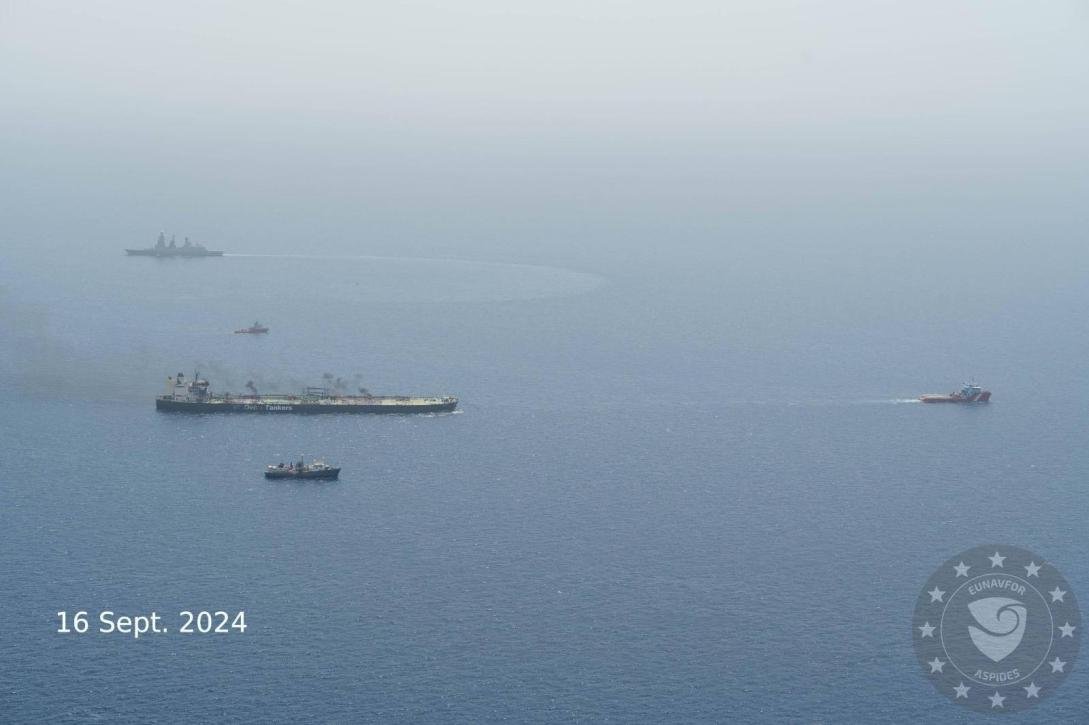

In its first year, the third European Union (EU) naval task force operating in African waters and concentrating on the Red Sea has provided support and close protection to over a thousand vessels.
In the course of executing its mandated protection duties for merchant and other shipping using the Red Sea, including the Bab-el-Mandeb Strait, Operation Aspides (Greek for “shield”) has 24 “kills” to its credit. These are listed as two USVs (unmanned surface vehicles), four ballistic missiles and 28 UAVs (unmanned aerial vehicles). “Close protection” was provided for 370 vessels with a further 640 vessels given what the operation terms “support”.

Additionally, assets assigned to Aspides have been part of rescuing 50 seafarers. The operation is headquartered in the Greek city Larissa and is commanded by Hellenic Navy Rear Admiral Vasileios Gryparis.
Ahead of its mandate expiring on Wednesday, 19 February, the EU Council extended it until 28 February 2026 with what a statement terms “a reference amount” in excess of 17 million euros. The extension decision follows an operation review.
To ensure and improve maritime security in its area of operation (AoO), Aspides will now collect information on arms trafficking and “shadow fleets” (deceptive shipping practices) to share with EU member states, the European Commission (EC), the United Nations Office on Drugs and Crime (UNODC), Interpol, the EU Agency for Law Enforcement Co-operation (EUROPOL) and the International Maritime Organisation (IMO).
Aspides’ mandate is that of a defensive maritime security operation with the objective of restoring and safeguarding freedom of navigation in the Arabian and Red seas as well as the gulfs of Aden, Oman and the Persian Gulf. It has, according to the Operation website, three “naval units” attached as well as a force headquarters aboard a frigate.
Other EU naval operations in African waters are Atalanta (western Indian Ocean and Horn of Africa) and Irini (Mediterranean Sea).