
Two recent South African law enforcement initiatives, one in Cape Town, and the other in Gauteng, have provoked interest and in some cases, controversy.
Both have been launched without explicit parliamentary authorisation. Because they involve or are intended to involve, the deployment of armed personnel, they raise questions regarding Section 199(3) of the country’s constitution that says ‘armed organisations or services may only be established in terms of national legislation.’
In 2019 the City of Cape Town, with financial support from the Western Cape provincial government, initiated the Law Enforcement Advancement Plan (LEAP). This enables it to supplement the South African Police Service’s (SAPS) capacity in areas with high murder rates in the metro. By June 2023, 1 235 LEAP officers had been appointed.
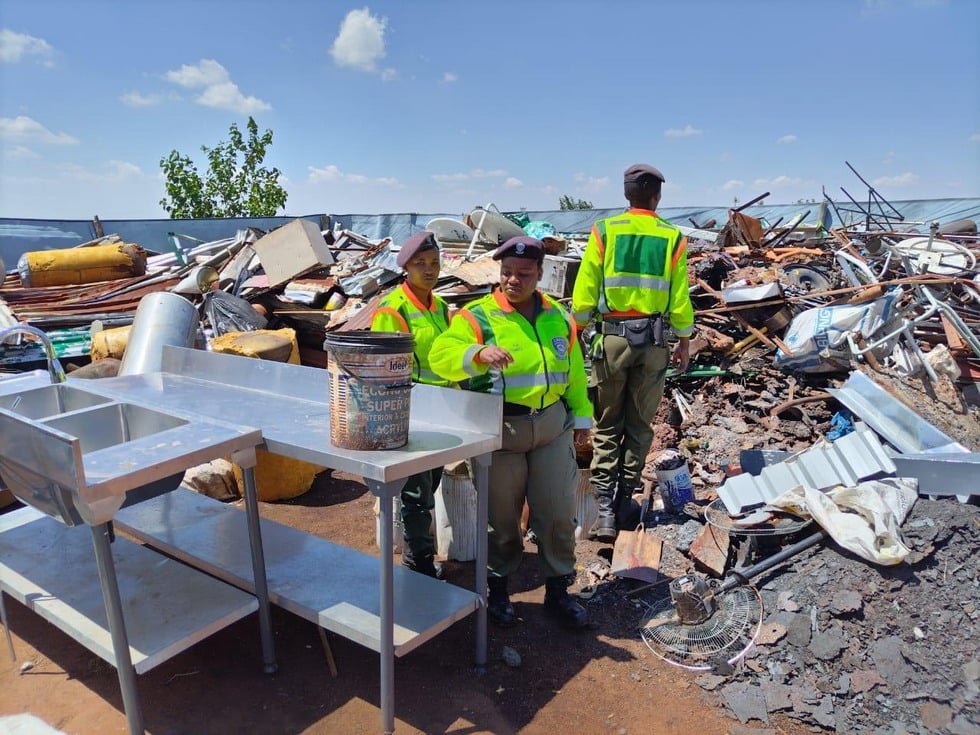
In November 2022, Gauteng Premier Panyaza Lesufi announced that the Gauteng provincial government would establish a 6 000-strong force of crime prevention wardens (CPWs). After a rushed recruitment process, an initial 3 200 were appointed in May 2023.
There are distinct differences between the two initiatives. Unlike Gauteng’s CPWs, which are newly created, LEAP is an expansion of Cape Town’s existing law enforcement capacity.
LEAP officers are not police but ‘peace officers’. These are law enforcement officials, referred to in South Africa’s Criminal Procedure Act, whose powers are more limited than those of the SAPS or metro police. LEAP is in line with a 2018 Government Gazette that authorises municipalities to appoint peace officers.
There is no equivalent Government Gazette authorising provincial governments to appoint peace officers. In December 2023, the Ministry of Justice announced that the Gauteng government was authorised to appoint peace officers if they were hired as traffic officers. But the 2011 Gazette that the justice ministry referred to deals with traffic officers appointed by the national Road Traffic Management Corporation, and doesn’t apply to provincial governments. Deployment of the CPWs as peace officers is therefore illegal.
There are other significant differences between the two initiatives. The Cape Town metro has followed an incremental approach to expanding LEAP, enabling consistent selection and training standards to be applied.
But the CPWs establishment shows the risks of allowing components of government to establish armed law enforcement organisations. There is no evidence that Gauteng has given forethought to how it will develop and manage the CPWs, or whether it has the organisational capacity and infrastructure to run a policing agency of this size.
The provision of training for the CPWs has been ad hoc. The latest batch of 1 785 recruits is being trained by the South African National Defence Force – which lacks the expertise to train police. These recruits bring the total number of CPWs to nearly 5 000, making them the second largest state policing agency in South Africa, after the far larger SAPS.
But have the CPWs, and arguably also LEAP in Cape Town, been created in contravention of the country’s constitution? LEAP personnel are armed with firearms, and the Gauteng government has indicated that it intends to arm the CPWs as well, though it’s unclear how many currently have guns.
Section 334 of the Criminal Procedure Act allows the Minister of Justice to designate personnel as peace officers. Although it has been on the law books for a long time, it may be used to subvert Section 199(3) of the constitution. Most explicitly, in the case of the Gauteng CPWs, it is being used to circumvent the authority of Parliament.
The unregulated creation of armed law enforcement organisations in South Africa carries serious risks for national security, policing and crime. The justice minister’s response to the CPWs’ creation reflects an indifference to these risks, and is an about-face by the ruling African National Congress, which has vociferously defended centralised control over the police.
Multiple state organisations, including the SAPS itself, already contribute to illegal firearm proliferation because of weapons being lost by, or stolen from, their members. Providing guns to CPWs without the ability to properly manage their distribution and use is likely to aggravate the problem. The Gauteng government’s lack of capacity to train CPWs in firearm use exposes the public to danger from poorly trained ‘police’.
Questions raised by Gauteng’s CPWs include whether provinces have the scope to play a greater role in shaping policing, and whether new armed policing organisations are actually needed. National government’s ability to answer these questions is obstructed by the absence of an effective policy-making machinery.
Provincial governments that want to improve safety should not assume that the answer lies in deploying more armed police. They should rather invest in the types of policing that don’t rely on personnel carrying firearms.
Written by David Bruce, Independent Researcher and ISS Consultant.
Republished with permission from ISS Africa. The original article can be found here.