

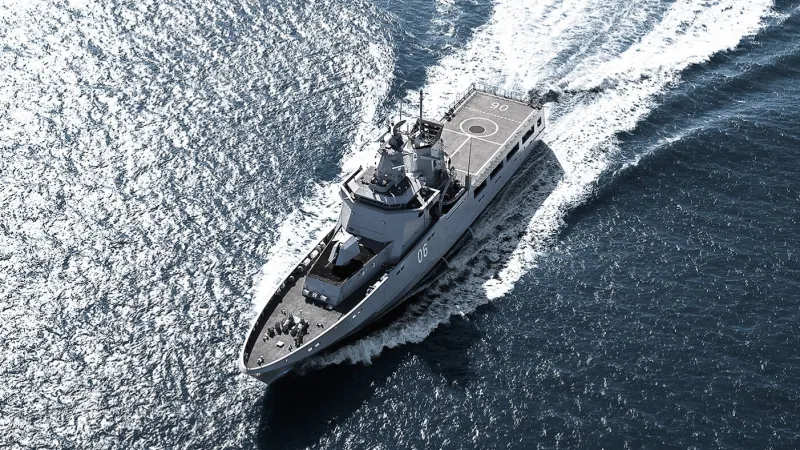
ALEXANDRIA — NVL Egypt has formally commenced the production phase for ten PV43-M offshore patrol vessels (OPVs) for the Egyptian Navy, marking a major milestone in Cairo’s effort to localize its defence industrial base. Production began on schedule in September 2025 at the Alexandria Shipyard, following the selection of NVL Egypt—a joint venture between Germany’s NVL Group, Abou Quir Ports Construction & Management Company (APCM), and Magnom Industries—as the prime contractor in 2023.
The program represents a shift in Egypt’s procurement strategy, moving from direct acquisition of foreign-built hulls to licensed domestic manufacturing with substantial technology transfer.
The PV43-M Platform
The PV43-M is a 43-meter patrol vessel derived from the proven OOB-31 design, originally developed for the Croatian Navy. Displacing approximately 270 tons, the vessel is optimised for littoral security duties, including maritime surveillance, search and rescue (SAR), and critical infrastructure protection—a vital role given Egypt’s extensive offshore natural gas assets in the Mediterranean.
Designed for high endurance relative to its size, the PV43-M can operate autonomously for up to ten days with a crew of 16. The propulsion system, comprising two engines delivering 2,525 kW each, drives the vessel to top speeds exceeding 28 knots, with an economical cruise speed of 15 knots.
While specific armament configurations for the Egyptian hulls have not been publicly detailed, the platform was showcased with modular options ranging from 30mm main cannons and 12.7mm heavy machine guns to anti-ship missiles. NVL Egypt has stated the vessels will possess “anti-surface warfare” (ASuW) capabilities. They will be capable of joint operations, suggesting a configuration more potent than a standard constabulary patrol boat.
Advanced Sensor Suite
To support these kinetic capabilities, the Egyptian Navy has selected a sophisticated sensor package from French defence contractor Safran. In a deal finalised in November 2024, NVL Egypt opted to equip the fleet with the VIGY 4 optronic sighting system and the Argonyx inertial navigation system.
The VIGY 4 is a stabilised, long-range panoramic observation system capable of detecting and tracking threats in reduced visibility conditions, including fog and total darkness, utilising a Short Wave Infrared (SWIR) channel. Crucially, the system is capable of fire control for small and medium-calibre weapons, allowing the vessel to engage fast-moving surface threats such as smuggling skiffs or unmanned surface vessels (USVs).
The Argonyx system provides resilient navigation data. Based on Safran’s patented HRG Crystal gyroscope technology, it ensures precise heading and localisation data even in Global Navigation Satellite System (GNSS)-denied environments—an increasingly common scenario in modern naval warfare where GPS jamming is prevalent.
Strengthening Indigenous Industry
The primary strategic driver behind the PV43-M program is the “localisation of expertise.” Unlike the 2020 procurement, where Egypt received Lürssen patrol boats originally destined for Saudi Arabia, these ten vessels are being constructed entirely on Egyptian soil.
“This programme represents a strategic milestone in strengthening Egypt’s naval forces, as ten state-of-the-art naval vessels will be built entirely in Egypt,” NVL Egypt stated. The company emphasised that its role extends beyond shipbuilding to include the development of long-term maintenance services, spare parts supply chains, and technical support, ensuring the fleet’s sustainability without relying entirely on foreign depots.
Tim Wagner, CEO of NVL, noted that the program paves the way for “new international projects in close cooperation with the Egyptian Navy,” hinting at future expansions of the joint venture’s portfolio.
Broader Naval Modernisation
The PV43-M program runs parallel to other modernisation efforts within the Egyptian Navy. The service is also collaborating with the United States’ Swiftships to co-produce 28-meter Coastal Patrol Craft (CPC28) at the Egyptian Navy Shipyard, with a total requirement for 50 vessels.
Furthermore, NVL and Egypt have explored designs for the CC-60 Compact Combatant. Introduced at the EDEX 2021 exhibition, the CC-60 is a larger, 60-meter corvette-class vessel equipped with 3D radar and electronic warfare capabilities. It is designed to accommodate vertical-launch unmanned aerial vehicles (UAVs) and light helicopters, offering anti-submarine warfare capabilities that complement the surface-focused mission of the PV43-M.
Egypt has received multiple vessels from Lurssen, including coastal patrol craft. Five years ago, it received nine 40 metre patrol boats and a single 60 metre coastal defence boat under a 130 million euro deal after the contract with the original customer, Saudi Arabia, fell through.
By simultaneously running these programs, Egypt is effectively recapitalising its littoral combat force, creating a tiered defence network capable of securing the Suez Canal and the Red Sea against asymmetric threats while fostering a domestic shipbuilding industry capable of supporting the fleet for decades to come.


