

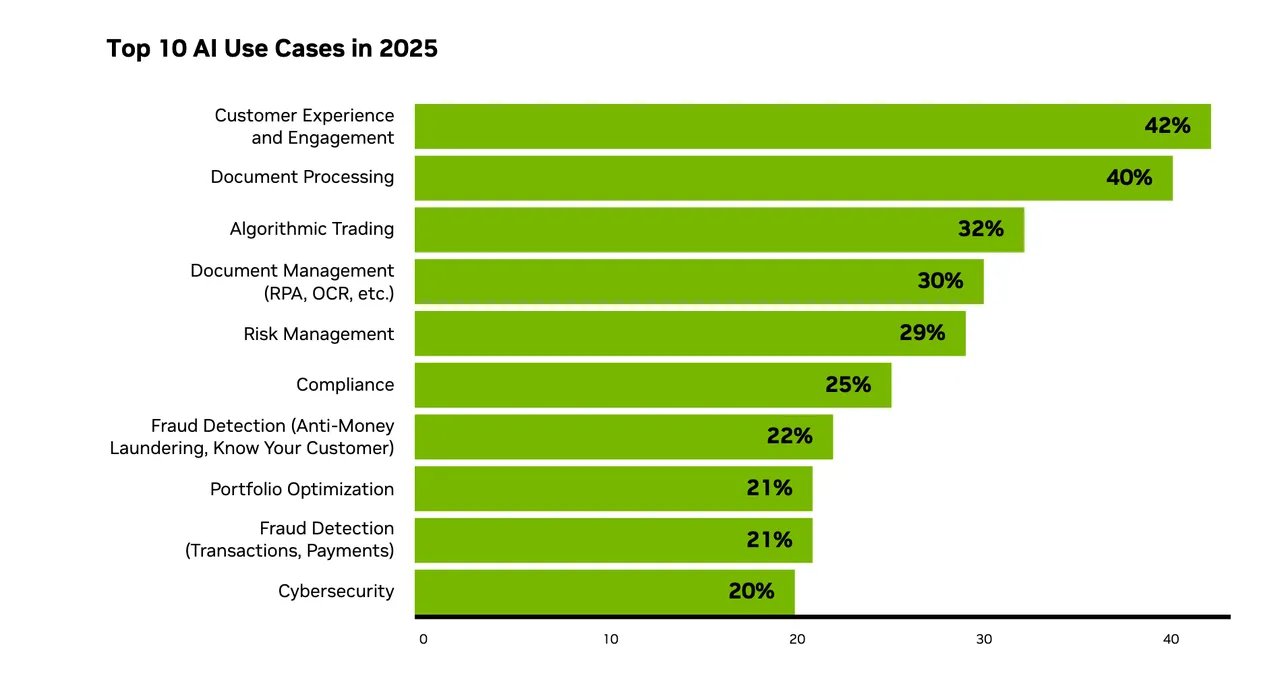
NVIDIA published its sixth annual “NVIDIA State of AI in Financial Services” report this week, based on a survey of more than 800 industry professionals worldwide.
While much of the report showcases areas of growth in AI, as one might expect from the dominant AI chipmaker, it also points out key use cases where large institutional players in financial services are finding traction and success, delivering efficiency gains and ROI, and the top challenges.
Fairly obvious and much-discussed examples include fraud detection, risk management and customer service.
Among the findings are that nearly 100% of respondents reported there would be no decrease in AI budgets, with expectations that they will either increase or stay the same in the next year. Overall, AI usage is up as well, with 65% of respondents reporting that their company is actively using AI, up from 45% in last year’s report.
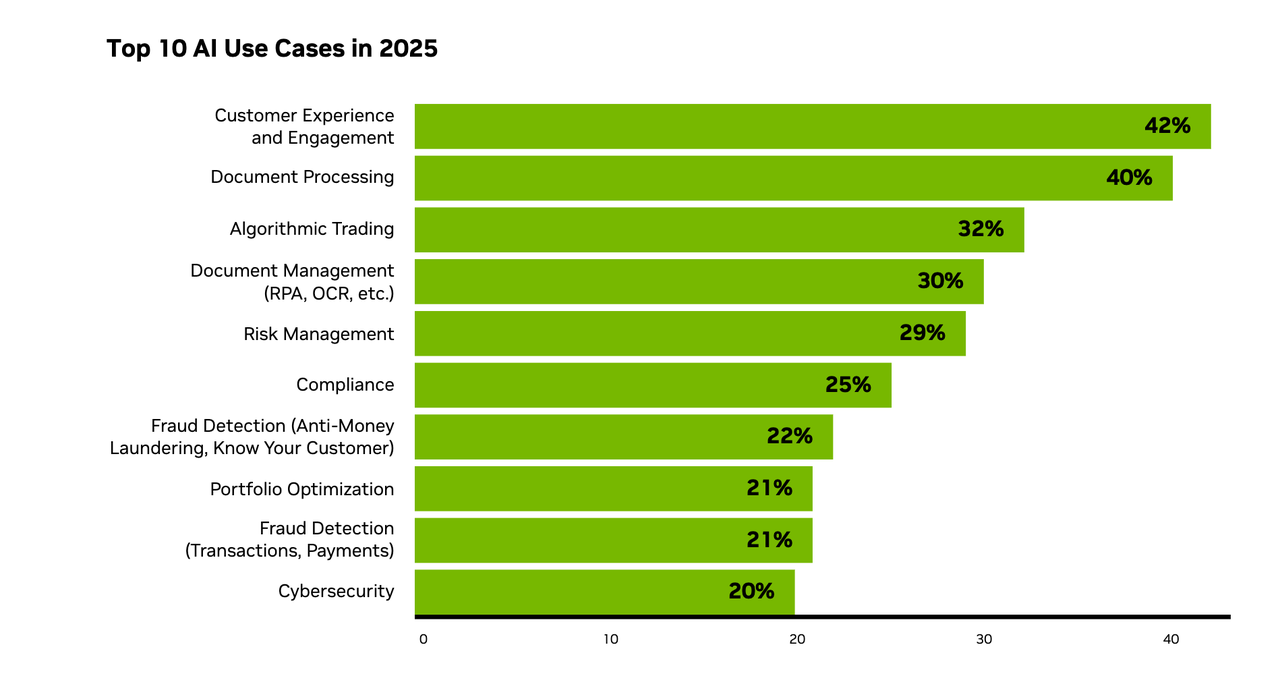
Source: NVIDIA State of AI in Financial Services: 2026 Trends
When it comes to types of AI being used, 61% of respondents report their companies are using or assessing generative AI, up from 52% year over year.
More interesting is the finding that 42% of respondents and their companies are using or assessing agentic AI, with 21% saying they’ve already deployed AI agents. And 84% said open-source models and software are important to their AI strategy.
The top five challenges with agentic AI include performance reliability issues (accuracy, drift, unpredictable results etc.) reported among 34% of respondents, a lack of internal skills or experts to manager or monitor AI agents (33%), data-related issues (privacy, sovereignty, disparate locations) reported by 30%, implementation issues from (not being easy to use, deploy or integrate with existing workflows) reported by 28%, and finally, regulatory and ethical concerns reported by another 28%.
All of this should prove food for thought within the advisory technology subsector of financial services.
Relationship AI in Beta at Datalign Advisory, Monthly Pricing at Aidentified
Competition continues to heat up in the still small, next-generation AI-driven arena of advisor prospecting platforms.
This week, Datalign Advisory announced Relationship AI, which is still in beta with select clients and partners.
This new functionality is meant to surface and highlight money-in-motion events and financial indicators. It signals that a prospect may be navigating a significant life moment, which appears broadly similar to core platform features at competitors such as Aidentified and FINNY.
Highlighted as part of the new announcement are condensed briefings, scannable in 30 seconds, intended to give advisors quick initial context across four key categories.
These include topics that are likely to resonate with the prospect, called Conversation Starters, and an indication of their communication preferences for outreach.
Then, in addition to requisite demographic details, professional background (career stage, household composition and geographic context), the platform will share wealth indicators and money-in-motion events that might include home purchases, job changes or inheritances, for example.
Advisors would also receive information on the prospect’s lifestyle interests and behavioral signals, including causes they support, communities they’re active in, and other interests the platform has identified.
Datalign is taking reservations for Relationship AI access in 2026, with expansion planned to other areas of wealth management, including private banking and insurance, later this year.
The launch follows Datalign’s June 2025 release of GEOsAI, an AI-powered tool meant to help advisors identify underserved communities. In February, Datalign announced that Link Ventures had invested another $5 million in the startup, bringing the venture capital firm’s total investment to $9 million.
Also this week, competitor Aidentified announced the launch of its new Starter Plan, which replaces the company’s former Professional option. It provides access to the platform’s core capabilities, which include advanced prospecting, relationship mapping, and wealth intelligence, but on a month-to-month subscription basis. The plan is meant for advisors and teams that want to evaluate value and ROI without a long-term contract, which is a common complaint among advisors.
The Starter Plan costs $49 per user per month with additional details on Aidentified’s pricing page.
Jump Lands Focus Financial Partners Wealth
AI notetaker and meeting automation platform Jump announced another large customer and partner win this week: Focus Financial Partners.
Focus, which has undergone a reorganization and rebranding over the last two years, has, in a nutshell, two major components: the Focus Partners Wealth division, which is made up of salaried advisors, and the firms in its Focus Network (1099 advisor firms). Those two combined currently manage around $500 billion in client assets.
Jump is the only approved AI automation platform at Focus Partners Wealth, where licenses will be covered by the firm. The more independently run Focus Network firms will make their own decisions about adopting the technology, pay for their own contracts, and are free to continue using other platforms if they have adopted them.
This announcement follows a busy 2025 for Jump, during which it grew its user base to more than 20,000 advisors, including partnerships with Osaic, LPL Financial, and Cetera, among others, as well as integrations with financial planning providers eMoney, RightCapital and others.


