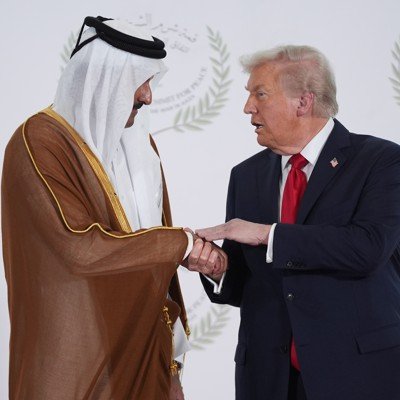
To seal the recent Gaza peace deal, President Donald Trump asked Arab states to, once again, find a compromise with Israel. Despite Trump’s promises to the contrary, they had to accept seriously watered-down language on a future Palestinian state and a partial, rather than full, Israeli withdrawal from Gaza. Coming on the heels of Israel’s missile strike on Doha that also rattled Arab states, Trump may now feel all the more pressure to appease the United States’ Arab partners, like he did last month when he offered a formal security guarantee to Qatar (a first for any state in the Middle East) to quiet Arab doubts about U.S. reliability as a security partner.
Are more U.S. pledges now on the way?


Saudi Arabia is pushing for a U.S. security deal, but taking on new commitments isn’t worth the real and potential costs to U.S. interests. Instead, Trump needs to stay focused on the heart of the problem and maintain pressure on Israel to curb its regional aggression. Coupled with Arab states shouldering the burden of their own security, pressure like this is best for ending conflict in the region.
The United States has a bad habit of making new commitments to states in the Middle East when it wants to either expand or maintain regional order and peace. New pledges are the goodies Washington hands out to keep everyone in—or sometimes to expand—the fold.
With the Abraham Accords, for instance, the United States committed sales of F-35 fighter jets, recognition of disputed territories, and financial support to get the United Arab Emirates, Bahrain, Sudan, and Morocco to normalize relations with Israel. Those pledges essentially greased the wheel for greater regional cooperation.
Encouraging cooperation is a good thing, but not when it comes at the expense of U.S. national security, which the Trump administration must now put front and center as it considers how to manage relations with Arab states today.
The United States is already overcommitted to the Middle East. It maintains upwards of 50,000 troops there (that’s up by nearly half since Hamas’ October 7 attack on Israel) despite the waning significance of the region to the United States.
The two main strategic drivers of U.S. deep engagement in the Middle East over the last five decades—oil and terrorism—are no longer major strategic challenges. The U.S. is now a net exporter of oil, meaning it no longer depends on the region’s fossil fuels; and with the defeat of the ISIS caliphate in 2019 and general weakening of al-Qaeda, the terrorism threat can be mostly handled by local actors.
In short, Washington is giving the Middle East far too much. It shouldn’t now give even more to tamp down frustrations over the Gaza deal and the Doha strike, or more broadly to try to bring some permanent, transformative fix to the troubled region, which appears to be Trump’s greater ambition. Rather than step deeper into the Middle East, Washington needs to step back.
Under similar circumstances, President Joe Biden considered giving Saudi Arabia a NATO-like security guarantee to get Riyadh to come onboard with the Abraham Accords. Riyadh asked for the pledge because, similar to Qatar today, the United States provided no military defense of Saudi Arabia after a 2019 attack by Yemen’s Houthi rebels on two Saudi oil refineries. Right on cue, Biden offered up the security pledge to grease the wheels of regional cooperation.
Trump just followed Biden’s playbook with Qatar—and might follow that playbook again with new security pledges across the region to appease Arab states post-Gaza and expand the Abraham Accords. This makes little sense, given limited U.S. interests in the Middle East; and it runs counter to the Trump administration’s own strategy of shifting forces out of the region to focus attention on Asia and the Western Hemisphere where the United States has far more at stake. More commitments mean the forces stay too to uphold those commitments.
Trump needs to make clear to the Qataris the limits of this new pledge, and avoid doling out more of them to other Arab partners. This would not only help the United States, but would likely benefit the Middle East too. The U.S. decision not to defend Saudi Arabia militarily after the Houthi attack in 2019 forced Riyadh to recognize that it had to bear more of the burden of its own security. The result? It ended its brutal, costly military operations in Yemen. This isn’t an isolated case. From Iran to post-Assad Syria, we’ve seen other similar instances of peace and stability when the U.S. draws back.
Trump should also maintain pressure on Tel Aviv (which he finally used to push Israel into the Gaza peace deal) to tone down its regional aggression. As opposed to doling out goodies, this has worked best to calm Middle East tensions of late. Keeping that pressure up now will help tame regional strikes, like Doha, that led Trump to make the pledge to Qatar in the first place.
In general, Trump can get the regional stability and order he wants in the Middle East by doing less, not more. Stepping back, rather than stepping farther into, the Middle East just makes sense.
Will Walldorf is a Professor at Wake Forest University and Senior Fellow at Defense Priorities.