


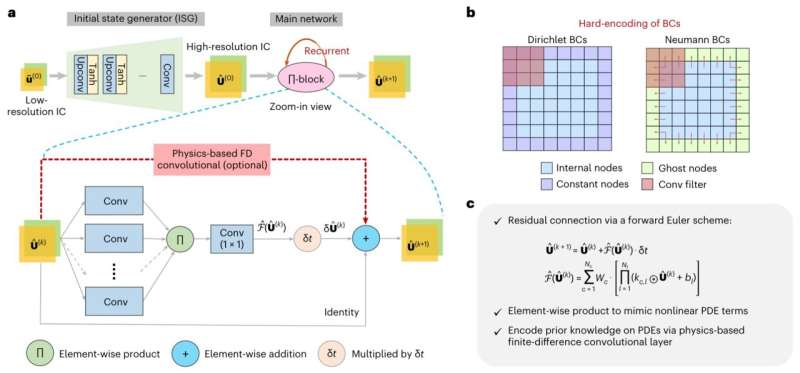
Prof. Liu Yang from the University of Chinese Academy of Sciences (UCAS), in collaboration with her colleagues from Renmin University of China and Massachusetts Institute of Technology, has proposed a novel network, namely, the physics-encoded recurrent convolutional neural network (PeRCNN), for modeling and discovery of nonlinear spatio-temporal dynamical systems based on sparse and noisy data.
The approach can be applied to a variety of problems such as reaction-diffusion processes and other partial differential equation (PDE) systems, including forward and inverse analysis, data-driven modeling and discovery of PDEs. The prior physics knowledge is forcibly “encoded,” which gives the network interpretability.
In particular, the researchers proposed a deep learning framework that forcibly encodes a given physics structure in a recurrent convolutional neural network to facilitate learning of the spatiotemporal dynamics in sparse data regimes. The paper is published in the journal Nature Machine Intelligence.
They found that such a computational paradigm exhibits high accuracy, robustness, interpretability and generalizability, and demonstrated the capabilities of the proposed network architecture by applying it to various tasks in scientific modeling of spatiotemporal dynamics such as reaction-diffusion processes.
In general, predicting the evolution of complex spatiotemporal dynamical systems is a challenging task in many cases due to insufficient prior knowledge and the lack of an explicit PDE formulation to describe the nonlinear process of the system variables. Conventional machine learning methods have to rely on a large amount of training data and suffer from problems such as poor interpretability, weak generalization, and uncontrollable modeling errors.
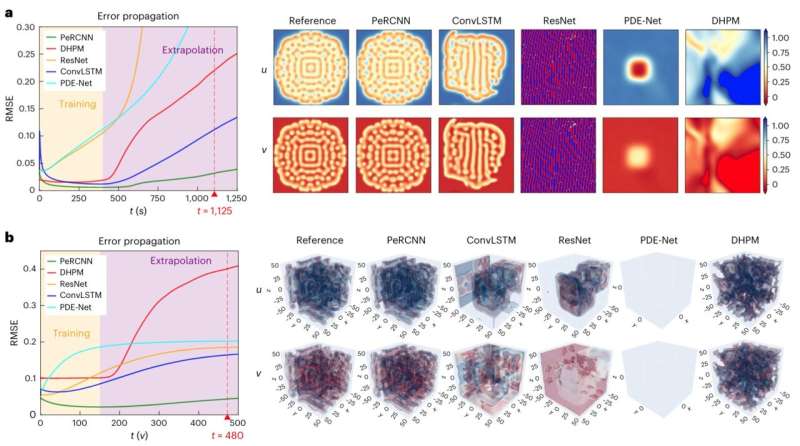
Thanks to the recent development of data-driven approaches, it is possible to learn spatio-temporal dynamics from measurement data while adding prior physics knowledge. However, existing physics-based machine learning paradigms impose physical laws or governing equations through soft penalty constraints, and the solution quality largely depends on a trial-and-error proper setting of hyperparameters. Therefore, it is of great necessity to develop new knowledge-embedded learning model to learn the underlying spatiotemporal dynamics from data.
According to the researchers, a major advantage of the PeRCNN is that the prior physics knowledge can be encoded into the network, which guarantees that the resulting network strictly obeys the given physics. This has significant advantages in improving the convergence and accuracy of the model. By encoding the given physical structure into the recurrent convolutional neural network, the performance of modeling spatiotemporal dynamical systems based on sparse and noisy data has been improved.
Through extensive numerical experiments, they showed how the proposed approach can be applied to model and discover a variety of reaction-diffusion processes and other PDE systems. By comparing the proposed approach with some existing methods (also known as baseline models), they found that the approach consistently outperforms (although not as well as) the considered baselines under different noise levels and data richness.
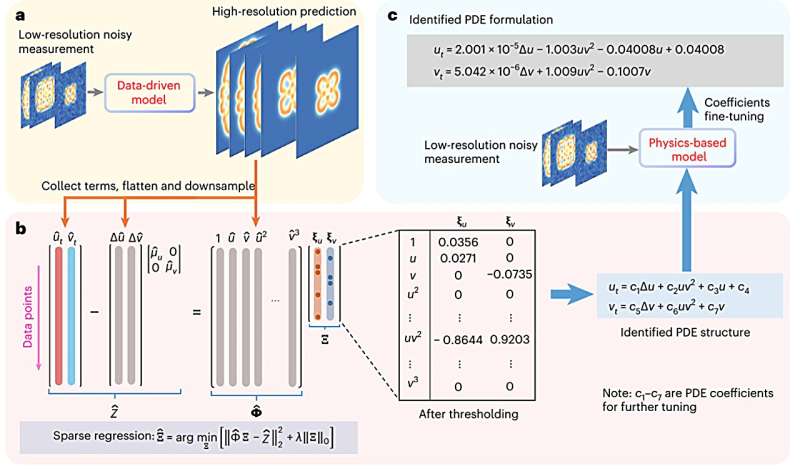
In addition, the researchers integrated the sparse regression technique with the PeRCNN model to discover the explicit form of PDEs. The entire procedure consists of three steps: data reconstruction, sparse regression and fine-tuning of coefficients.
This study is expected to advance the development of data-driven modeling of complex spatiotemporal dynamical systems, providing scientists and engineers with more powerful tools for understanding and predicting natural and engineering phenomena.
The approach, which combines deep learning and their prior physics knowledge, is expected to be applicable in multiple disciplines and play an important role, including fluid mechanics, biochemistry, environmental science, engineering, materials science, and more.
The researchers look forward to seeing the further development and application of this new approach, which may unravel more mysteries about complex spatiotemporal dynamical systems and bring new breakthroughs for future scientific and technological development.
More information:
Chengping Rao et al, Encoding physics to learn reaction–diffusion processes, Nature Machine Intelligence (2023). DOI: 10.1038/s42256-023-00685-7
Chinese Academy of Sciences
Citation:
Novel physics-encoded artificial intelligence model helps to learn spatiotemporal dynamics (2023, August 4)
retrieved 4 August 2023
from https://techxplore.com/news/2023-08-physics-encoded-artificial-intelligence-spatiotemporal-dynamics.html
This document is subject to copyright. Apart from any fair dealing for the purpose of private study or research, no
part may be reproduced without the written permission. The content is provided for information purposes only.


