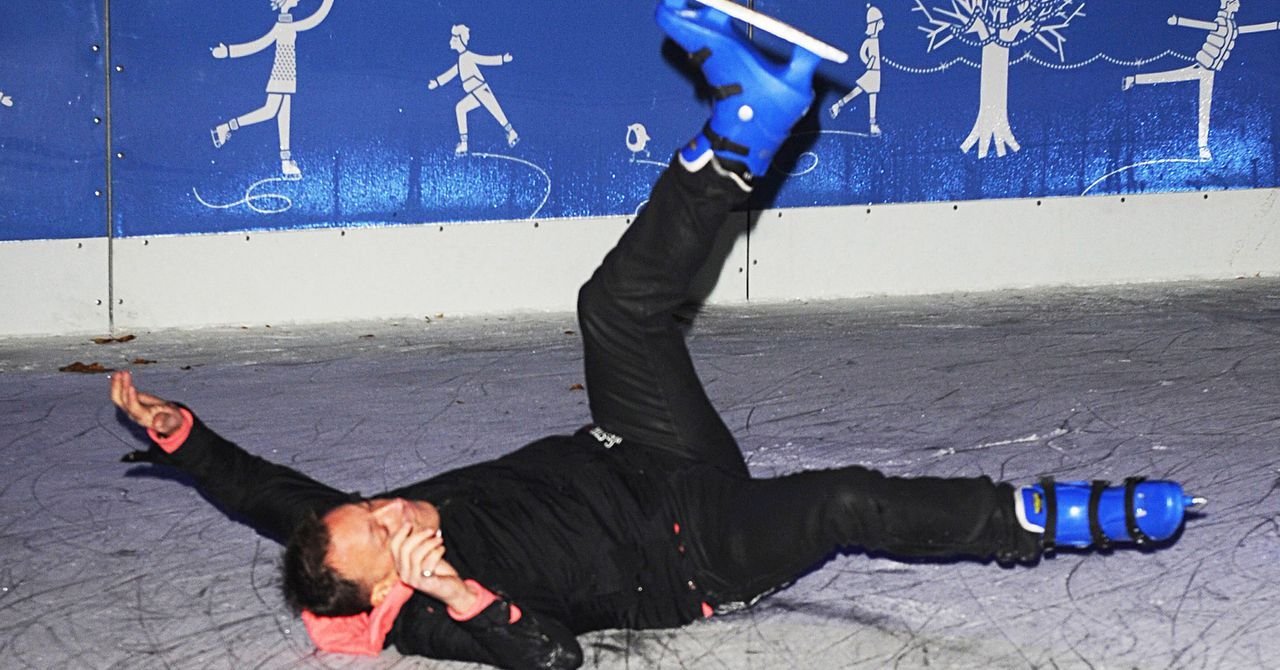
They intuited that molecules near the surface behave differently from those deep within the ice. Ice is a crystal, which means each water molecule is locked into a periodic lattice. However, at the surface, the water molecules have fewer neighbors to bond with and therefore have more freedom of movement than in solid ice. In that so-called premelted layer, molecules are easily displaced by a skate, a ski or a shoe.
Today, scientists generally agree that the premelted layer exists, at least close to the melting point, but they disagree on its role in ice’s slipperiness.
A few years ago, Luis MacDowell, a physicist at the Complutense University of Madrid, and his collaborators ran a series of simulations to establish which of the three hypotheses—pressure, friction or premelting—best explains the slipperiness of ice. “In computer simulations, you can see the atoms move,” he said—something that isn’t feasible in real experiments. “And you can actually look at the neighbors of those atoms” to see whether they are periodically spaced, like in a solid, or disordered, like in a liquid.
They observed that their simulated block of ice was indeed coated with a liquidlike layer just a few molecules thick, as the premelting theory predicts. When they simulated a heavy object sliding on the ice’s surface, the layer thickened, in agreement with the pressure theory. Finally, they explored frictional heating. Near ice’s melting point, the premelted layer was already thick, so frictional heating didn’t significantly impact it. At lower temperatures, however, the sliding object produced heat that melted the ice and thickened the layer.
“Our message is: All three controversial hypotheses operate simultaneously to one or the other degree,” MacDowell said.
Hypothesis 4: Amorphization
Or perhaps the melting of the surface isn’t the main cause of ice’s slipperiness.
Recently, a team of researchers at Saarland University in Germany identified arguments against all three prevailing theories. First, for pressure to be high enough to melt ice’s surface, the area of contact between (say) skis and ice would have to be “unreasonably small,” they wrote. Second, for a ski moving at a realistic speed, experiments show that the amount of heat generated by friction is insufficient to cause melting. Third, they found that in extremely cold temperatures, ice is still slippery even though there’s no premelted layer. (Surface molecules still have a dearth of neighbors, but at low temperatures they don’t have enough energy to overcome the strong bonds with solid ice molecules.) “So either the slipperiness of ice is coming from a combination of all of them or a few of them, or there is something else that we don’t know yet,” said Achraf Atila, a materials scientist on the team.
The scientists looked for alternative explanations in research on other substances, such as diamonds. Gemstone polishers have long known from experience that some sides of a diamond are easier to polish, or “softer,” than others. In 2011, another German research group published a paper explaining this phenomenon. They created computer simulations of two diamonds sliding against each other. Atoms on the surface were mechanically pulled out of their bonds, which allowed them to move, form new bonds, and so on. This sliding formed a structureless, “amorphous” layer. In contrast to the crystal nature of the diamond, this layer is disordered and behaves more like a liquid than a solid. This amorphization effect depends on the orientation of molecules at the surface, so some sides of a crystal are softer than others.
Atila and his colleagues argue that a similar mechanism happens in ice. They simulated ice surfaces sliding against each other, keeping the temperature of the simulated system low enough to ensure the absence of melting. (Any slipperiness would therefore have a different explanation.) Initially, the surfaces attracted each other, much like magnets. This was because water molecules are dipoles, with uneven concentrations of positive and negative charge. The positive end of one molecule attracts the negative end of another. The attraction in the ice created tiny welds between the sliding surfaces. As the surfaces slid past each other, the welds broke apart and new ones formed, gradually changing the ice’s structure.