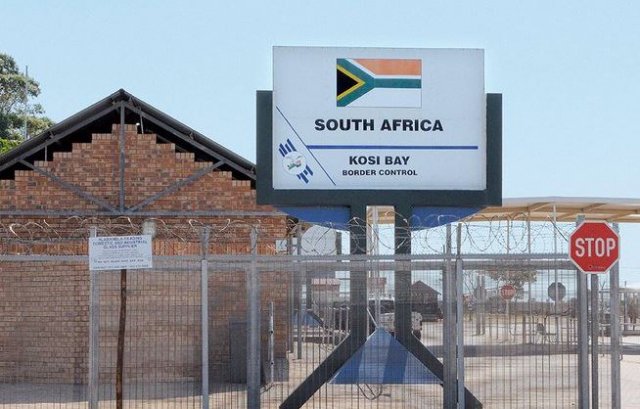

Home Affairs Minister Leon Schreiber gave a Parliamentary questioner wanting to know if ports of entry names will change short shrift saying under-funding means money will go to securing borders – not on other matters.
Economic Freedom Fighters (EFF) Member of Parliament Thapelo Mogale asked Schreiber if the Border Management Authority (BMA) intended renaming ports of entry to reflect local language and cultural identities of their locations. “If not, why not and what are the relevant details?” the Gauteng public representative wanted to know.
A single sentence response reads: “The BMA continues to confront acute underfunding challenges in its core mandate of securing South Africa’s borders for development and government will not be spending money the entity does not have on any other matters”.
Another Parliamentary questioner – Mariam Muhammad (MKP – uMkhonto we Sizwe Party) – aware of the “serious funding shortages” facing Commissioner Michael Masiapato’s BMA – sought Ministerial input on personnel and equipment at the still to be built one-stop border posts.
Without mentioning actual figures, she was informed, in writing, the one-stop border posts will include high-tech equipment such as cargo scanners to detect concealed cargo, amongst others. Further, the BMA procured body-worn cameras (BWCs) “which create a real-time, permanent record of what transpires during an encounter between the officials and travellers to detect corrupt activities between travellers and officials”.
Additional BWCs will be procured when funds are made available.
Muhammad was further informed, again without any specific mention of cost, the BMA in collaboration with the Department of Home Affairs (DHA) are improving an Enhanced Movement Control System (EMCS) order to speed up immigration processing.
In reply to a question from ActionSA’s Lerato Ngobeni, Schreiber explained that the BMA is under capacitated in terms of Human Resources for Ports of Entry and the Border Law Enforcement Area. “The BMA is further under-capacitated in terms of the Information Technology resources; technology for border management and control; and general resources for the efficient and effective management of South African borders,” he stated.
“The National Treasury has not allocated the full requested funding, particularly for goods, services, and capital expenditure, which affects the BMA’s ability to invest in necessary operations and technology,” Schreiber continued.
In July last year, the BMA told Parliament’s Joint Standing Committee on Appropriations (JSCA) and the Portfolio Committee on Home Affairs (PCHA) its 2023/24 budget request was R2.9 billion but it received less than half (R1.34 billion). This allocation increased marginally to R1.4 billion in 2024/25, with R1.47 billion allocated for the current 2025/26 financial year.
To make up for the shortfall, the BMA requested R500 million from the Criminal Assets Recovery Account in 2023 but only R150 million was approved. The BMA has requested another R3.4 billion in CARA funding, to be used for the procurement of additional resources.
According to Schreiber, “there is a significant lack of investment in modern surveillance technology, such as drones, high-definition cameras with facial recognition, and artificial intelligence capabilities across all 71 ports of entry. The current situation, with multiple non-interfacing legacy networks inherited from different departments, severely hampers information sharing and operational efficiency.”
He said many of the port of entry facilities are in an unsatisfactory state and require significant funding for repair and maintenance to meet international standards.
These resource constraints result in a number of negative impacts, including porous borders vulnerable to illegal immigration, human trafficking, smuggling of illicit goods (like firearms, contraband, and cigarettes), and a heightened risk to national security and the economy.
Replying to another question by Ngobeni, Schreiber said the funding shortfall has been, and continues to be, a significant barrier to the BMA’s ability to effectively fulfil its mandate. “While some successes have been achieved, adequate funding would enable the entity to invest in critical areas such as human resources, tools of trade, and ICT resources that are urgently needed to ensure sustainable service delivery.”
The Minister explained that obsolete ICT infrastructure and unreliable network connections at the Ports of Entry poses a serious risk to national security, as it compromises the efficiency, reliability, and resilience of systems that support border management, surveillance, data protection, and communication. “The current outdated technology is vulnerable to cyber threats, lacks compatibility with modern security protocols, and hinders real-time information sharing across border stakeholders.”
The absence of essential trade tools within the impairs efficient and secure processing. Without key equipment like scanners, inspection devices, and ICT systems, officials face challenges in accurately verifying and clearing shipments, resulting in delays and congestion.
This deficiency also hampers the ability to detect contraband, counterfeit goods, or security threats, increasing the likelihood of illegal activities going unnoticed. Additionally, the lack of proper tools diminishes the effectiveness of border control efforts, hampers operational efficiency, and undermines international trade protocols ultimately affecting national security and economic stability, Schreiber stated.
While the BMA is under-resourced, it has acquired equipment using the R150 million CARA allocation, and on the transportation side this includes 80 vehicles, 32 quad bikes, seven tractors, and eight buses. Personal equipment includes 400 tactical helmets, 72 binoculars, 100 tactical vests, 400 elbow and knee guards, and 400 tactical gloves.
Eight multi-rotor drones have been acquired for R7.6 million, while procurement of two fixed wing drones worth R6 million is underway. The procurement of three inshore patrol boats worth R14 million is ongoing, while 700 Beretta Px4 Storm pistols and 150 R5 assault rifles are expected to be delivered by the end of March.