
• Business
  • Energy
  • Markets
  • Intelligence
    • Policy Intelligence
    • Fashion Intelligence
    • Economic Intelligence
    • Security Intelligence
  • Technology
  • Infrastructure
  • Politics
  • LBNN Blueprints
  • Business
  • Energy
  • Markets
  • Intelligence
    • Policy Intelligence
    • Fashion Intelligence
    • Economic Intelligence
    • Security Intelligence
  • Technology
  • Infrastructure
  • Politics
  • LBNN Blueprints
LIVE MARKETS
Initializing...
Home Business

Nigeria’s non-oil trade hits record $6.1bn

Simon Osuji by Simon Osuji
January 20, 2026
in Business
0
Nigeria’s non-oil trade hits record $6.1bn
0
SHARES
0
VIEWS
Share on FacebookShare on Twitter

Data compiled by pre-shipment inspection agencies and cited by the Nigerian Export Promotion Council show that the 2025 performance is the highest since the agency was established nearly five decades ago.

The growth reflects both higher export volumes and wider access to international markets for Nigerian goods.

Speaking during a progress report and 2026 export outlook briefing, the Executive Director and Chief Executive Officer of the council, Nonye Ayeni, said the result signalled deeper integration of Nigeria’s non-oil sector into global trade.

“The non-oil export sector rose to approximately $6.1 billion, representing a year-on-year growth of about 11.5 percent over the $5.4 billion recorded in 2024,” she said, noting that the figure surpassed the previous record set only a year earlier.

The latest figures show that Nigeria exported 281 non-oil products during the year, spanning agriculture, processed goods, and solid minerals.

Analysts say the breadth of products points to a gradual shift towards value addition and broader participation in global markets, even as informal cross-border trade continues to account for a sizeable share of activity and limits the country’s ability to capture export value fully.

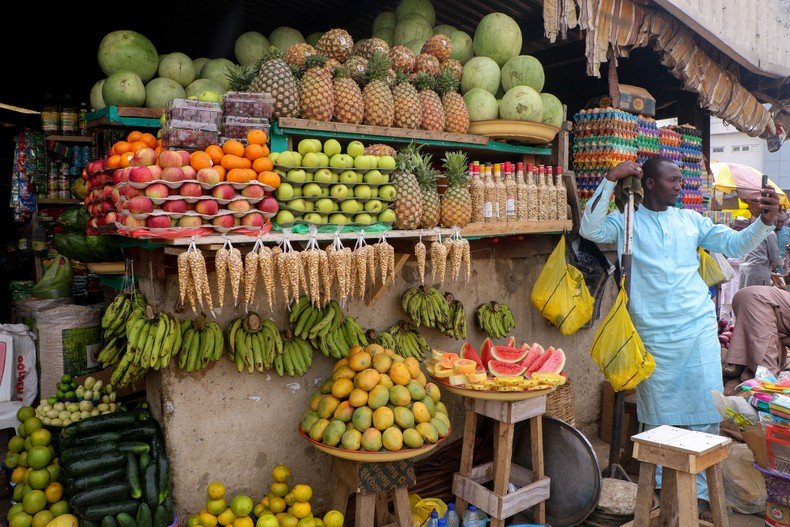
A view from Wuse Bazaar (Fruit Market) in Abuja, Nigeria on February 18, 2024. [Getty Images]

The export gains come against a broader continental challenge highlighted by the World Bank. In a recent report on food security and logistics in Africa, the lender warned that the continent remains heavily dependent on a narrow range of staple foods, namely cassava, rice, maize, and wheat, which together account for 45 percent of caloric intake across Africa.

According to the report, Africa imports more than 30 million tonnes of maize, over 35 million tonnes of rice, and about 60 million tonnes of wheat annually, mainly from Europe, South Asia, and other regions.

“Just four key commodities account for 45 percent of caloric intake across Africa,” the World Bank noted, adding that transport and logistics play a decisive role in food availability and affordability.

Once on the continent, imported staples face delays linked to inadequate port infrastructure, inefficient logistics, and long inland journeys. On average, food travels about 4,000 kilometres over 23 days in Africa, about four times as far as in Europe, increasing the risk of spoilage and higher costs. Weak road networks, congested borders, and poor rural connectivity further compound the problem.

As the country celebrates record non-oil export earnings, policymakers face the parallel challenge of strengthening logistics, boosting local food production, and ensuring that trade gains translate into improved food security at home.


Source link

Previous Post

Regtech Adoption Rises in Sub-Saharan Africa Amid AI Uptake, Regional Integration, and New Regulations

Next Post

Tailings Standard Highlights Value Of Planning For Mine Closure

Next Post
Tailings Standard Highlights Value Of Planning For Mine Closure

Tailings Standard Highlights Value Of Planning For Mine Closure

Leave a Reply Cancel reply

Your email address will not be published. Required fields are marked *

POPULAR NEWS

  • Mahama attends Liberia’s 178th independence anniversary

    Mahama attends Liberia’s 178th independence anniversary

    0 shares
    Share 0 Tweet 0
  • Ghana to build three oil refineries, five petrochemical plants in energy sector overhaul

    0 shares
    Share 0 Tweet 0
  • The world’s top 10 most valuable car brands in 2025

    0 shares
    Share 0 Tweet 0
  • Top 10 African countries with the highest GDP per capita in 2025

    0 shares
    Share 0 Tweet 0
  • Global ranking of Top 5 smartphone brands in Q3, 2024

    0 shares
    Share 0 Tweet 0

Get strategic intelligence you won’t find anywhere else. Subscribe to the Limitless Beliefs Newsletter for monthly insights on overlooked business opportunities across Africa.

Subscription Form

© 2026 LBNN – All rights reserved.

Privacy Policy | About Us | Contact

Tiktok Youtube Telegram Instagram Linkedin X-twitter
No Result
View All Result
  • Home
  • Business
  • Politics
  • Markets
  • Crypto
  • Economics
    • Manufacturing
    • Real Estate
    • Infrastructure
  • Finance
  • Energy
  • Creator Economy
  • Wealth Management
  • Taxes
  • Telecoms
  • Military & Defense
  • Careers
  • Technology
  • Artificial Intelligence
  • Investigative journalism
  • Art & Culture
  • LBNN Blueprints
  • Quizzes
    • Enneagram quiz
  • Fashion Intelligence

© 2026 JNews - Premium WordPress news & magazine theme by Jegtheme.