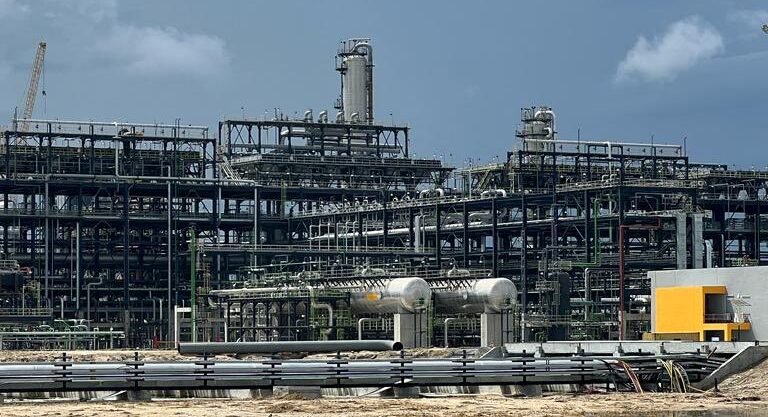
Nigeria’s mega Dangote refinery has restored its crude distillation unit, CDU, to full capacity of 650,000 bdp after a maintenance shutdown, as it prepares to restart its fuel producing residual fluid catalytic cracker (RFCC).
Its Chief Executive David Bird said the CDU is now running at its full nameplate capacity, while the RFCC will begin “performance test runs” next week ahead of full operations.


The refinery, located in Lagos, is designed to process 650,000 barrels of crude oil per day, making it the largest single train refinery in Africa. It is expected to reduce Nigeria’s reliance on imported refined petroleum products.
A source at the refinery told Argus Media that the CDU received 170,000 barrels of crude, followed by 450,000 barrels and 537,000 barrels in subsequent deliveries as operations stabilised.
The chief executive officer David Birdstated that the CDU was “operating steadily at the full nameplate capacity of 650,000 bdp”.
Meanwhile, an internal company report previously seen by Argus showed the highest throughput achieved earlier was 570,000 bdp.
The refinery’s CDU had been offline for around two weeks for maintenance works. During that period, Dangote imported intermediate products to sustain supply to customers.
Bird’s reference to the 650,000 bdp nameplate capacity indicates that planned capacity expansion work aimed at raising output to 700,000 bdp has not yet been completed.
Why Dangote’s CDU restart matters for fuel supply
The CDU is the primary refining unit responsible for separating crude oil into components such as naphtha, kerosene and gasoil. These feed downstream processing units that produce petrol, diesel and aviation fuel.
Operating at full CDU capacity improves feedstock flow across the refinery and supports higher refined product output. Earlier throughput levels of the petrochemical plant has been below installed capacity, which in itself limited total refinery output.
Dangote refinery, which began operation in 2023, could supply about 70 million litres of petrol at full capacity, virtually meeting the domestic demands of Africa’s most populous country.
What to expect from the RFCC test runs
Meanwhile, the RFCC, which has been offline since December, is scheduled to begin “performance test runs” next week, according to the company’s CEO.
The unit converts heavier residual fractions into higher value products, particularly petrol. Its restart is necessary to increase the refinery’s gasoline production volumes.
On the other hand, other units grouped as the “motor spirit block” including the naphtha hydrotreater, isomerisation unit and catalytic reformer were running but had not reached full capacity following earlier maintenance, according to an industry source.
However, Dangote told Argus that “full restoration and optimisation” of the motor spirit block had been achieved.
The phased stabilisation of the CDU and RFCC remains central to the refinery’s plan to reach consistent full operations.