With more than 250 works by over 50 artists, Tate Modern’s Nigerian Modernism exhibition in London explores the dynamic evolution of modern art in Nigeria over 65 years. This enormous showcase could be better described as an experience than an exhibition.
Spanning eight rooms, it traces Nigerian history and artistic evolution, starting in the years leading up to the country’s independence, through the volatility of civil war and rebirth up to the turn of the 21st century and the dawn of a new era. The story is told not with words but through paint and charcoal, wood and ceramic, with each piece of art a relic of Nigeria’s lived history and the long shadow it casts. From the 1920s to the 1990s, the artists’ works shift in style and medium, but their pursuit of freedom is a constant and a common thread.
The exhibition begins with a series of pre-independence oil paintings that display features of the European-style art education that its artists received. Aina Onabulu’s 1922 Sisi Nurse depicts philanthropist and women’s rights activist Charlotte Olajumoke Obasa in a style that is reminiscent of Art Deco.
As the decades progress, you see the emergence of vernacular styles – Akinola Lasekan’s 1958 Iya Agba portrays an elderly Yoruba woman in traditional dress and headwear, a subject which is at odds with the formal, Western portraiture style.
Away from canvases and acrylics, the skill and individuality of early twentieth century Nigerian artists shines through the most in the intricate and beautiful wood carvings, ranging in size from millimetres – Justus D Akeredolu’s 1930s Thorn Carvings – to metres – Olowe of Ise’s 1910-1914 pair of wooden door panels and lintel, which depicts the king of Ikere and his wife receiving a British officer in court.
An entire room is dedicated to the genius of internationally renowned sculptor Ben Enwonwu, with a floor-to-ceiling image of him creating his famous sculpture of Queen Elizabeth II. Enwonwu was the first African modernist to gain international recognition for his paintings and sculptures, and his works showcase a paradox of modernist art forms rooted in Nigeria’s cultural past, externalising the cultural struggles he experienced throughout his life. Some oil paintings on display, such as the 1957 Fulani Girl and 1948 Still Life, depict symbols of heritage such as weaving and masks in the Cubist style, a marriage of Nigerian tradition and global modernity.
Enwonwu’s 1974 work Tutu, depicting a young Yoruba woman of royal lineage, is one of three portraits of her produced in the space of a year, and is a joy to behold. One of the three sold for £1.2m ($1.6m) at a London auction in 2018.
Ladi Kiwali, credited with transforming traditional Nigerian pottery, is the first prominent female artist to be showcased. Despite their age, her tactile creations are iridescent in the light of the gallery, and draw on traditional folklore with depictions of animals and shapes.
Art at the dawn of independence
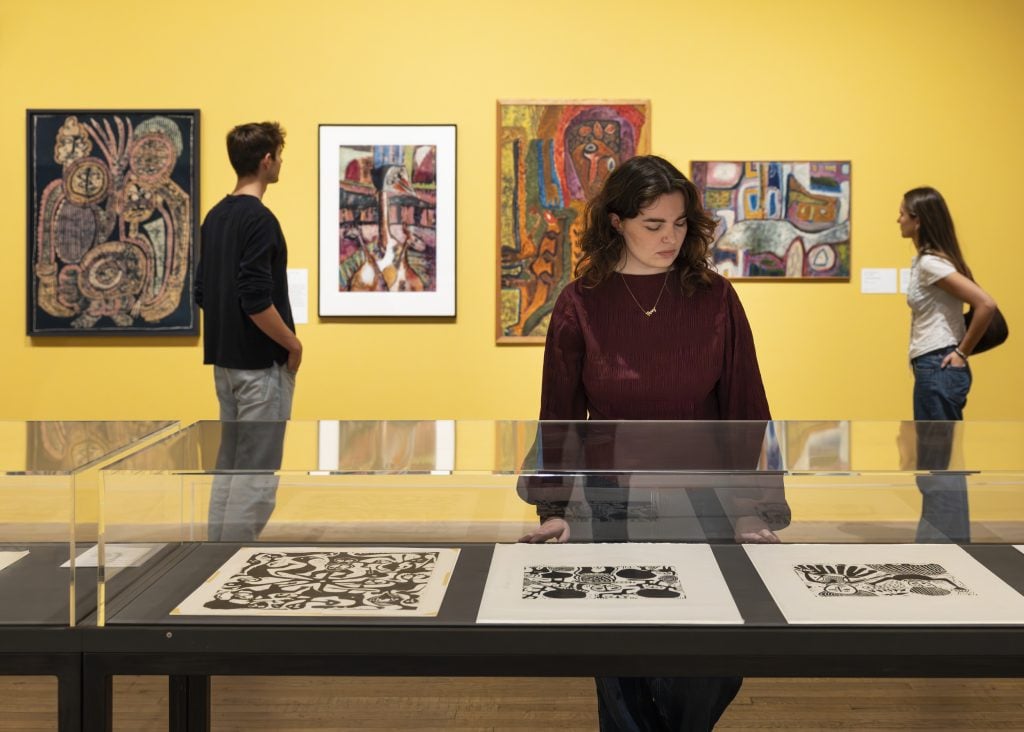
The influence of Nigerian independence on art is most evident in the array of styles demonstrated by the Zaria Art Society, founded in the city of that name, and their rejection of the Eurocentric art curriculum two years prior to Nigeria’s gaining of independence. Here, brightly coloured oil paintings celebrate looming freedom in an array of styles and subjects. Demas Nwoko’s 1960 painting Nigeria in 1959 heralds the end of an era with its depiction of fatigued white colonial officers with Nigerian soldiers looming large in the background. Compared to the rigid formal portraits earlier in the exhibition, such as those by Lasekan and Onabulu only a few years earlier, the contrast in mood and sense of possibility could not be more striking.
Whorls of colours and shapes make up the Salon Hang that once adorned the walls of the Mbari Artists and Writers Club, a vital hub for Nigeria’s literary and artistic talent following independence. It includes woodcuts, etchings and prints. At first it threatens to overwhelm the viewer, but its vast cultural impact and reflection of artistic freedom following independence is better understood when each piece is first considered in turn.
The impact of independence on ordinary people was revealed in the increased accessibility of art education for all Nigerians, which heralded a new generation of artists. Erhabor Emokpae grew up among the Guild of Carvers in Benin City and he adapted traditional Edo-Benin carvings in his wooden sculptures, later becoming a member of the Society of Nigerian Artists and of the Nigeria Arts Council. His 1963 oil painting Struggle between Life and Death speaks to “both being and nothingness” – a sentiment that feels especially poignant as it was painted when Nigeria was in limbo between colonial rule and the reality of independence.
JD Okhai Ojeikere’s 1971-1975 photograph series Hairstyles is a landmark feature here. The original project comprised almost 1000 images celebrating Nigerian hair design. Ojeikere recognised hair styling as a Nigerian art form in its own right, and the eight photographs on show at the exhibition depict hairstyles that became fashionable during the Nigerian independence period, including the braided “suku” and the tall “onile gogoro” or skyscraper.
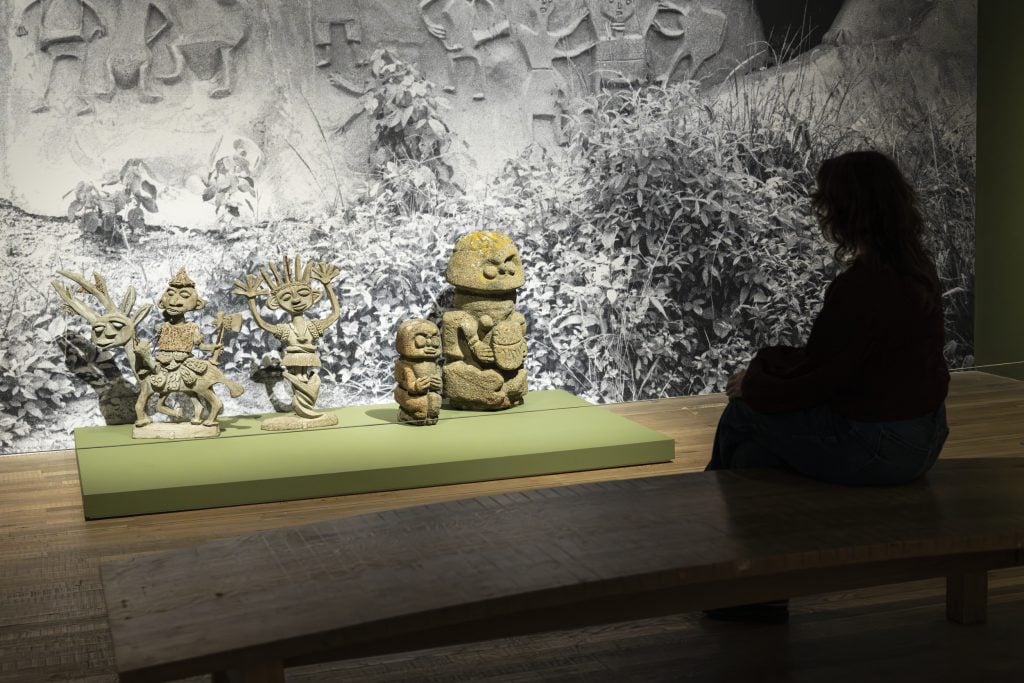
Dominating the walls of the next room are floor-to-ceiling textiles and sculptures depicting Yoruba gods and goddesses that were created by members of the Sacred Art Movement, born in the 1950s to celebrate the healing properties of nature. In muted blues and greens, they are a stark contrast to the Osogbo School, a colourful contemporary art movement that evokes inspiration and expression.
Yet the primary subjects of both these artistic schools are the same, and through several rooms their celebration of Yoruba traditions and legends is clear. Rufus Ogundele’s 1965 oil painting Sacrifice to Ogun, God of Thunder celebrates Yoruba deities in an abstract riot of colour. Twins Seven-Seven’s fantastical 1964 ink and gouache creation Devil’s Dog depicts Esu, a mischievous trickster from Yoruba legend.
The impact of the Nigerian 1967-1990 civil war on art and artists plays a curiously small part in the exhibition, with only one room exploring how the Nsukka School of art grew out of its aftermath. Compared to the vibrancy and jollity of previous rooms, the paintings and prints on display here are suggestive of devastation and loss in their simplicity and mutedness. Oboira Udechukwu’s haunting and otherworldly 1977 oil painting Beggar and Child and his 1976 ink drawing Mourners are sobering depictions of the effect of such tragic loss of life on the nation.
Journey through the soul of a nation
At its core, the exhibition asks what it means to belong, and how nationhood is imagined and expressed, and this is best shown in the final exhibits.
El Anatsui’s hardwood sculpture Leopard’s Paw-Prints and Other Stories (1991) has indigenous graphic languages carved into it with a chainsaw, a tool that was chosen as a metaphor for the violence of slavery. Uzo Egonu’s 1968 oil painting Women in Grief is incongruous in its colourful description of conflict and suffering. His The Stateless People (1981) is a bold metaphor for the alienation experienced by artists who are forced to leave their homeland – as Egonu himself was – an experience he described as being “symbolically stateless”.
Across decades, mediums, and movements, Nigerian Modernism invites viewers on a journey through the soul of a nation. In 250 carefully chosen art pieces, it reveals how Nigerian artists have wrestled with identity, tradition, modernity, and freedom and transformed personal and national histories into visual form.
From the intimate intricacies of wood carvings to the bold experimentation of post-independence paintings, from the colourful celebration of Yoruba heritage to the sobering reflections on civil war and displacement, each room offers a new perspective on what it means to belong.
It is an exhibition that demands time, attention, and openness, yet in return offers a profound, visceral insight into Nigeria’s modernist imagination and an intimate glimpse into the birth of a nation – a vivid reminder that art doesn’t only observe history, it helps shape it, too. n
- Nigerian Modernism is at London’s Tate Modern from 8 October 2025 to 10 May 2026.