

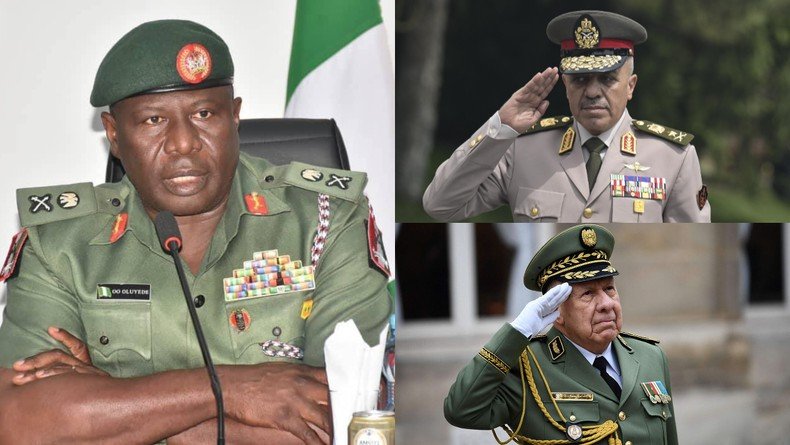
Africa’s largest economies are increasingly investing in advanced military aviation as regional security threats intensify and global defence partnerships deepen.
With Egypt and Algeria expanding their fleets, Nigeria is now pushing to upgrade its own air capabilities.
Chief of the Air Staff, Air Marshal Sunday Kelvin Aneke, said the platforms; 24 M-346 fighter ground attack aircraft, 12 AH-1Z Viper attack helicopters and 10 AW-109 Trekker helicopters; form part of a broader strategy to strengthen operational effectiveness across Nigeria’s security theatres.
The update comes seven months after the Nigerian Air Force (NAF) disclosed plans to acquire 49 aircraft by the end of 2026 during the July 17, 2025 Aircraft Engineering Conference in Abuja.
At the time, officials said the expansion would bolster air power in the fight against insurgency and internal security threats.
Aneke said strategic engagements with the United States, Italy and Türkiye were progressing and expressed confidence that deliveries would materialise within the projected timeline.
“We salute President Tinubu for his unwavering support to national security, as demonstrated by his bilateral engagement with the Government of the Republic of Türkiye for defence equipment,” Aneke said during the inauguration of facilities at NAF Base Kaduna.

Africa’s Air Power Divide
Nigeria’s fleet expansion unfolds amid broader air force upgrades across the continent, where military aviation capability increasingly defines strategic influence.
Egypt remains Africa’s most powerful air force by scale, operating more than 1,000 aircraft, including F-16s, Rafale jets and MiG-29 platforms, according to defence industry estimates.
Algeria, one of the continent’s highest military spenders, operates advanced Sukhoi Su-30 fighter jets and has deepened defence cooperation with Russia in recent years, strengthening both its strike and air defence systems.
Various defence rankings consistently place Nigeria third in sub-Saharan Africa by overall air capability, behind Egypt and Algeria, though with a significantly smaller fleet size and lower defence expenditure compared to the North African powers.
Unlike Cairo and Algiers, whose fleets are structured for conventional deterrence and regional projection, Nigeria’s air force has historically focused on counter-insurgency, anti-banditry operations and internal security missions.
Defence analysts say the planned acquisition of M-346 jets; commonly used for advanced training and light combat roles; signals a push toward improved strike precision and pilot development rather than immediate parity with North Africa’s heavyweight fleets.
From Procurement to Readiness
Alongside hardware acquisition, the Air Force is investing in infrastructure and pilot training. Aneke inaugurated new student pilot accommodation in Kaduna, describing the facilities as essential to preparing crews for advanced platforms.
“My mission here is not just about buildings but about fulfilling my command philosophy, to enhance and sustain a highly motivated, professional and mission-ready force,” he said.
Separately, Chief of Defence Staff General Olufemi Oluyede urged troops in Bayelsa State to maintain professionalism while protecting oil and gas infrastructure, underscoring the economic stakes of national security.
Analysts caution that aircraft purchases alone do not guarantee dominance, pointing instead to maintenance, logistics and pilot readiness.
If deliveries proceed in 2026, the upgrade would mark one of West Africa’s most significant air expansions in recent years, though the gap with Egypt and Algeria would remain wide.



