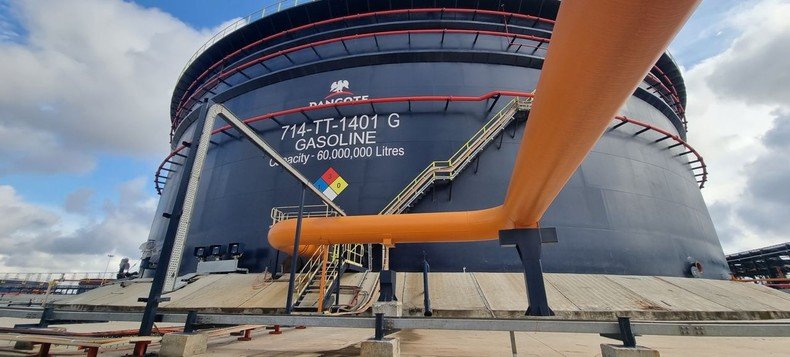
Nigeria has suspended the issuance of gasoline import licenses, a move that strengthens the position of billionaire Aliko Dangote, owner of Africa’s largest petroleum refinery, who has long argued that fuel imports are no longer necessary.
Data from the Nigerian Midstream and Downstream Petroleum Regulatory Authority (NMDPRA) shows that nearly all the gasoline supplied in Nigeria in February came from the Dangote refinery.
Oil marketing companies, including a unit of TotalEnergies SE, Conoil Plc and MRS Nigeria Plc, which together accounted for about 25% of the country’s gasoline imports in January, have now had their import licenses suspended.
Under the new policy, gasoline import permits will only be issued when local production cannot meet demand. According to NMDPRA spokesperson George Ene-Ita, that situation does not currently exist.


Import License Dispute
The development marks a turning point in a battle Dangote had previously taken to court. The billionaire had filed a lawsuit against the regulator for granting import permits to NNPC Ltd and several private oil firms, including AYM Shafa Ltd, A.A. Rano Ltd, T. Time Petroleum Ltd, 2015 Petroleum Ltd and Matrix Petroleum Services Ltd, arguing that such approvals violated regulations and undermined Nigeria’s growing local refining capacity.
The refinery also demanded 100 billion naira ($66 million) in damages, claiming authorities continued to issue import licenses for diesel and aviation fuel despite the available domestic supply. Dangote later withdrew the case after relations with the government improved.
His refinery, which can process 650,000 barrels of crude per day, is currently operating at about 78% capacity. Last month, the facility supplied roughly 64% of Nigeria’s gasoline demand, leaving a gap of around 20 million litres per day that was covered using previously imported stock.
Dangote, however, is not stopping there. The Dangote Group recently signed two agreements worth $750 million with China’s XCMG and India’s Engineers India Ltd (EIL) to expand its refinery and petrochemical operations.
Once completed, the investment is expected to boost the refinery’s capacity to about 1.4 million barrels per day, a move that could reshape the country’s energy industry for decades to come.