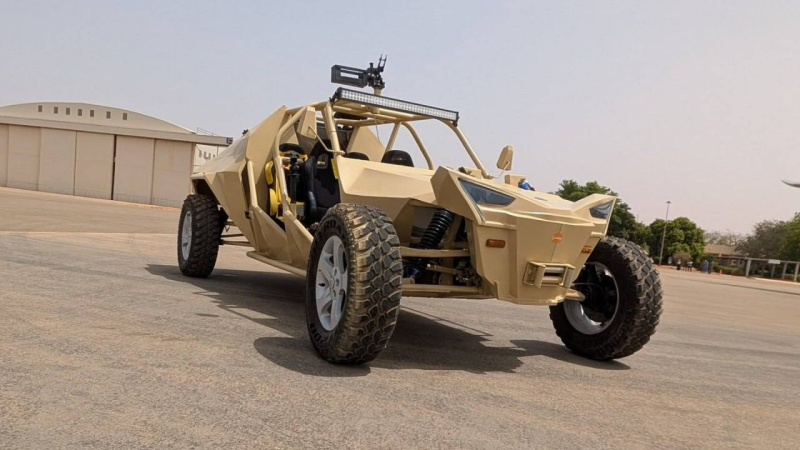
In May 2025, the Republic of Niger achieved a significant advancement in its defense and industrial sectors with the unveiling of the Tamgak Wangari, its first fully domestically produced tactical vehicle. This military all-terrain buggy, designed and constructed by Nigerien engineers, was introduced to the public at Military Base 101 in Niamey.
The ceremony, attended by the Chief of Staff of the Nigerien Armed Forces (FAN) and prominent local industry leaders, underscored the vehicle’s importance as a symbol of national pride and innovation. Developed by Guedesign Automotive, a Nigerien firm, the Tamgak Wangari reflects the country’s commitment to self-sufficiency and its resolve to address the Sahel region’s unique security challenges through homegrown solutions.
This milestone follows closely on the heels of a similar achievement in neighbouring Burkina Faso, where domestically manufactured light-armoured vehicles were showcased just days prior, highlighting a regional trend toward strengthening local defence capabilities. The Tamgak Wangari emerged from years of meticulous field research and engineering by Guedesign Automotive’s dedicated team. Crafted to endure the Sahel’s demanding conditions—extreme heat, shifting sands, and rugged landscapes—the vehicle combines high mobility with structural durability.

Its buggy-style design enables it to traverse challenging terrain effortlessly, while its robust construction ensures reliability in harsh environments. A key feature is its practicality: designed for austere settings with limited infrastructure, the Tamgak Wangari can be maintained without sophisticated facilities, making it well-suited for remote operations. The vehicle’s name carries profound significance—“Tamgak” evokes the strength of Niger’s Aïr Mountains, while “Wangari” honors the struggle and ingenuity of local innovation. Beyond its military utility, it stands as a powerful emblem of Niger’s sovereignty and determination.
The unveiling at Military Base 101 marked a moment of national pride, with military and industry leaders celebrating the Tamgak Wangari as a step toward reducing reliance on foreign defence imports. Tailored to the Nigerien Armed Forces’ operational needs, the vehicle addresses the Sahel’s specific challenges, from scorching temperatures to unpredictable terrain. This grassroots initiative distinguishes Niger in a region where many militaries depend heavily on external suppliers.
Niger’s progress mirrors a growing trend across the Sahel, where nations are increasingly developing localized solutions to enhance their defense capabilities. Just days before Tamgak Wangari’s debut, Burkina Faso showcased its light-armoured vehicles at the Synergy of Safety, Security and Defence (SYSDEF) exhibition in Ouagadougou, held from May 8 to 10. Adapted from pickup trucks, these vehicles feature reinforced armour, protective turrets, and tactical upgrades to bolster troop mobility and safety in volatile areas. Burkina Faso has also introduced a mobile military hospital and expanded equipment procurement from partners such as Egypt, Turkey, and China. Together, these efforts by Niger and Burkina Faso illustrate a regional commitment to building defence industries capable of tackling asymmetric warfare and persistent instability.
The Tamgak Wangari supports the objectives of the Alliance of Sahel States (AES), comprising Mali, Burkina Faso, and Niger, which prioritizes self-reliance amid strained relations with traditional Western allies. By investing in domestically produced military vehicles, these countries aim to create equipment precisely suited to their needs, whether navigating expansive deserts or countering cross-border threats. Burkina Faso, for example, is advancing local production and retrofitting through technical institutions and private workshops, paralleling Niger’s approach. This collective shift toward indigenous innovation suggests a future where the Sahel depends less on imported solutions and more on its resourcefulness.
For Niger, the Tamgak Wangari represents both a practical asset and a symbolic triumph. Its design emphasises mobility, resilience, and ease of maintenance, making it invaluable for operations in the Sahel’s unforgiving terrain. Yet its significance extends further. The vehicle showcases the ingenuity of Nigerien engineers and technicians, demonstrating their ability to meet national demands under challenging circumstances. Officials view it as a foundation for future defence initiatives and industrial projects, with the potential to generate employment and strengthen infrastructure. In a region historically reliant on external support, this move toward autonomy signals Niger’s broader aspirations.
The Tamgak Wangari’s launch, alongside Burkina Faso’s recent advancements, paints a picture of a Sahel region determined to shape its own security and industrial destiny. Burkina Faso’s armored vehicles, designed for high-risk zones, complement Niger’s all-terrain buggy, reflecting shared goals among AES members. Confronted by insurgencies, smuggling, and instability, these nations are crafting flexible, locally tailored responses. By producing their military hardware, they mitigate the risks of foreign supply chain dependencies and assert greater control over their defence strategies.