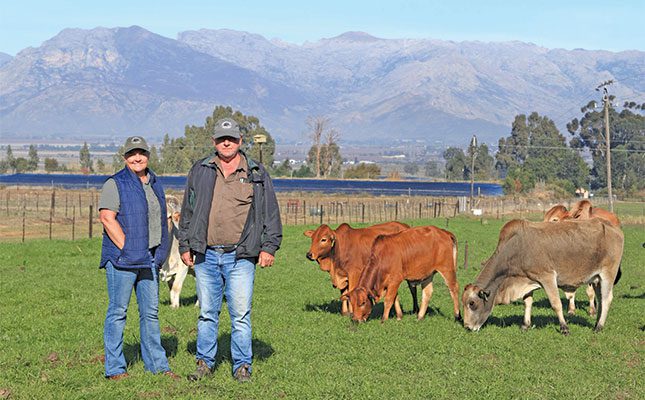
The Olifantsberg Boran stud may only have been established three years ago, but it’s already showing promise of becoming a name to watch in the industry. Farm managers Johan Geldenhuys and Ruanda Brink spoke to Glenneis Kriel about their breeding strategy, and why they believe the Boran is the breed of the future.


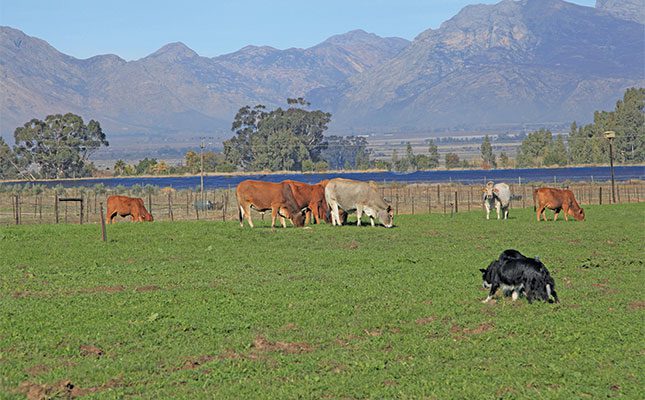
Photo: Glenneis Kriel
Olive Farm, located on the slopes of Olifantsberg in the Breede River Valley, Western Cape, is primarily a lifestyle farm spanning 46ha, of which 12ha are planted to olive trees.
Three years ago, farm co-owners Philip Nel and Johan Geldenhuys (who also manages the operation) decided to venture into Boran cattle production to diversify the enterprise, add value to land not planted to olive trees, and enhance the farm’s overall sustainability
Boran production is relatively limited in the Western Cape, with most breeders centred in the northern parts of South Africa.
In the Olifantsberg region, livestock are typically used to diversify wine and fruit farming, with cattle breeds like the Sussex and Angus being the most common.
However, after some careful research, Nel and Geldenhuys decided to rather venture into Boran production.
“The deciding factor for us was Lizette Basson’s experience with the breed,” says Geldenhuys. “She used to farm in Fauresmith in the Free State, but has since moved to Australia where she established a Boran stud. She played a pivotal role in shaping the South African Boran breed.”
He adds that Basson is the sister of Ruanda Brink, who manages Olive Farm alongside him.
Nel and Geldenhuys were specifically drawn to the Boran’s adaptability, efficient feed-to-meat conversion ratio, fertility, calm temperament, and disease and tick resistance. All of these traits aligned well with their extensive, low-input farming philosophy.
“We wanted a breed that could thrive on the veld with minimal intervention, and the Boran stood out in that regard,” says Geldenhuys.
Brink adds that one of the things that impressed her most was the breed’s gentle nature.
“The docility of the bulls in what used to be my sister’s Adelson Boran stud, even with small children playing around them, made a huge impression on me,” she recalls.
The docility, however, depends largely on how the animals are managed. Despite their calm temperament, Boran cattle have a strong herd instinct and will work together to defend themselves against threats, such as predators or stock thieves.
“They have a powerful kick and won’t take nonsense from any threat,” says Geldenhuys, with a grin.
Starting a stud with the potential to make an impact on the industry is expensive, especially when working with a breed that’s already in high demand, such as the Boran. “Good genetics cost good money,” explains Geldenhuys.
To establish a solid genetic foundation, Nel and Geldenhuys purchased a package of seven Boran cows with their calves from the Roeleveld Boran stud in Riversdale, Southern Cape, for about R180 000.
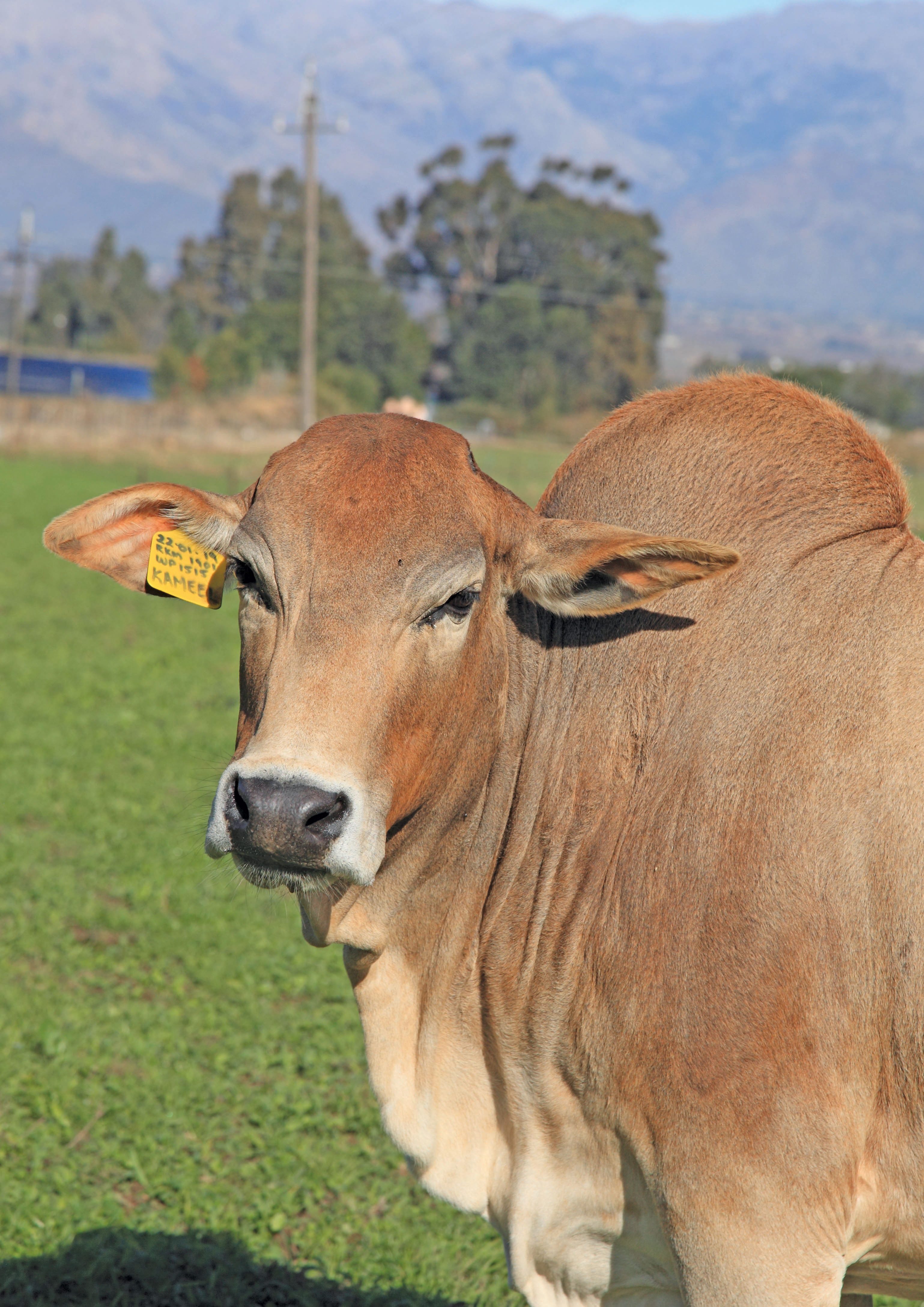
“We decided to buy the animals from Leendert Roeleveld, the owner of the Roeleveld stud, because Basson helped him to establish his stud. We are also in the same province and share similar production conditions. We receive about 750mm of rain per year, and I believe their rainfall is slightly higher,” he says.
From there, Nel and Geldenhuys began using artificial insemination (AI) to fast-track genetic progress and expand their stud.
“We were fortunate to get hold of old straws that Basson could not take to Australia because of import restrictions. We paid less than half the price of today’s top genetics, which often cost from R15 000 upwards per straw,” says Geldenhuys.
The straws, stored at Embryo Plus for safekeeping, included semen from five bulls from Adelson Boran that were considered among the best in the industry at the time, namely Koning (TLM05-526), Forrester (FE 96 075), Keiser (EG 08 001), Beertjie (EG 06 008), and Poena (B05 074).
So far, the stud has grown to 17 cows and five bulls. Last year, they sold five bulls to commercial producers for crossbreeding at a competitive price of R25 000 each.
“Using Boran bulls in crossbreeding programmes offer numerous advantages, including improved growth rates, carcass yields, and meat quality in the offspring, depending on the breed they are crossed with,” says Geldenhuys.
He adds that they haven’t yet realised the full commercial value of their animals, as the Boran breed is still relatively unknown in the Western Cape. “We’re confident this will change as more producers become aware of the breed’s benefits,” he says.
Their aim is to build the stud to about 30 animals.
“With limited land, we choose to focus on quality over quantity. A smaller stud lets us select more carefully and build a stronger genetic foundation for superior animals,” says Geldenhuys.
While AI is currently used, Geldenhuys says they plan to invest in a top bull once the herd reaches its target size in order to complement the AI programme. The bull will then be replaced every two years to introduce fresh blood into the stud.
Geldenhuys admits that their conception rate with AI hasn’t been as high as they had hoped. Cows are induced into oestrus via a controlled internal drug-release programme.
Geldenhuys attributes their AI challenges to a combination of an inadequate livestock handling facility and the absence of a defined breeding season, as cows are inseminated two months after calving.
They have since looked at various pen designs, and consulted with their veterinarian and other farmers to build a pen that will make it much easier to create a set-up that allows for more effective animal handling.
The new pen includes a curved race leading to the handling station, which prevents the animals from seeing what is ahead of them and in effect reduces stress. It also features two exits – one for loading animals onto trucks, and the other onto trailers.
Pastures
The cattle are raised in 13 rotational grazing camps, each measuring 1ha in size, planted to perennial ryegrass, chicory, and lucerne under irrigation. Geldenhuys says the cattle’s movement is guided by observation of the animals and pastures, such as the volume of pasture eaten and the amount of regrowth. For instance, lucerne should be in the four-leaf stage before it is grazed.
The same applies to irrigation. Geldenhuys explains that he touches the soil and looks at it to determine if irrigation is needed. He says irrigation is primarily used in summer, as their farm is in a winter rainfall region.
The cattle also receive energy and protein licks throughout the year, as well as a multimineral lick once a year, to prevent potential deficiencies.
Their goal is to be self-sufficient, but they had to buy feed over the past year because of dry conditions that negatively impacted on-farm feed availability.
Geldenhuys says Boran cattle are non-selective grazers, which is another factor he likes about them; they eat everything that comes in their way. He therefore moves them to some of the fallow lands around the farm dams to ‘help’ with the cleaning of reeds.
Breed association
Nel and Geldenhuys say they are pleasantly surprised by the high standards set by the Boran Cattle Breeders’ Society of South Africa.
“Having a stud requires a lot of administration, with heifers screened once a year and bulls every two years for inclusion in a stud.
“Animals that do not comply with the strict breed standards or who have deformities, even slight ones, are rejected and may not be sold for commercial use. They nevertheless still make good steak when properly processed,” says Geldenhuys.
DNA samples are taken of each registered animal for authenticity and traceability.
“These high standards help to ensure that buyers get the quality they deserve when they invest in a Boran animal,” adds Geldenhuys.
Email Johan Geldenhuys at [email protected], and Ruanda Brink at [email protected].