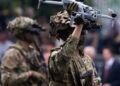
The Georgia Army National Guard has launched a new section focused on electromagnetic warfare (EW) in Forest Park.
The 111th EW Company will operate under the 221st Intelligence and Electronic Warfare (IEW) Battalion, which oversees data-driven tasks in support of warfighters on the battlefield.
The formation will be responsible for the tracking, recognition, and positioning of signals of interest, with work to be coordinated with combatant commanders.
The @GeorgiaGuard made history with the activation of the 111th Electromagnetic Warfare Company, the first unit of its kind in the @USArmy. This marks a significant step in modernizing the Army’s capabilities within a critical domain. https://t.co/e0OYXdGLKl
— National Guard (@USNationalGuard) June 10, 2025
It will have division commanders and four platoons of EW teams, with a total workforce of 80 troops.
In August, the unit will conduct its first field exercise in the Chattahoochee National Forest, with drills focused on electromagnetic support, static and moving signals, and helicopter training in partnership with the Georgia Guard’s 78th Aviation Troop Command.
From ‘Legacy’ Formation
The 111th EW Company traces its lineage to the 1st Battalion, 111th Signal Battalion, which is the sole Georgia Army National Guard unit mobilized during the Berlin Crisis in the 1960s and the first mobilized since the Korean War.
Its parent command, the 221st IEW Battalion, has seen action in the Middle East, Kosovo, and Cuba, and has supported larger missions involving the US Central Command and US Indo-Pacific Command.
“The legacy of the 221st Intelligence and Electronic Warfare Battalion and the Georgia Guard to lead from the front and provide those critical capabilities to support the warfighter both locally and abroad is going to be driven by Georgia Soldiers,” Georgia Guard Brig. Gen. Theodore Scott III commented.
“As the battlefield continues to evolve, the 221st IEW is ready,” Scott continued. “It’s one of the most deployed units in the state and has been for a number of decades. And so that continues to articulate the relevancy of 221st and now the 111th.”