
Artificial intelligence-powered large language models (LLM) need to be trained on massive datasets to make accurate predictions—but what if researchers don’t have enough of the right type of data?


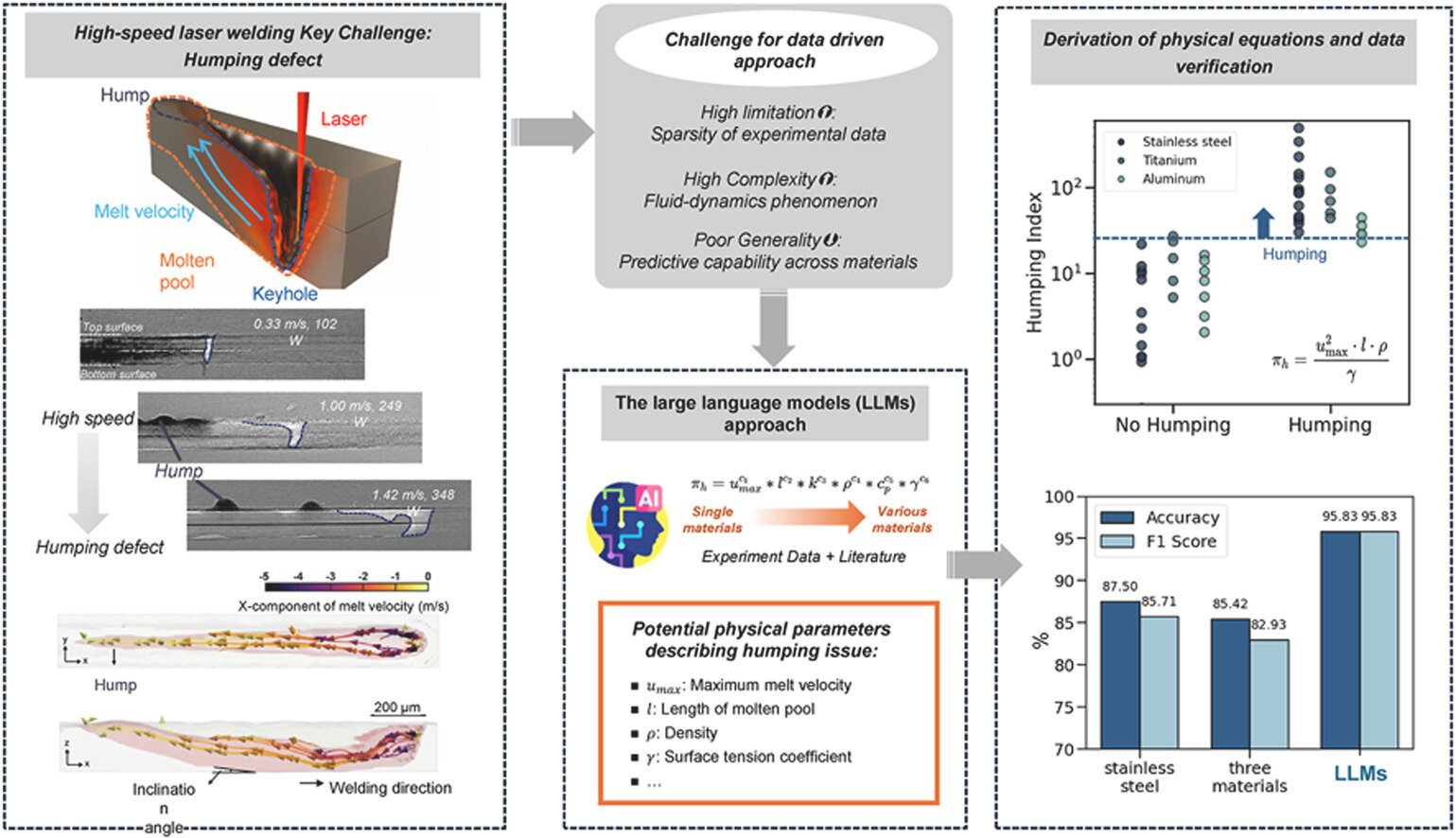
A team at Penn State recently developed an integration framework that uses minimal new experimental data to identify relevant information in existing scientific literature. By combining information from existing research and their own experiments, the LLM-powered framework can derive numeric equations that accurately predict physical phenomena in high-speed laser welding, a manufacturing technique capable of highly precise welds on items like fuel cells in electric vehicles.
Using their new approach, the researchers said they can begin to optimize the welding technique, which typically has a high potential for technical failure. Their research, available online today, will be featured in the October issue of the International Journal of Machine Tools and Manufacture.
According to Zhengxiao Yu, a doctoral candidate studying industrial and manufacturing engineering (IME) and co-author of the paper, traditional methods of developing equations are time consuming for researchers and require tons of existing numeric data. Researchers must either produce more than 1,000 data points from their own experiments, or review and interpret data points from prior studies by other researchers to accurately formulate an equation.
“With our model, we can simply input the literature data and substantially speed up the process,” Yu said.
The numeric equations enable researchers to better understand the connections between various parameters, leading to highly detailed insights into why and when certain physical responses appear during welding.
According to Zen-Hao Lai, a doctoral candidate studying materials science and engineering and co-author of the paper, one of the most prevalent phenomena their LLM can help explain is “humping”—a common defect in laser welding that occurs when metal is welded too quickly. Equations detailing the specific parameters involved in humping errors could help researchers address the problem in future welds.
Using an equation also allows for the team to effectively incorporate data taken from prior experiments when predicting the physical properties of a new weld, even if the physical characteristics of the old welds—like metal type or the speed of the welding system—are not identical.
The challenge is that the data from prior experiments is often only available as text —meaning researchers would have to individually comb through many papers to identify the data and then convert it to the correct format, according to Jingjing Li, professor of IME and of engineering science and mechanics.
“We have enough existing data, but most of it is text-based rather than numeric data and highly experimental, meaning it is difficult to generalize to new welds,” Li explained. “Traditionally, we cannot develop equations without numeric data, but this application of a LLM model allows us to.”
The team used 48 total datasets to develop their framework, five of which came from their own experiments and 43 from existing research. The team used the data from their experiments—including types of metal and frequency of humping—to develop candidate equations representing specific variables and their relationships. Then, the researchers developed a rubric to use as the LLM processed existing scientific literature.
The LLM could identify relevant information, convert the correct data and recommend equations most likely to describe how different physical parameters would influence the quality of a weld, or whether the weld would experience humping.
While the process of selecting an equation is not fully automated by the LLM, Li explained how it is much more efficient and generalizable than previous approaches. Using the framework, 10 equations can be generated in about one minute—much more efficient than the hours of research it took to create one equation with traditional methods. The researchers then score and rank the equations based off the developed rubric, using the equation with the highest score.
“We use the physical parameters of the weld like melt velocity, thermal conductivity and density to determine how the equation is going to be applied,” Li said. “This still requires a lot of domain knowledge from researchers, but could be built upon, and keeps our equations standardized across different materials and physical properties.”
The team plans to continue optimizing their framework, with the goal of effectively applying the LLM across different applications within manufacturing.
“What we are really doing with this work is applying existing LLM models to the manufacturing field in a novel way,” Yu said. “Incorporating this framework could allow us to optimize additive manufacturing, among other manufacturing applications beyond just laser welding.”
More information:
Kyubok Lee et al, Derivation of physical equations for high-speed laser welding using large language models, International Journal of Machine Tools and Manufacture (2025). DOI: 10.1016/j.ijmachtools.2025.104320
Pennsylvania State University
Citation:
Doing a lot with a little: New AI system helps explain laser welding defects (2025, September 22)
retrieved 22 September 2025
from https://techxplore.com/news/2025-09-lot-ai-laser-welding-defects.html
This document is subject to copyright. Apart from any fair dealing for the purpose of private study or research, no
part may be reproduced without the written permission. The content is provided for information purposes only.