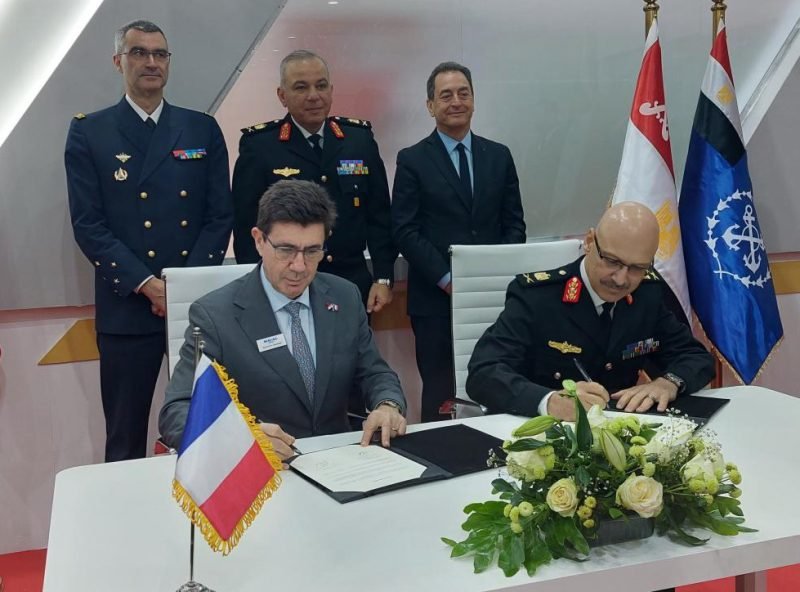
The Egyptian Navy has formally renewed its partnership with Naval Group, signing a five-year contract for the in-service support (ISS) of seven major surface combatants. Finalised in early December, this agreement extends a sustainment framework originally established in 2019 and ensures the operational readiness of Egypt’s modern French-built fleet.
This contract covers a diverse and strategically critical flotilla: the FREMM multi-mission frigate Tahya Misr, the two Mistral-class Landing Helicopter Docks (LHDs) Gamal Abdel Nasser and Anwar El Sadat, and four Gowind 2500 corvettes—El Fateh, Port Said, El Moez, and Al Ismailia. The deal guarantees that the Original Equipment Manufacturer (OEM) retains oversight of maintenance, logistics, and technical upgrades for these complex systems through 2029.
The renewal comes as the Egyptian Navy continues its transition from a coastal defence force to a blue-water navy capable of power projection in the Eastern Mediterranean and the Red Sea. The operational availability of these specific vessels is central to that strategy.
The Tahya Misr, a 6,000-tonne AQUITAINE-class frigate delivered in 2015, serves as a primary anti-submarine warfare (ASW) asset. Originally built for the French Navy as the Normandie, it is equipped with the Herakles multi-function radar and CAPTAS-4 variable depth sonar. Maintaining the acoustic discretion and sensor fidelity of an ASW platform requires rigorous technical oversight, which Naval Group will provide under this ISS framework.
Similarly, the two Mistral-class LHDs, acquired in 2016, represent the core of Egypt’s amphibious and command capabilities. Displacing approximately 21,500 tonnes, these vessels function as helicopter carriers, command centres, and floating hospitals. Their maintenance regime is particularly demanding due to the complexity of their propulsion pods and the high tempo of flight deck operations. Keeping these capital ships at high readiness allows Egypt to maintain a credible deterrent for securing offshore gas interests, such as the Zohr field, and ensuring freedom of navigation through the Suez Canal.
A focal point of the Naval Group-Egypt partnership remains the Gowind corvette programme. While the first-of-class El Fateh was constructed at Naval Group’s Lorient shipyard in France, the subsequent three vessels—Port Said, El Moez, and Al Ismailia—were built locally at the Alexandria Shipyard.
This local construction was facilitated by a comprehensive technology transfer (ToT) arrangement. The new ISS contract reinforces this industrial localisation. By engaging the Alexandria Shipyard and local technicians in the maintenance cycle, the agreement moves beyond simple repairs and fosters a sustainable domestic defence industry. Naval Group notes that teams of engineers and technicians will work directly on the vessels, conducting continuous upgrades to keep combat systems relevant against evolving threats.
The integration of local suppliers is a key component of the new deal. Discussions are currently underway to bring Egyptian component manufacturers into the supply chain for ship maintenance operations. This approach reduces reliance on foreign supply lines for routine consumables and lowers the lifecycle costs of the fleet.
The Role of NVL Egypt
The execution of this contract relies heavily on Naval Group’s local subsidiary, established in Alexandria in 2018. This entity acts as the on-ground interface between the Egyptian Navy’s logistical command and the French technical base.
In modern naval warfare, in-service support encompasses more than dry-docking and hull cleaning. It involves the sustainment of sophisticated software architectures, specifically the SETIS combat management system installed across the FREMM and Gowind platforms. Managing software baselines, cybersecurity patches, and sensor integration requires a permanent, specialised presence. The Alexandria subsidiary ensures that these technical services are delivered rapidly, minimising the downtime associated with sending components back to Europe for servicing.
Strengthening a Decade-Long Strategic Tie
Pierre Eric Pommellet, Chairman and CEO of Naval Group, stated that the company is honoured to extend its cooperation with the Egyptian Navy. He noted that the contract allows the group to continue its support in both the maintenance and modernisation of the fleet.
This renewal marks roughly ten years of close cooperation between Paris and Cairo in the naval domain. The relationship has evolved from a buyer-seller dynamic into a deeper industrial partnership. For Egypt, having the OEM committed to a long-term sustainment plan mitigates the risks associated with operating high-tech Western naval assets. For Naval Group, the contract secures a predictable revenue stream and solidifies its foothold in the Middle East and North Africa (MENA) region, where competition from other European and Asian shipbuilders is intensifying.
The scope of the work will likely include scheduled mid-life updates and obsolescence management, ensuring that vessels delivered nearly a decade ago remain interoperable with newer allied fleets. By securing this five-year horizon, the Egyptian Navy can plan its operational deployments with the assurance that its capital ships will remain mission-capable.