
For decades, narcotics trafficking across North Africa’s maritime frontiers depended on speedboats and a margin of interception risk. That model has evolved. Along Morocco’s Atlantic and Mediterranean seaboards, traffickers have quietly transitioned to unmanned systems designed to evade radar, patrol craft, and conventional border controls. Semi-submersible underwater drones, capable 200 kg of narcotics transporting 200 kg of narcotics, are assessed to have transited the 15-km Strait of Gibraltar beneath surveillance radars, while long-range fixed‑wing and vertical‑takeoff UAVs with wingspans exceeding four metres and endurance approaching seven hours, have conducted aerial deliveries from Moroccan launch zones to isolated Andalusian recovery sites.
This shift is neither experimental nor isolated. Comparable tactics have surfaced across other strategic corridors, including the Red Sea, where a downed unmanned aircraft carrying 50 kg of contraband was recovered near the Egypt–Israel border in March 2025. Together, these incidents point to a deliberate recalibration by organised criminal networks: replacing exposure of speedboat runs with low-signature, high-payload drone operations that exploit technological and coordination gaps across regional security architectures.
What is emerging is not merely a change in transport method, but the construction of a transnational “drone corridor” for narcotics trafficking—one shaped by rapid technology, adaptive TTPs, and lessons drawn from modern conflict environments. The implications for maritime security are significant. Drone-enabled smuggling now represents a persistent, scalable threat that challenges existing surveillance models and exposes critical vulnerabilities in coastal monitoring, interagency coordination, and cross-border enforcement, cementing drone‑enabled narcotics trafficking as one of North Africa’s most persistent maritime insecurity threats.
The Drone Trail: Recent High‑Profile Incidents
A. Underwater Narco‑Drones (July 2022)
In July 2022, Spanish National Police uncovered multiple semi‑submersible “underwater drones” designed to slip beneath radar and carry narcotics across the Strait of Gibraltar. Each craft is GPS‑enabled and internet‑controlled with a payload capacity of up to 200 kg. The 14‑month operation culminated in raids across Cádiz, Málaga, and Barcelona, resulting in eight arrests and the seizure of the submersibles alongside six large aerial drones and traditional contraband (hashish, marijuana, cash)


Note: According to the report, all of the unmanned underwater vehicles (UUVs) were seized on land, specifically in industrial warehouses in Castellar de la Frontera (Cádiz) while still in production (two in the manufacturing phase and one nearly finished). None of them was intercepted while actually operating at sea.
B. Massive VTOL Aerial Drone (July 2021)
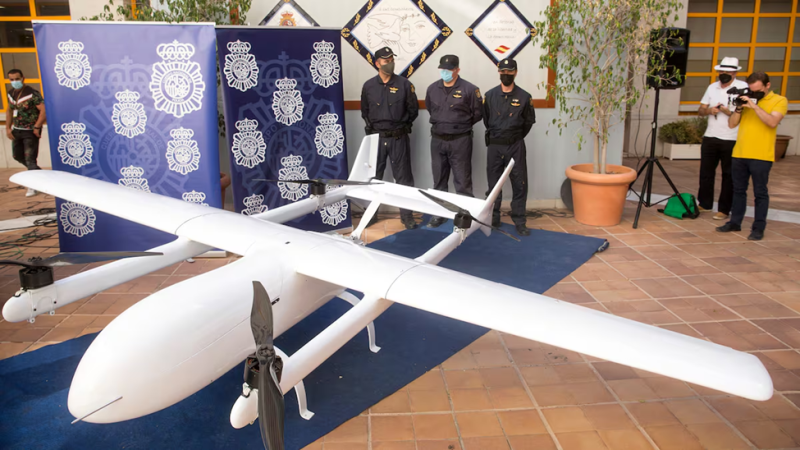
In July 2021, Málaga police displayed a white, tailless UAV with a 4.5 m wingspan, then the largest drone ever seized for narcotrafficking between Spain and Morocco. According to the police report, the seized UAV had the capability of carrying 150 kg of narcotics over seven hours at speeds up to 170 km/h. Manufactured in China, it combined four electric motors for vertical lift with a combustion engine for cruise flight. Police traced its flight path from rural Morocco to a drop zone near Almáchar, Andalusia, and warned of the collision risk such large VTOL craft pose to civilian air traffic.


Note: It is clear that the drone was recovered on the ground during a search of a villa in Almáchar rather than being intercepted in flight. It was seized, along with computer equipment and smuggling tools, while stationary at the suspect’s premises, not caught airborne.
C. Ukrainian‑Built Narco‑Fleet (November 2024)
A joint Spanish operation in November 2024 dismantled a narco‑drone network shuttling hashish from Morocco into southern Spain. Authorities arrested ten suspects and searched six properties along the Costa del Sol and Campo de Gibraltar. The unmanned aircraft trucked in from Ukraine each flew roughly 50 km over the Strait, delivered a 10 kg payload, and returned autonomously for reloads. Investigators estimate the ring had planned to move up to 1,000 kg before the bus


D. Egypt–Israel Border Case (March 2025)
On 25 March 2025, troops of Israel’s Home Front Command downed an unmanned aircraft carrying 50 kg of narcotics launched from Egypt’s side of the Red Sea border. The drone and its cargo were handed over to police for investigation, marking a significant extension of narco‑drone tactics into different areas; Although there are reports of frequent attempts to bring weapons and drugs over the Egyptian border using drones.
E. Algeria–Morocco Cross‑Border Case (May 2025)
In May 2025, Morocco’s Royal Gendarmerie intercepted a drone laden with psychotropic pills (including Captagon) near Bni Drar, close to the Algerian border. One suspect was apprehended beside the downed UAV, while accomplices fled. Moroccan media, citing Assabah, described a sophisticated network “using drones to transport large quantities of psychotropics,” highlighting traffickers’ exploitation of remote, rugged inland launch zones.
F. Morocco–Spain Drone Smuggling Case (November 2025)
In November 2025, Spanish Civil Protection dismantled a trans-Mediterranean drug-smuggling network that employed long-range drones to transport cannabis from northern Morocco into southern Spain. The operation followed the interception of a newly identified aerial smuggling system, whereby UAVs crossed the Mediterranean at night and released drug consignments near Spain’s Costa de la Luz resort areas. According to Spanish authorities, the network successfully moved up to 200 kg of cannabis in a single night, with packages dropped onto Spanish soil and rapidly recovered by ground teams operating under the cover of darkness.
BBC News reported that traffickers used visual markers, such as lights attached to the drug packages and night-vision goggles, to facilitate precise recovery after aerial drops. Spanish Civil Defence released footage showing heavily armed officers raiding a hideout in Alcalá de los Gazules, Cádiz, where large quantities of cannabis were stored. The operation resulted in nine arrests, the seizure of more than 200 kg of cannabis, 320,000 euros in cash, and 18 drug-related items. Authorities assessed the network as highly organised, demonstrating increasing criminal adaptation of UAV technology to bypass maritime patrols and border controls along the western Mediterranean corridor.


Why Drones? Criminal Logic Behind the Shift
Economics:
Up‑front investment: A state‑of‑the‑art UAV can cost between €30,000 and €150,000, depending on its propulsion system and avionics
Payload leverage: These platforms carry 10–200 kg per sortie(trip), meaning even a single successful flight can recoup many times the drone’s purchase price when loaded with high‑value narcotics.
Stealth
Radar evasion: Semi-submersible drones run entirely beneath radar coverage, while low‑flying fixed‑wing and VTOL UAVs can fly at altitudes avoiding most patrol radars. It is necessary to note that the Semi-submersible drone and the VTOL were not caught in action either at sea or in the air.
Unmanned deniability: Without a crew on board, detected drones yield fewer human leads, minimising arrest risk for high‑level facilitators.
Scale & Flexibility
Modular drops: Knowledgeable operators can deploy multiple variants of drones (Quadcopters, Hexacopters, VTOL) in sequential runs, rather than risking one drone.
Rapid turnarounds: Semi -autonomous return capabilities allow a single platform to make repeated crossings with minimal ground support.
Drone Forensics: What Seized Devices Reveal
Analysis of recovered narcotics drones consistently points to a blend of readily available civilian components and bespoke modifications, showcasing traffickers’ technical sophistication:
- Structural materials: Hulls and airframes combine lightweight composite fibreglass and carbon-fibre panels for stealth and buoyancy. Where visible, seams and weld patterns suggest small‑batch custom fabrication rather than mass production.
- Consumer‑grade navigation & control: GPS modules, open‑source flight controllers, and tablet‑based telemetry relays are integrated alongside heavier-duty batteries and signal‑relay antennas, revealing a hybrid approach that leverages low cost with operational reliability.
- Thermal management & shielding: Submersible drones employ rudimentary heat‑dissipation vents, while aerial platforms feature heat‑resistant payload bays tactics designed to reduce infrared signatures during launch and recovery.
Legal & Security Gaps: The Unmanned Blind Spot
There is a lot of jurisdictional ambiguity when it comes to addressing unmanned systems and some proposed solutions.
Proposed Solutions:
- New drone‑tracking protocols: Mandate AIS‑equivalent beacons or remote‑ID for commercial and large‑capacity UAVs/USVs.
- Shared North Africa–EU maritime surveillance treaties: Establish joint patrols, real‑time data sharing, and unified response rules.
- AI‑based anomaly detection: Deploy machine‑learning tools to flag unusual vessel profiles, submersibles or low‑altitude drones in both maritime and air traffic corridors.
The Bigger Picture: Global Parallels & Drone War Influence
Criminal networks across the world have been watching, learning, and leveraging unmanned systems in remarkably similar ways. North Africa’s drone‑enabled narco‑corridors now form part of a rapidly globalising phenomenon.
- Russia–Ukraine war spillover: The conflict has accelerated drone R&D and expanded production of tactical UAVs. As some Ukrainian-built drone models seem to enter the markets, inexpensive, battle‑proven platforms find their way into illicit hands, fueling black‑market availability for traffickers.
- South Africa’s “narco drones”: Already in 2016, South African gangs were deploying UAVs to ferry drugs into Namibia and Mozambique. Reports describe the Hawks’ Anti‑Drone Unit intercepting these machines and even fielding birds of prey alongside IR‑equipped drones to counter them, a testament to both traffickers’ innovation and law enforcement’s adaptation.
- Latin America lead: Colombian cartels pioneered semi‑submersible vessels and fixed‑wing drug drones years ago to bypass coastal patrols. Their successes inspired subsequent narco‑drone tactics.
Other African region:
Southern Africa
- Documented “narco‑drone” use:
Crime syndicates in South Africa have been confirmed to employ small aerial drones both for reconnaissance and for distributing illicit drugs. This isn’t limited to pure “delivery” missions; drones are used to scout border zones and guide ground couriers to drop points. The Commercial Unmanned Aircraft Association of Southern Africa (CUAASA) notes that criminal groups are adapting hobbyist UAVs into “narco drones” in much the same way Colombian traffickers have done. ISS Africa. - Regulatory response:
South African regulators, in partnership with industry groups like CUAASA, are drafting drone‑registration and accreditation frameworks to flag suspicious bulk purchases of hobbyist UAVs and to enable law‑enforcement agencies to track drone imports more effectively. ISS Africa.
West Africa
- High‑tech drone seizures by Nigeria Customs (2025):
In Q1 2025, the Nigeria Customs Service reported intercepting multiple “controlled equipment” shipments, including unregistered drones worth ₦912 billion, alongside pharmaceuticals and other contraband. While the public statement did not detail specific narco‑drone missions, the scale and sophistication of the drones seized may hint at the potential smuggling‑network capabilities beyond traditional concealment methods. Vanguard News. - Lack of publicised drone‑delivery cases:
To date, there are no publicly confirmed incidents in Nigeria, Ghana, or neighbouring states where drones have been explicitly documented dropping narcotics loads across borders. This suggests either that (a) drone use remains nascent and low‑volume in West Africa, or (b) operations are going undetected or underreported by local media and enforcement agencies.
East Africa
- No verified narco‑drone incidents:
Despite extensive searches of Kenyan, Tanzanian and Ugandan press outlets and law‑enforcement releases, there are no publicly documented cases of drones being used to smuggle narcotics in East Africa (2021–2025). - Alternate UAV uses:
- Law‑enforcement surveillance: Kenyan police have deployed drones to locate illicit‑brew dens and arrest drug peddlers, but these missions are counter‑narco operations, not smuggling runs. Kenyans.
- Militant/reconnaissance roles: Islamist insurgents (e.g., al‑Shabaab in Somalia, militants in Mozambique and DRC) have used drones for battlefield surveillance, but again, not for narcotics logistics. ISS Africa.
Conclusion:
Unmanned systems for narcotics smuggling are no experimental novelties; there are reports dating far back on drones used for drug smuggling, however, they have become a persistent, evolving phenomenon that is reshaping North Africa’s maritime security landscape.
From underwater submersibles to long‑endurance VTOL drones, criminal networks are continuously refining their tactics and absorbing lessons from modern drone warfare worldwide. As these actors adopt ever more complex unmanned platforms, authorities face a strong imperative to evolve in turn upgrading technical capabilities, closing legal loopholes, and forging collaborative frameworks across African and European partners. This is not a future threat for Africa: it is unfolding today, one stealthy drone drop at a time, and the only certainty is that without concerted action, the “drone highway” will only grow more entrenched.