
• Business
  • Markets
  • Politics
  • Crypto
  • Finance
  • Intelligence
    • Policy Intelligence
    • Security Intelligence
    • Economic Intelligence
    • Fashion Intelligence
  • Energy
  • Technology
  • Taxes
  • Creator Economy
  • Wealth Management
  • LBNN Blueprints
  • Business
  • Markets
  • Politics
  • Crypto
  • Finance
  • Intelligence
    • Policy Intelligence
    • Security Intelligence
    • Economic Intelligence
    • Fashion Intelligence
  • Energy
  • Technology
  • Taxes
  • Creator Economy
  • Wealth Management
  • LBNN Blueprints

Nanopore technology achieves breakthrough in protein variant detection

Simon Osuji by Simon Osuji
August 1, 2023
in Technology
0
Nanopore technology achieves breakthrough in protein variant detection
0
SHARES
2
VIEWS
Share on FacebookShare on Twitter

Nanopore technology achieves breakthrough in protein variant detection
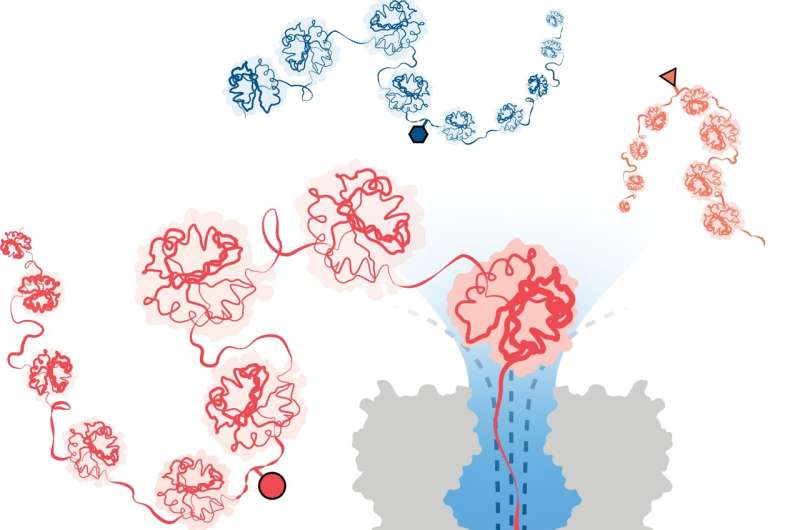
An engineered protein nanopore directed a water flux strong enough to capture, unfold and translocate proteins exceeding 1200 amino acids in length. Modulation of electrical current during protein translocation through the nanopore detected post-translational modifications deep within the proteins (shown as circle, triangle, and hexagon). Image credit: Wei-Hsuan Lan and Yujia Qing. Credit: An engineered protein nanopore directed a water flux strong enough to capture, unfold and translocate proteins exceeding 1200 amino acids in length. Modulation of electrical current during protein translocation through the nanopore detected post-translational modifications deep within the proteins (shown as circle, triangle, and hexagon). Credit: Wei-Hsuan Lan and Yujia Qing.

A team of scientists led by the University of Oxford have achieved a significant breakthrough in detecting modifications on protein structures. The method, published in Nature Nanotechnology, employs innovative nanopore technology to identify structural variations at the single-molecule level, even deep within long protein chains.

Related posts

Dangote Refinery delivers cleaner air, healthier lives with high quality fuel – MD – EnviroNews

Dangote Refinery delivers cleaner air, healthier lives with high quality fuel – MD – EnviroNews

February 20, 2026
Full Arvinas, Pfizer data confirm potential and limits of ‘Protac’ drug in breast cancer

Roche gets FDA decision date on closely watched breast cancer drug

February 20, 2026

Human cells contain approximately 20,000 protein-encoding genes. However, the actual number of proteins observed in cells is far greater, with over 1,000,000 different structures known. These variants are generated through a process known as post-translational modification (PTM), which occurs after a protein has been transcribed from DNA.

PTM introduces structural changes such as the addition of chemical groups or carbohydrate chains to the individual amino acids that make up proteins. This results in hundreds of possible variations for the same protein chain.

These variants play pivotal roles in biology, by enabling precise regulation of complex biological processes within individual cells. Mapping this variation would uncover a wealth of valuable information that could revolutionize our understanding of cellular functions. But to date, the ability to produce comprehensive protein inventories has remained an elusive goal.

To overcome this, a team led by researchers at the University of Oxford’s Department of Chemistry has successfully developed a method for protein analysis based on nanopore DNA/RNA sequencing technology. In this approach, a directional flow of water captures and unfolds 3D proteins into linear chains that are fed through tiny pores, just wide enough for a single amino acid molecule to pass through.

Structural variations are identified by measuring changes in an electrical current applied across the nanopore. Different molecules cause different disruptions in the current, giving them a unique signature.

The team successfully demonstrated the method’s effectiveness in detecting three different PTM modifications (phosphorylation, glutathionylation, and glycosylation) at the single-molecule level for protein chains over 1,200 residues long. These included modifications deep within the protein’s sequence. Importantly, the method does not require the use of labels, enzymes or additional reagents.

According to the research team, the new protein characterization method could be readily integrated into existing portable nanopore sequencing devices to enable researchers to rapidly build protein inventories of single cells and tissues. This could facilitate point-of-care diagnostics, enabling the personalized detection of specific protein variants associated with diseases including cancer and neurodegenerative disorders.

Professor Yujia Qing (Department of Chemistry, University of Oxford), contributing author for the study, said, “This simple yet powerful method opens up numerous possibilities. Initially, it allows for the examination of individual proteins, such as those involved in specific diseases. In the longer term, the method holds the potential to create extended inventories of protein variants within cells, unlocking deeper insights into cellular processes and disease mechanisms.”

Professor Hagan Bayley (Department of Chemistry, University of Oxford), contributing author and co-founder of Oxford Nanopore Technologies, added, “The ability to pinpoint and identify post-translational modifications and other protein variations at the single-molecule level holds immense promise for advancing our understanding of cellular functions and molecular interactions. It may also open new avenues for personalized medicine, diagnostics, and therapeutic interventions.”

This work was carried out in collaboration with the research group of mechanobiologist Sergi Garcia-Maynes at King’s College London and the Francis Crick Institute.

More information:
Pablo Martin-Baniandres et al, Enzyme-less nanopore detection of post-translational modifications within long polypeptides, Nature Nanotechnology (2023). DOI: 10.1038/s41565-023-01462-8

Provided by
University of Oxford

Citation:
Nanopore technology achieves breakthrough in protein variant detection (2023, August 1)
retrieved 1 August 2023
from https://phys.org/news/2023-08-nanopore-technology-breakthrough-protein-variant.html

This document is subject to copyright. Apart from any fair dealing for the purpose of private study or research, no
part may be reproduced without the written permission. The content is provided for information purposes only.


Source link

Previous Post

RFK Jr. Defends Bitcoin, Denounces Climate Concerns as ‘Smokescreen’ to Limit Freedom

Next Post

GameStop Pauses on Crypto Wallets Due to Regulatory Ambiguity

Next Post
GameStop Pauses on Crypto Wallets Due to Regulatory Ambiguity

GameStop Pauses on Crypto Wallets Due to Regulatory Ambiguity

Leave a Reply Cancel reply

Your email address will not be published. Required fields are marked *

RECOMMENDED NEWS

Bilfinger secures work on UK’s first liquid air storage site

Bilfinger secures work on UK’s first liquid air storage site

2 years ago
Tickmill partners with ProTrade Investments to expand its presence in Oman

Tickmill partners with ProTrade Investments to expand its presence in Oman

7 months ago
7 Benefits of hiring young talents for your business

7 Benefits of hiring young talents for your business

2 years ago
A New Reality Show About Virgins Highlights Why Gen Z Isn’t Having Sex

A New Reality Show About Virgins Highlights Why Gen Z Isn’t Having Sex

6 months ago

POPULAR NEWS

  • Ghana to build three oil refineries, five petrochemical plants in energy sector overhaul

    Ghana to build three oil refineries, five petrochemical plants in energy sector overhaul

    0 shares
    Share 0 Tweet 0
  • The world’s top 10 most valuable car brands in 2025

    0 shares
    Share 0 Tweet 0
  • Top 10 African countries with the highest GDP per capita in 2025

    0 shares
    Share 0 Tweet 0
  • Global ranking of Top 5 smartphone brands in Q3, 2024

    0 shares
    Share 0 Tweet 0
  • When Will SHIB Reach $1? Here’s What ChatGPT Says

    0 shares
    Share 0 Tweet 0

Get strategic intelligence you won’t find anywhere else. Subscribe to the Limitless Beliefs Newsletter for monthly insights on overlooked business opportunities across Africa.

Subscription Form

© 2026 LBNN – All rights reserved.

Privacy Policy | About Us | Contact

Tiktok Youtube Telegram Instagram Linkedin X-twitter
No Result
View All Result
  • Home
  • Business
  • Politics
  • Markets
  • Crypto
  • Economics
    • Manufacturing
    • Real Estate
    • Infrastructure
  • Finance
  • Energy
  • Creator Economy
  • Wealth Management
  • Taxes
  • Telecoms
  • Military & Defense
  • Careers
  • Technology
  • Artificial Intelligence
  • Investigative journalism
  • Art & Culture
  • LBNN Blueprints
  • Quizzes
    • Enneagram quiz
  • Fashion Intelligence

© 2023 LBNN - All rights reserved.