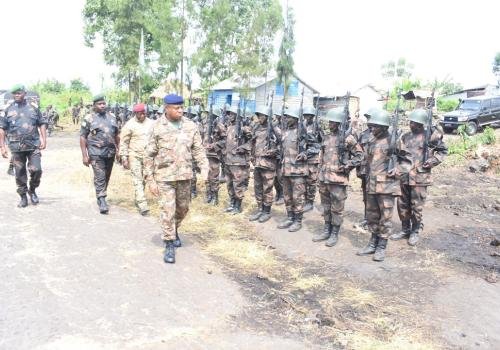

The SA National Defence Force (SANDF) on Thursday 1 May confirmed that “the phased withdrawal” of troops and equipment from the eastern Democratic Republic of Congo (DRC), three days after a Parliamentarian chastised the Department of Defence (DoD) for its lack of communication on the exit.
The confirmation, from the SANDF Directorate Corporate Communication in the form of a statement attributed to its Director, Rear Admiral (JG) Prince Tshabalala, came four days after the exit was first reported. This delay in communicating from the SANDF and silence from Defence and Military Veterans Minister, Angie Motshekga, drew pointed comment from Chris Hattingh, Democratic Alliance (DA) National Assembly (NA) spokesman for Motshekga’s portfolio.

A day ahead of the Tshabalala statement, Hattingh noted neither Parliament nor the South African public received communication on the SAMIDRC (Southern African Development Community [SADC] Mission in the DRC) withdrawal. Motshekga is scheduled to attend next Friday’s (9 May’s) Portfolio Committee on Defence and Military Veterans (PCDMV) meeting and can expect pointed questions around not only the South African exit from the eastern DRC but also the terms and scope of the deployment.
A Hattingh statement has it “the withdrawal of South African troops from eastern DRC has been marred by poor planning, vague objectives and a disturbing lack of transparency. What should have been a co-ordinated and strategic exit has instead become a confused and dangerous process, placing our soldiers at risk and leaving the nation with more questions than answers”.
“Alarmingly, accounts suggest that M23 rebels—widely believed to be backed by Rwanda—are inspecting military equipment as convoys pass through. Members of the elite Quick Reaction Force (QRF) have described the experience as ‘frustrating and humiliating,’” Hattingh added.
Against this, the Tshabalala statement notes the withdrawal is in line with a 13 March directive following an SADC Extraordinary Summit of Heads of State and Government. The Summit and subsequent meetings of the defence force chiefs of the three SAMIDRC troop contributing countries (TCCs) – Malawi, South Africa and Tanzania – “endorsed the withdrawal plan via road through Rwanda and Tanzania”.
The withdrawal route from Goma through Rwanda to Chato was confirmed by a joint SADC/TCC reconnaissance team. “The withdrawal plan,” according to the DCC statement, “will take place in phases and the SANDF will provide regular updates to the public regarding the safe return of our soldiers to South Africa”.
Against these assurances, Hattingh will use information supplied by South African soldiers while on the ground in the DRC when questioning Motshekga on 9 May. He said he was told about logistic failure, poor communication and uncertainty about the status of military vehicles and heavy weaponry. Other questions in the Hattingh quiver relate to the current status of SANDF assets in the DRC, identification of “operational failures” as well as the situation as regards safety of South African military equipment and personnel.
Rwandan troops escorted SAMIDRC forces through their territory from Tuesday, with one eyewitness reporting a convoy of 20 vehicles moving through the Rwandan town of Gisenyi. Trucks carrying containers, boats, artillery pieces, and other equipment were observed. Once all SAMIDRC forces reach their staging ground in Tanzania, troops and equipment will return to their home countries.
Rwanda’s Minister of Foreign Affairs and International Cooperation, Olivier Nduhungirehe, said the SAMIDRC withdrawal was a “positive step” toward peace. “Rwanda is providing safe passage and an escort for convoys of SAMIDRC troops and equipment withdrawing from eastern DRC through Rwanda to Tanzania. The presence of SAMIDRC troops was always a complicating factor in the conflict, and today’s start of withdrawal marks a positive step in support of the ongoing peace process,” he said on Tuesday.
The troops are traveling along the Rubavu–Kigali–Rusumo route toward the Chato District in northwestern Tanzania. Initial plans to repatriate forces through Goma International Airport were abandoned after AFC/M23 rejected the proposal, citing damage to the airport caused by Congolese government forces during the fighting in Goma. However, the M23 has parked vehicles across the runway to block it.
This week also saw, according to a senior United Nations (UN) representative and confirmed by the International Committee of the Red Cross (ICRC), convoys moving several hundred unarmed DRC armed forces (Forces Armées de la République Démocratique du Congo, FARDC) members from Goma to Kinshasa. All, including families of the military personnel, were residing at the MONUSCO base in the North Kivu capital.
The ICRC was approached by several actors – notably the DRC Ministry of Defence and Veterans, MONUSCO and the M23/Congo River Alliance – to act as a neutral intermediary.
Once the agreement with the ICRC was concluded, all concerned committed to ensuring the safety of people in the convoys travelling over 2 600 km from Goma to the national capital.