
“Gratitude”, “tribute” and “steadfast commitment” feature in United Nations (UN) reactions to the upcoming withdrawal of SA National Defence Force (SANDF) personnel from its peacekeeping mission in the Democratic Republic of Congo (DRC).
The withdrawal was made public by South African President Cyril Ramaphosa at the weekend nearly four weeks after he, according to The Presidency, informed Secretary-General Antonio Guterres South Africa would exit MONUSCO (the French acronym for UN Stabilisation Mission in the DRC).
On Monday, during a regular weekly briefing, Guterres’ spokesman Stephane Dujarric said “deep gratitude” was due to the government and people of South Africa for their steadfast commitment to UN peacekeeping over several decades. This applied to all South African peacekeepers for their dedication in supporting the MONUSCO mandate which, among others, allows for the use of force to combat armed groups in the volatile central African country. Execution of this mandated task saw South African troops, along with Southern African Development Community (SADC) colleagues from Malawi and Tanzania, mobilised into a Force Intervention Brigade (FIB) with its own quick reaction forces as sub-units.
Dujarric paid tribute to South African blue helmets who died “in the service of the people of the DRC” – a sentiment echoed in the MONUSCO reaction statement to the South African exit – scheduled to be completed by year-end.
Just over 50 South African military personnel lost their lives in the DRC over the last 27 years to combat, accidents, murder, suicide and other causes.
South Africa’s participation in DRC peacekeeping efforts under the UN flag started with the deployment of a single officer, under Operation Mistral, to Uganda in September 1999. This grew to specialist SANDF elements – air cargo handling, airfield crash and rescue, firefighting, aero-medical and a combined command/joint support unit in May 2000. Later commitments saw the deployment of soldiers, mainly from SA Army infantry battalions; helicopter air and ground crews for Rooivalk combat support and Oryx medium transport assets; and SA Military Health Services (SAMHS) personnel to staff a level one field hospital in Goma in DRC.
The first SANDF combat force – aptly called task force one – arrived in the DRC in April 2003. It comprised a headquarters, infantry battalion group, engineer squadron, river ferry crossing unit, well drilling unit and a military police section.
More than 12 400 personnel were serving with MONUSCO as of October 2025, including some 9 177 troops and 926 police officers from over 50 countries. Since inception, 304 fatalities have been recorded.
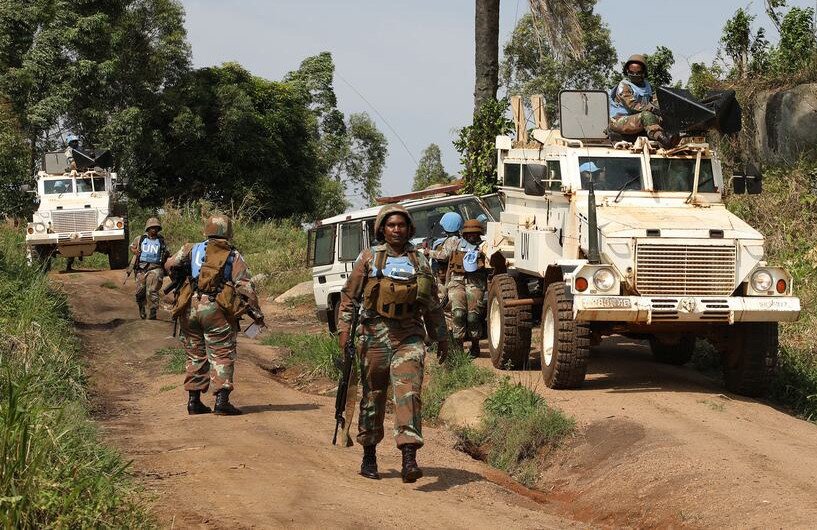
South Africa currently has a personnel strength of 700 plus wearing blue helmets and using white painted SANDF vehicles on the MONUSCO register, making it one of the top 10 troop contributing countries (TCCs) to the mission. Bangladesh with 1 825 has the most uniformed military personnel in MONUSCO, followed by Nepal (1 150), India (901), Tanzania (853), Indonesia (824) and South Africa (757).
MONUSCO said it “looks forward to continuing to engage with the Republic of South Africa on broader peacekeeping issues, including lessons learned and continued support to efforts aimed at advancing peace and stability.”
It also will work closely with the UN Secretariat and relevant stakeholders to ensure that any transition related to the withdrawal “is managed in a safe, orderly, and responsible manner, in line with United Nations standards and operational requirements.”
Defence expert Dean Wingrin noted that the SANDF withdrawal from MONUSCO leaves South Africa with no external peacekeeping deployments for the first time in over two decades, after having deployed forces to 11 countries since 1999.
“This decision is both good and bad. For the first time since 1999, South Africa will not be part of any United Nations, African Union, or Southern African Development Community peacekeeping mission, a significant shift for a leading regional political and economic power.
“On the one hand, this marks a clear loss of influence, prestige and responsibility on the continent. On the other, the reasons behind the decision are understandable and, frankly, long overdue. The UN itself has been winding down MONUSCO. The mission was meant to end in 2025, then extended to 2026, amid a broader UN peacekeeping funding crisis and reduced reimbursements to troop-contributing countries,” Wingrin said.
He pointed out that South Africa has already been quietly downscaling its presence over the past year. Troop numbers dropped from around 1 200 a few years ago to about 700 today, with the UN reportedly considering a further reduction to roughly 350.
Interestingly, President Ramaphosa’s statement does not reference the UN drawdown or its’ funding pressures. Instead, it frames the move as a unilateral decision to “consolidate and realign SANDF resources”, Wingrin said.
“That phrase is the real issue. The SANDF is increasingly unable to sustain external deployments while simultaneously protecting South Africa’s land and sea borders, due to its own severe funding crisis. It has been defunded for decades, leading to severe capacity constraints.
“So much so, that the Army can only muster 15 of the required 23 Companies to patrol the land border and is heavily dependent on the Reserves. The Navy cannot patrol the seas as it should, nor can the Airforce supply airlift, maritime patrol and air support.”
According to Wingrin, while the loss of prestige matters when withdrawing from the DRC, another cost is often ignored: Peacekeeping provides junior soldiers, NCOs and officers invaluable operational experience, coalition exposure and real-world military lessons, even as senior planners do not learn the lessons learnt in blood from previous operations.
MONUSCO (like all peacekeeping and enforcement missions) is only a tool for stabilising the battlefield and protecting civilians while a political solution is pursued. Without the diplomacy, no mission can succeed, Wingrin emphasised.