

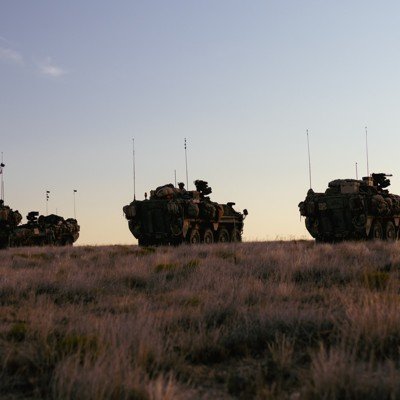
FORT CARSON, Colo.—For an infantry crew, nothing can replace the experience of riding in a big truck and firing guns at targets hundreds of yards away. Shell cases clinking as they collect on the roof, the smell of diesel and gunpowder, the thump of recoil, the sound of the team’s voices in a headset—the tactile practice is crucial for creating muscle memory and prepping the brain for the sensory experience of battle. Or is it?
Brig. Gen. Eugene Ferris, the 4th Infantry Division’s deputy commanding general for maneuver, asked his team to find out.

“We’ve got all this gunnery data” but “do we know what’s correlated with better success?” recalled Lt. Col. Jonathan Bate, who leads the 2nd Battalion, 23rd Infantry Regiment in the division’s 1st Stryker Brigade Combat Team.
They didn’t. So Bate’s brigade put together a team to answer that question. The result was what they call “the Moneyball approach,” affectionately named after the 2011 baseball movie that starred Brad Pitt as the Oakland As’ general manager. The approach uses statistics to determine what skills and metrics best predict whether soldiers will qualify for crew gunnery certification the first time around.
A gunnery crew must pass six types of tests, or tables, to earn its marksmanship certifications: a written test, a simulation, in-person range training with lasers and blanks, two live-ammo sessions, and the final qualification round. These semi-annual and annual certifications are required across multiple weapons platforms, such as tanks, Strykers and Bradley ground vehicles. For Strykers, there’s a crew of three—a driver, a gunner, and a vehicle commander, but only the gunner has to qualify on the table exercises.
“We found that, out of all the tables, there was one table that turned out to be statistically significant, correlated with achieving a first-time qual”: the laser-and-blank range, Bate said.
Before developing the statistical model, Bate and his team assumed that a soldier’s performance during the live-ammo segments would be the best predictor of final-round performance. Instead, it was Table Three, which is the first time soldiers combine their operational knowledge and muscle memory.
“It was really unexpected to us,” Bate said. “But it turns out, [Table Three] really evaluates the crew command’s crew proficiency. Shows if they can use the right fire commands, like, ‘troops in the open’…and using the right terminology before you engage a target, and acquiring the target. That was the thing that was correlated with better Table Six qualification scores.”
If more data proves that Table Three is a reliable predictor of qualification, it would allow crews who aren’t quite up to snuff to be sent back for more training, which could save time and money, Bate said.
“If you score below, let’s say like an 800 or 850 out of 1,000 on that table, you go back and retrain, because you only have a 70 percent chance of achieving a first-time qual. So it saves us time. It saves us ammunition and resources, and helps us overall become more successful,” he said.
Now, Bate wants to build an automated tool using machine learning to “take all of these factors and then pop out a predicted score on table six,” to flag crews that need retraining.
“The tools are out there. It’s really just a fight for the data, for the will to use it,” he said.
Challenging assumptions
Bate said the revelation that a training exercise where gunners shoot lasers instead of live ammo was a good indicator of marksmanship came as a bit of a shock.
“A lot of soldiers would think that Table Three is not important. And so this gave us evidence,” he said. “And for leaders, it’s a good dipstick check for, like, maybe your crews aren’t ready to move on, because they’re just gonna go and fail at Table Six. And once you shoot it, you can’t reshoot it again.”
This insight hinged on the “qualitative common-sense knowledge from brigade master gunner or sergeant,” Bate said. We had “very smart lieutenants doing the data analytics and then we had a really smart sergeant with the common sense—the experience. We put that all together, and he helped us interpret the results from the data.”
A quick Google search for “Army Table 3 gunnery training” supports that notion, as most results are for tables four through six—the parts of the certification that require live ammo. Targets aren’t knocked down in Table Three even though the lasers are firing, so there’s no haptic feedback.
The typical reasoning is that the number of targets shot would be most important “because you’re like, ‘Oh, the gunner is accurate, so [they’re] probably going to qualify the first time.’ This one shows that the communication with the crew in the rehearsal of working together is actually more important,” said Lt. Col. Nate Platz, commander of the 704th Brigade Support Battalion in the 4th Infantry Division’s 2nd Stryker Brigade Combat Team.
The division wants to improve its data collection, expand it to improve the model, and learn more about the crews and their experiences such as “how many gunneries have they shot before? Are they having any personal issues or stressors?” Bate said.
“We don’t have Table One and Two scores,” Bate said. So there’s a need to “really expand the data set…we just scratched the surface. There’s probably a lot better ways to do this.”


