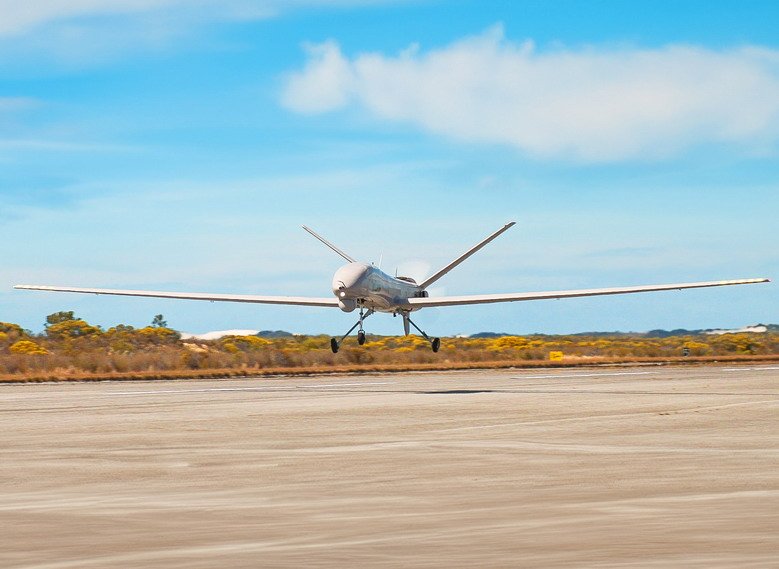
The Milkor 380 medium-altitude, long-endurance (MALE) unmanned aerial vehicle (UAV) is the largest such aircraft to be designed and manufactured in Africa, and will be complemented by an even larger UAV – the Milkor 780 – which is currently under development.
Milkor said the 380 “exemplifies South Africa’s growing prowess in aerospace technology and its potential to enhance security, surveillance, and operational efficiency. With the eyes of the world on South Africa during the G20, the Milkor 380 stands as a testimony to South African innovation with applications for border protection, intelligence gathering, and beyond, underscoring the nation’s commitment to self-reliant defence solutions.”
“The Milkor 380, developed entirely in South Africa, represents a significant leap forward in unmanned systems technology. Designed for versatility and reliability, it addresses a wide range of operational needs in both military and civilian contexts. As global leaders convene in South Africa for the G20 in late November, this UAV highlights how local innovation can contribute to international security dialogues, particularly in areas like maritime domain awareness and counter-terrorism.”
Milkor said the aircraft is globally competitive, and features a wingspan of 18.6 metres, enabling stable flight in diverse conditions. With a maximum take-off weight (MTOW) of 1 500 kg and a payload capacity of up to 220 kg, it can accommodate a variety of mission-specific equipment, including electro-optical/infrared (EO/IR) sensors, synthetic aperture radar (SAR), and precision-guided munitions.
Powered by a turbocharged Rotax 915is engine (in future it will feature a turboprop), the UAV achieves an operational endurance of up to 35 hours, allowing for extended loiter times over target areas. It operates at altitudes reaching 30 000 feet, “providing a strategic vantage point for surveillance while remaining beyond the reach of many ground-based threats.” Top speed is 250 km/h and cruise speed 110-150 km/h.

The Milkor 380 features modular payload bays for seamless integration of advanced systems, such as signals intelligence (SIGINT) pods and electronic warfare (EW) suites. Recent advancements include a strategic memorandum of understanding (MoU) with Hanwha Systems to incorporate active electronically scanned array (AESA) synthetic aperture radar (SAR), enhancing its all-weather imaging capabilities for global export markets. Autonomous take-off and landing systems reduce operator intervention, while satellite communication extends its range to over 4 000 km in beyond-line-of-sight operations.
Milkor has partnered with leading companies, such as Germany’s Hensoldt, to integrate sophisticated sensor suites, including the ARGOS II HDT Airborne Observation System with laser designator capabilities. The aircraft’s nose is capable of housing several different electro optical/infrared and radar sensors. For maritime/naval roles, Milkor partner with Aerodata AG to create the AeroForce 380, integrating a radar, AIS, and electro-optical/infrared gimbals.
The Milkor 380 can be armed, and has already been displayed with Al Tariq X-series precision guided munitions, Halcon Desert Sting DS-16 guided bombs, and FZ602 laser-guided rocket launchers. A mockup of a Milkor-developed missile has also been shown under the aircraft, as Milkor is exploring in-house missile development.

The Milkor 380 is ideal for a broad spectrum of applications, the company said, such as border surveillance, maritime surveillance, wildlife conservation, and strike missions. It could, for example, help secure South Africa’s land borders, combating cross-border crime and human trafficking; be used to assist in anti-poaching efforts in reserves like the Kruger National Park; coordinate disaster relief efforts; and help monitor South Africa’s 2 800 km coastline.
The Milkor 380 first flew in September 2023 and is currently in production at the company’s Cape Town facility – it has secured export orders. Annual production stands at eight per year, with plans to reach 16 units a year around 2026. First deliveries to customers are expected this year.

The Milkor 380’s production phase has paved the way for an even larger follow-on project, the Milkor 780 with a 24 metre wingspan. This high-altitude, long-endurance UAV is expected to carry 2 700 kilograms of payload on nine hardpoints. It will have a flight time of 30–40 hours, giving a maximum range of 9 300 km (line-of-sight communications range will be 250 km). Maximum speed will be 315 km/h and its cruise speed will be 230 km/h.
“The 780 project is currently in the detailed design stage, moving towards completed data packs and manufacturing should start later this year or early next year,” Milkor Marketing Manager Daniel du Plessis reported earlier in 2025. “Our assembly facility should be able to build two 780s at a time.” The entire airframe will be built at a dedicated production facility in Cape Town, which is being fitted out.
Milkor hopes to unveil the Milkor 780 at the 2026 edition of the Africa Aerospace and Defence (AAD) exhibition, and launch the aircraft on to the international market then.