

Before Releaf became one of Nigeria’s most closely watched agritech companies, it was little more than an idea shared by two founders still in school.
Ikenna Nzewi and his friend Uzoma Ayogu started the company in 2017 with a simple belief, that Africa’s food system was broken in ways that could be fixed, and that solving it could lead to something much bigger.
That ambition got Releaf into Y Combinator in 2017, placing the startup among a new wave of globally backed African ventures. But getting into one of Silicon Valley’s most prestigious accelerators didn’t mean they had everything figured out.
In its early days, Releaf experimented. It moved between ideas, from an agricultural marketplace to trade finance, searching for something that could truly work within the realities of African markets.
That search eventually led Nzewi and Ayogu, both Americans of Nigerian descent and then students at Yale and Duke, back to Nigeria, their country of origin and Africa’s largest producer of oil palm. They travelled across 20 of Nigeria’s 36 states, trying to understand where technology could actually make a difference. What they found was not just a gap. It was a collapse.
From global dominance to import dependency
Nigeria used to lead the global palm oil market. Today, it’s one of its biggest importers. From the 1950s to the 1970s, the country accounted for over 40% of global palm oil production, exporting more than enough to meet both local and international demand.
Today, Nigeria’s share of global production has fallen to less than 2% as of 2024. At the same time, the country now spends an estimated $600 million annually importing palm oil. The problem wasn’t a lack of demand, and it’s not because there aren’t enough farmers. The real issue is how the system works.
Across the country, smallholder farmers, who make up the bulk of Nigeria’s agricultural system, still rely on manual methods to process palm nuts. The work is slow, physically demanding, and highly inefficient.
“Using rocks, farmers could crack about 2.5 metric tons of nuts a week,” Nzewi said. “It’s extremely slow and drudgerous for that level of return.”
Even where machinery existed, it wasn’t much better. Some local equipment could process less than 24 metric tons per week, often with poor quality output. In many cases, up to 25% of farmers’ produce went to waste. For Nzewi and Ayogu, this was the real problem, and it was the one Releaf was built to solve.
Building Kraken
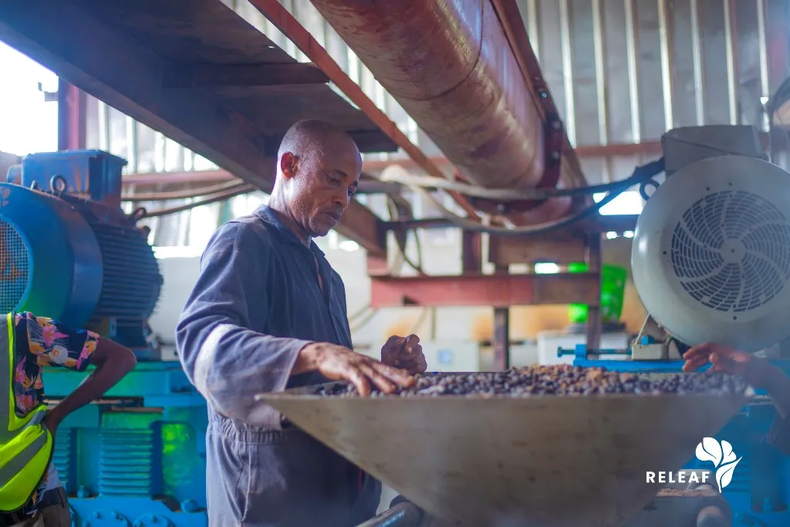
The solution became Kraken. After two years of research and development, Releaf built a proprietary palm nut processing system designed to handle the realities of African agriculture.
“It took two years of intensive R&D,” Nzewi said. “From the outset, we wanted to build West Africa’s most advanced palm nut processing technology.”
That difference mattered, especially because imported de-shelling machines, often used by large companies, can process up to 720 metric tons per week, but come with trade-offs. They cost over $350,000 and are designed for plantation-grown palm varieties, not the thicker-shelled nuts produced by smallholder farmers.
Kraken was built differently. When it came online in January 2021, it could process 500 metric tons per week at 95% purity, significantly higher than the industry average. It also costs less than half the price of imported systems.
More importantly, it worked where others didn’t. It was faster than local alternatives, up to 25 times faster than existing equipment and 240 times faster than manual cracking, while reducing waste.
That same year, Releaf raised $4.2 million in seed funding, a sign the model was beginning to work.
Fixing what breaks
The first version of Kraken handled everything, from preparing the nuts to cracking and separating kernels, in one integrated system. But it had a flaw. If one part failed, everything stopped.
“So Kraken 1 only had one cracker,” Nzewi explained. “If it got blocked or needed maintenance, the whole system would shut down.”
Kraken 2 fixed that. The upgraded system introduced redundancy, allowing multiple processes to run simultaneously without shutting down operations. Maintenance could happen while the machine continued working. At the same time, performance improved across the board, higher yields, lower costs, and reduced manpower. It was a more efficient, more resilient system that came at a critical time.
In 2023, Releaf raised $3.3 million in pre-Series A funding to scale its operations and launch new products, including Kraken II and SITE, a geospatial mapping tool developed in collaboration with Stanford University to optimize the placement of food processing infrastructure.
In total, the company has now raised over $10 million to scale its processing technology, expand across Nigeria, and invest in innovations.
From waste to opportunity
But the next evolution didn’t come from the machine itself. It came from what the machine left behind.
Every day, Releaf’s processing facilities produced large volumes of palm kernel shells — a byproduct traditionally burned, dumped, or sold cheaply. For decades, these shells were treated as waste. Releaf started to see them differently.
“Africa produces roughly a billion tons of biomass every year,” Nzewi said. “And palm kernel shells are one of the best feedstocks for biochar you can find.”
That insight led to the creation of Releaf Earth, the company’s climate-focused arm, and a move into industrial biochar production.
The biochar bet
Biochar is produced by heating organic material in a low-oxygen environment, transforming it into a stable form of carbon that can remain in soil for hundreds, even thousands of years. Unlike carbon offsets or short-term solutions like tree planting, biochar represents long-term carbon removal.
“These are technologies that remove carbon and store it in a way that it can’t return to the atmosphere for up to 1,000 years,” Nzewi explained.
But beyond its climate impact, biochar also made business sense. It was scalable, and according to Nzewi, more cost-effective than many other carbon removal methods. Most importantly, it used materials Releaf already had. What was once treated as waste was now becoming a new source of revenue. And the benefits became clear quickly.
Biochar improves soil quality, increases water retention, and makes fertilizers more effective. Farmers using it see higher yields and better resilience to drought. Releaf gets more supply as farmers produce more. And the company can sell carbon credits internationally, generating revenue in dollars.
“It’s a win for our margins,” Nzewi said. “It’s a win for our farmers. And it’s a win for the environment.”
In trials, yields have improved by as much as 23% using biochar, enough, Nzewi says, to let the results speak for themselves. As farmers become aware of the product, try it, and see the difference firsthand, adoption tends to follow.
Building in a tougher funding climate
Releaf’s move into climate tech also reflects a broader shift across Africa’s startup ecosystem.
Over the past two years, funding has slowed. Foreign direct investment into Africa has dropped, and currency devaluations in markets like Nigeria have made returns more uncertain for global investors.
Agtech hasn’t been spared. In 2025, total funding fell by nearly 20% to under $170 million, with deal activity also declining. As a result, expectations have shifted.
“There’s been a greater emphasis on strong unit economics and a clear path to profitability,” Nzewi said.
For Releaf, biochar wasn’t just a climate play. It was a strategic one. As one of the early players in Nigeria’s biochar space, the company is building around two revenue streams: the sale of biochar itself, which can be priced between $400 and $600 per ton, and carbon removal credits, which sell for about $150 to $200 per ton of CO₂ equivalent.
By improving margins and introducing dollar-based revenue through carbon credits, Releaf has positioned itself more strongly in a tougher investment environment.
But building a climate business in Africa isn’t easy. Releaf had to rely heavily on grants, including support from the Cisco Foundation and the German government-backed SAIS programme, to finance its early biochar operations. The space is still new. And that comes with risk.
The risks and the opportunity
According to Nzewi, two major risks define climate tech today. The first is execution risk, the challenge of running complex industrial operations in rural environments.
The second is market risk, uncertainty around how carbon credits are priced, verified, and traded. Selling carbon credits is not the same as producing them. “You need relationships,” Nzewi said. “You need access to trusted networks.”
Releaf had an advantage. Nzewi previously worked at Bain & Company, while Ayogu turned down a role at Microsoft, one of the largest buyers of carbon credits globally. Those connections helped open doors.
But Nzewi believes Africa’s real opportunity lies in collaboration. “We need to adopt a mindset of partnership over mediocrity,” he said.
Rather than trying to control every part of the value chain, companies should focus on their strengths, and work with others to fill the gaps. Because in climate tech, quality matters.
“Mediocre carbon credit projects hurt everybody,” Nzewi said. “If buyers lose confidence, demand disappears.”
What comes next
Releaf’s ambitions are growing quickly. By 2030, the company aims to remove up to 700,000 metric tons of CO₂e, recycle 50,000 metric tons of waste biomass annually, and produce 20,000 metric tons of biochar each year. It also expects to create over 500 jobs within the carbon removal industry, while reaching more than a million farmers.
But in many ways, the idea behind it is still simple. It’s about looking differently at what already exists.
Palm kernel shells, once discarded, are now becoming the foundation of a new kind of climate business. The same supply chain that connects farmers to food manufacturers is now opening a path into global carbon markets.
“All we really did,” he said, “was look at what we already had, and ask how much more it could become.”


