

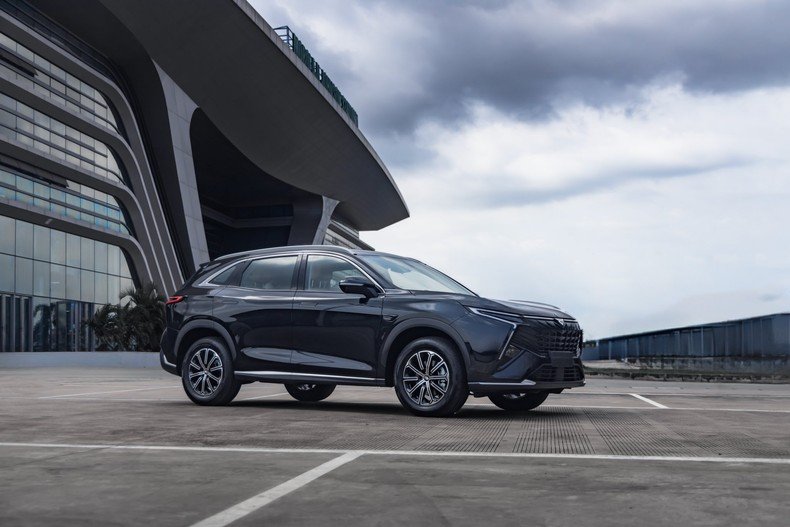
Nigeria is the third-largest importer of vehicles from the US. As of 2023, vehicle imports rose by an alarming 708%. The statistics aren’t difficult to believe. Drive down any Nigerian road, and what you see is a parade of familiar badges.
Mercedes-Benzes weaving past potholes with aristocratic grace, Toyota Corollas enduring their ninth life, Honda Accords holding their ground amidst Lagos traffic chaos.
More recently, there has been an influx of Asian contenders, sleek Hyundai Elantras, Kia Rios, and a growing army of Chinese-made Chery and Geely models, seducing cost-conscious buyers with their affordability and tech perks.
However, amidst this lineup of foreign brands, cars made in Africa, or particularly Nigeria, are a rare sight.
Ajayi Joshua Oluwatobi, who cut his teeth with three years at Mercedes-Benz Vans and later as CEO of Jetvan, decided to change that by founding one of Nigeria’s first indigenous automakers — Nord.
Born in a recession
Oluwatobi’s journey began during his National Youth Service Corps (NYSC) posting with Mercedes-Benz Nigeria. Retained after his service year, he quickly rose through the ranks in the Van division.
Under his leadership at Jetvan, Mercedes-Benz vans grew their market share from less than 1% to 7%, earning him the 2013 Mercedes-Benz Best Sales Performance for Africa award.
But in 2016, everything changed. Nigeria slipped into a recession, the naira crashed, and one by one, Oluwatobi watched his customers disappear.
“We were selling luxury vehicles. Suddenly, no one could afford them,” he told Business Insider Africa. “Customers who once bought new buses were now stuck repairing old ones. At one point, I feared losing everything. I knew I had to find an alternative.”
Oluwatobi started thinking differently. If foreign brands were becoming too expensive for Nigerians, why not build one at home, something strong, stylish, reliable, and, most importantly, affordable?
He sketched out prototypes, then brought in a German firm to fine-tune the designs. A trip to Thailand and China followed to source a supplier for the bodies of the vehicles that would match his vision. And then, in 2018, after years of hustling and piecing it all together, the very first Nord vehicle rolled out of the assembly line.
“We are building a company that gives Nigerians world-class vehicles at globally competitive prices,” he explained. “A car that retails for about $16,000 in Japan or the U.S. often sells for $45,000 in Nigeria. Nigerians deserve better.”
Recently, Nord announced that Nigerians can now purchase its entry-level brand-new EV for ₦16 million (about $11,000).
But price isn’t the only challenge. In a market where foreign goods, especially cars, are seen as superior, Nord has to overcome a deep-rooted bias. Many Nigerians would rather buy a second-hand Toyota than a brand-new locally assembled vehicle.
“Buying is often emotional,” Oluwatobi said. “That’s why commercial vehicles sell so well, the decision is driven by business, not sentiment. For personal cars, people lean toward foreign brands even when local options exist.”
Steering the policy wheel
This is where policy comes in. Data from the National Bureau of Statistics (NBS) shows that Nigeria spent N1.26 trillion on passenger car imports in 2024, down 14.3% from N1.47 trillion in 2023.
The drop wasn’t necessarily good news, as it was driven by soaring inflation and the naira’s sharp depreciation. Yet even with the decline, the economic and environmental toll of car imports remains heavy.
Every imported vehicle represents jobs created abroad instead of at home, and more pressure on scarce foreign exchange. And by flooding the roads with vehicles that have already outlived their prime, Nigeria locks itself into higher carbon emissions, worsening the country’s position in the fight against climate change.
“When Nigerians buy imported vehicles, we’re creating jobs in foreign factories with our own money,” Oluwatobi noted.
The government could shift this behaviour by creating incentives, tax breaks, favourable financing schemes, and protectionist measures for local manufacturers.
Some progress has been made. The Nigerian Consumer Credit Corporation, in partnership with NADDC, recently launched a ₦20 billion consumer credit fund to help Nigerians buy locally assembled cars from nine manufacturers, including Nord and Innoson. But industry players say more needs to be done.
On protectionist measures, the U.S. recently imposed a 100% tariff on Chinese-made electric vehicles in 2024, shielding its auto industry from subsidised foreign competition. Mexico also plans to raise tariffs on vehicles coming from Asia, particularly China, to 50% from the current 20%. Nigeria, Oluwatobi argues, must be equally bold.
Beyond tariffs, government patronage itself could be a game changer. It has become almost ritual for federal lawmakers and senior officials to be allocated luxury SUVs, often costing over $150,000 each, justified as tools for effective work.
Redirecting such purchases toward locally manufactured vehicles could give Nigeria’s auto industry the leap it desperately needs.
Nord’s capacity and ambition
Still, there are questions about originality, capacity, and durability. But Nord is hardly unusual; like global giants Toyota, Ford, and Volkswagen, it relies on a network of suppliers for parts that are then assembled locally.
Oluwatobi says between 32% and 40% of its components are already produced in Nigeria, including grills and plastic fittings.
He adds that the company can currently assemble about 20,000 vehicles a year, but with sufficient demand, production could scale up to 100,000 units.
The company operates two plants in Lagos: a 2,100m² facility in Sangotedo where all eight models are currently assembled, and a 5,400m² factory under construction in Epe. Beyond Nigeria, Nord has already sold vehicles to markets in Ghana, the Ivory Coast, and Egypt.
That’s still just a fraction of what Nigeria needs. According to the U.S. International Trade Administration, the country’s annual vehicle demand is around 720,000 units, dwarfing the output of local factories.
For Oluwatobi, however, the dream is bigger than numbers. “We want to be the company Africans can look to and say, ‘Because of Nord, my dream of owning a brand-new car has been achieved,’” he says.
It’s an ambitious vision, but in a country where imported cars dominate the roads, ambition may be exactly what it takes to drive change.


