

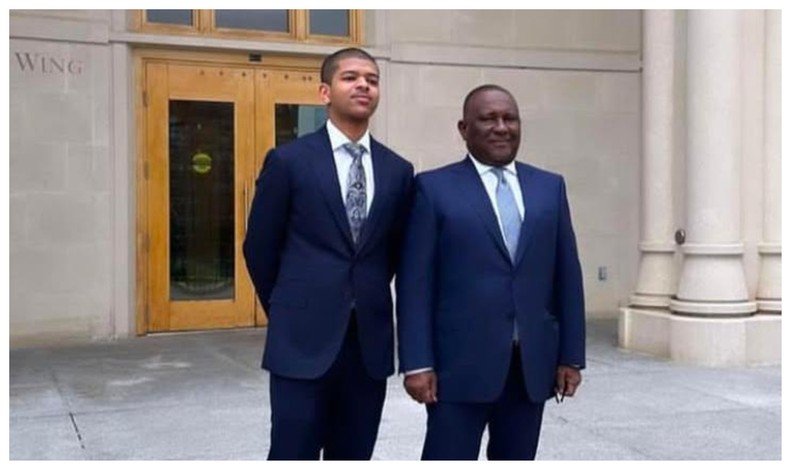
Isyaku Abdulsamad “Khalifa” Rabiu, the second child of Nigerian billionaire Abdul Samad Rabiu, is steadily emerging as a central figure within one of Africa’s most influential industrial conglomerates, BUA Group.
His growing responsibilities within the organisation, particularly his new role as Chief Officer for Global Procurement and Strategic Operations at BUA Foods, position him as a likely successor to a vast business empire valued in the tens of billions of dollars.
At a time when leadership succession is becoming an increasingly important subject among Africa’s family-owned conglomerates, Khalifa’s rise reflects more than personal advancement.
Rather, it signals the emergence of a new generation prepared to guide legacy institutions through a rapidly evolving economic landscape.
BUA Group has grown into one of West Africa’s largest and most diversified industrial organisations, with interests spanning foods, cement, infrastructure and manufacturing.
Two flagship publicly listed companies form the backbone of the conglomerate’s valuation.
By early 2026, BUA Foods and BUA Cement had achieved a combined market valuation exceeding ₦20.88 trillion, approximately $15.46 billion based on the Central Bank of Nigeria’s prevailing exchange rate.
BUA Foods was valued at ₦14.38 trillion, about $10.65 billion, while BUA Cement stood at ₦6.50 trillion, roughly $4.81 billion using the same exchange benchmark. The cement subsidiary’s market capitalisation has increased by 118.28 percent over the past year.
The surge in valuation reflects sustained investor confidence and strong demand across Nigeria’s consumer and construction sectors.
Boardroom Context Within the BUA Ecosystem
Khalifa Rabiu’s rising operational influence also comes against the backdrop of a notable boardroom development within the wider BUA ecosystem.
Isyaku, who is a nephew of BUA Group Chairman Abdul Samad Rabiu, held approximately 0.006 percent of the company’s then ₦18 billion issued shares at the time, making him one of its notable minority shareholders.
While the company did not link the resignation to any succession planning, the move drew attention from market observers, particularly given BUA’s status as a closely held, founder-led conglomerate.
Leadership transitions within family-controlled industrial groups are often gradual and carefully structured.
In many cases, board reshuffles precede operational consolidation under next-generation executives. However, BUA has not publicly framed the resignation within any formal succession roadmap.
The billionaire patriarch behind the empire
Meanwhile, Khalifa’s ascent comes as his father, Abdul Samad Rabiu, remains one of Africa’s wealthiest industrialists. Forbes estimates his net worth at $10.4 billion as of February 2026, while Bloomberg places it higher at approximately $12.4 billion.
The Kano-born businessman built BUA Group into a dominant force through decades of strategic expansion, disciplined execution and calculated risk taking.
His wealth has risen sharply in recent years, driven largely by the performance of BUA Foods and BUA Cement.
Rabiu holds controlling stakes in both companies, approximately 92.6 percent of BUA Foods and 97.66 percent of BUA Cement.
This includes a 56.37 percent direct stake and an indirect holding of about 39.75 percent through BUA Industries Limited, reinforcing his influence over the conglomerate’s direction.
His leadership has long been regarded as the cornerstone of BUA’s success, and the gradual emergence of the next generation suggests a carefully managed transition rather than an abrupt generational shift.
A legacy decades in the making
Within this broader narrative of succession and continuity, Khalifa was named after his late grandfather, Khalifah Isyaku Rabiu, a respected industrialist whose commercial activities in the 1970s and 1980s helped lay the foundation for what would eventually become BUA Group.
The continuity of leadership across three generations highlights the family’s long-term approach to wealth creation and corporate stewardship.
Today, Khalifa is widely viewed as the leading contender to carry that legacy forward.
He is ahead of his siblings, including Khadija “Cookie” Rabiu, a property adviser who has worked with London-based property consultants and is the founder of Croft Hausman.
She has built her career independently in the real estate sector and is not directly involved in the core operations of BUA Group.
His other siblings include Junaid Abdulsamad Rabiu and Rania Rabiu.
A rising leader with global exposure
Academically, Khalifa Rabiu holds a Bachelor’s degree in International Relations from Regent’s University London and a Master’s degree in Management from Georgetown University’s McDonough School of Business.
The combination of international academic exposure and operational experience has positioned him to engage with global markets and complex supply environments.
Before assuming his current role, he served as Director for Special Operations, overseeing transformation initiatives across key business units, including food production, cement manufacturing and animal feed.
These initiatives included strategic wheat sourcing, the establishment of a 40-metric-tonne-per-hour animal feed mill and the revitalisation of BUA’s rice operations.
He also supported digital transformation efforts aimed at improving procurement efficiency and strengthening cost controls in a sector exposed to import dependence and currency volatility.
Business meets political influence
Beyond the boardroom, he is the son of Abdul Samad Rabiu and Hannatu Musawa, Nigeria’s Minister of Arts, Culture and Creative Economy.
Her role within the federal cabinet reflects the family’s proximity to national policymaking circles and underscores a network that spans both economic and political spheres.
Historically, the Rabiu family has maintained a relatively low public profile, preferring corporate execution to media visibility.
However, the emerging leader has begun stepping into the spotlight through high-level engagements, including his introduction to Nigeria’s president during an international outing in Abu Dhabi; a moment observers interpreted as symbolic of his growing stature.
Wealth, Scale and Quiet Power
According to an individual familiar with the family’s assets, the Rabiu family’s influence extends beyond its industrial footprint and is reflected in a portfolio of rare global assets.
Abdul Samad Rabiu is understood to own high value aviation assets, including a Bombardier Global 8000 and a Gulfstream G550 private jet.
The family’s portfolio is also said to include luxury vehicles such as Bentley, Aston Martin and Mercedes Benz, alongside yachts frequently seen in destinations such as St Tropez, France.
Rabiu has previously been photographed aboard a luxury speedboat in Lagos, reinforcing perceptions of a family operating at the highest tier of global wealth.
Although Khalifa maintains a relatively low public profile, the scale of the family’s assets reflects the financial strength and strategic influence of the industrial platform he is positioned to help steward.
Speaking on his new role
In one of his rare public remarks, Khalifa expressed optimism about the company’s direction.
“I am excited to assume this role at such a pivotal time in BUA Foods’ growth journey. I look forward to advancing agile, sustainable procurement systems and operational strategies that support the company’s long-term ambitions,” he said.


