

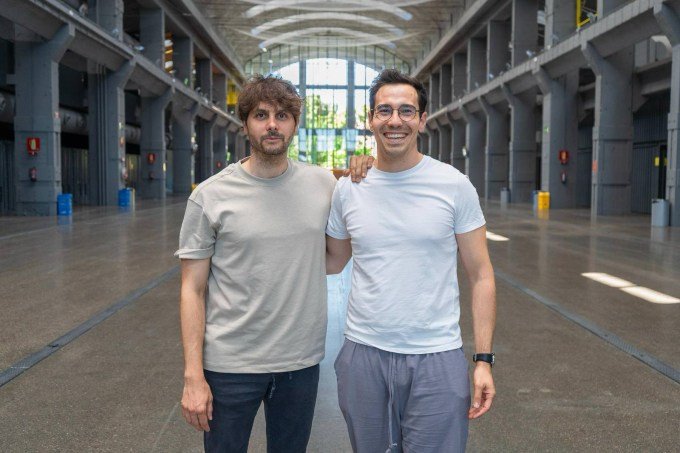
Francesco Cacciatore is a self-proclaimed skeptic. Yet after spending two decades in the European aerospace industry and hitting, as he put it, a “crisis,” he made an undeniably optimistic bet: he started a space company.
“You ask yourself, ‘What am I doing?’” he said in a recent interview. “I got offered some interesting opportunities, but then I kind of collapsed and realized I wanted to try and build something myself.”
That something turned out to be one of the most challenging problems in aerospace: reentry. Along with his cofounder Víctor Gómez García, Cacciatore founded Orbital Paradigm, a Madrid-based startup building a reentry capsule to unlock new markets for materials created in zero gravity.
In less than two years, with a team of nine and less than €1 million, the company built a test capsule dubbed KID, a precursor to a future reusable space capsule called Kestrel. KID is deliberately minimal: it weighs around 25 kilograms and is roughly 16 inches across, with no propulsion. It will mark the first time the startup puts hardware on orbit.

The customers for this first demonstration mission include French space robotics startup Alatyr, Germany’s Leibniz University Hannover and a third unnamed customer. To date, the company has raised €1.5 million in seed funding from Id4, Demium, Pinama, Evercurious, and Akka.
Orbital Paradigm didn’t initially set out to develop return capsules. The cofounders first envisioned in-space robotics, but prospective customers repeatedly said what they really wanted was a capability to go to orbit, stay a little while, and come back – repeatedly.
Customers “don’t want to do a one-off,” Cacciatore said. Institutions, startups and companies frequently want to fly between three and six times a year, he observed. Biotech companies represent a potentially lucrative market because microgravity can enable new materials, drugs and therapies, and these applications often require repeat tests by design.
Techcrunch event
San Francisco
|
October 27-29, 2025
That’s why Orbital Paradigm chose to build a smaller capsule rather than something like SpaceX’s Dragon, which flies astronauts and cargo to the International Space Station. “If you want to fly hundreds of kilograms or thousands of kilograms, then your customer is not the payload anymore, it is the destination to which you fly,” he explained.


The market for orbital return is growing more crowded on both sides of the Atlantic. Varda Space Industries became the first company to nail a commercial reentry in 2024, while Europe’s The Exploration Company achieved a controlled reentry with its own test vehicle this summer.
American startups like Varda and Inversion Space benefit from a few unique tailwinds: notably, the Department of Defense and other agencies have poured millions into hypersonic testing and delivery demos, often in the form of non-dilutive funding like grants or contracts that don’t require giving up company ownership.
“We don’t get that,” Cacciatore acknowledged. “That’s one of the reasons why we build to sell to customers from the beginning, because we don’t get anywhere otherwise. We are starved a bit more, so we need to be a bit more athletic maybe.”
The first launch is rapidly approaching. Orbital Paradigm will fly its maiden mission in roughly three months with an unnamed launch provider, carrying three customer payloads. KID won’t be recovered; instead, the goal is to separate from the rocket, transmit data from orbit, survive the intense heat and speeds of hypersonic reentry, and ping home at least once before the capsule impacts in an undisclosed area.
“We designed the vehicle not to have to land in a specific location,” he said, due to cost and complexity.
The second mission in 2026 will feature a scaled-down Kestrel, with a propulsion system and a parachute to guide the capsule to the Azores, where Portugal’s space agency is developing a spaceport. Like the first mission, there will be no orbital phase – it will just launch, spend around 30 minutes in microgravity before returning – but in this case Orbital Paradigm will be able to recover the vehicle and the payloads inside.
Cacciatore was proud of what the team has accomplished so far, but he was clear-eyed about the long road ahead: “Until we fly, we haven’t done much,” he said. “Words are nice, but flying is the ultimate test.”


