

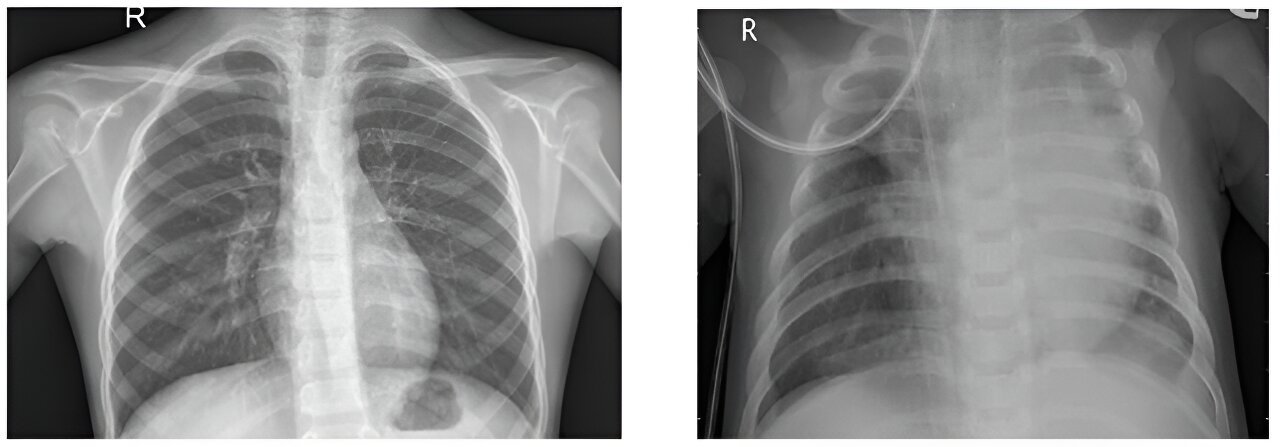
Pneumonia, an infection in the lungs that causes difficulty breathing, is most commonly diagnosed through chest X-rays. Typically, those chest X-rays are read by radiologists, but workforce shortages mean that in the future, it could be harder to get a diagnosis in a timely manner.


Additionally, early and accurate diagnosis of pneumonia is important as it accounts for about 15% of deaths in children younger than 5 years old, according to the World Health Organization.
That’s where machine learning comes in, said Sridhar Tayur, Ford Distinguished Research Chair and University Professor of Operations Management in Carnegie Mellon University’s Tepper School of Business.
“Machine learning is used for prediction, and in health care we want to predict if somebody has a disease or not,” he said. “If you give enough examples of images that have pneumonia and not pneumonia, because there are two cases, this is called binary classification.”
Tayur and a team of researchers studied a technique called support vector machine for classification using quantum-inspired computing, then compared it to other methods in a paper appearing in Frontiers in Computer Science.
“We showed that it is pretty competitive,” he said. “It makes fewer mistakes and it takes less time.”
How can quantum computing be applied to health care?
Tayur founded the Quantum Technologies Group at CMU to better understand and apply quantum computing methods to industries such as health care.
“People are always looking for more efficient ways of solving problems and novel methods and technologies to tackle it,” he said.
In the mid-20th century, scientists who led the first quantum revolution changed the world with innovations such as the transistor, laser and atomic clock. While hardware to compute using qubits is still in development, simulators are capable of tackling problems of realistic size with specially tailored algorithms, which is why this approach is known as quantum-inspired computing.
“Assuming that qubit devices of larger size and lower errors are going to be developed, we can simulate them on a regular computer right now,” Tayur said.
What are the challenges facing health care in adopting AI?
These technologies, however, are still at the leading edge of considerations when it comes to the application of artificial intelligence in health care.
In order to do so, the industry has four challenges ahead of it, as Tayur described in research with Tinglong Dai of Johns Hopkins Carey Business School: physician buy-in, patient acceptance, provider investment and payer support.
To achieve these goals, any AI applied to health care systems should consider how physicians will integrate it into their practices, and then review how patients perceive the role of AI in health care delivery.
“We wrote that paper in 2022, but things haven’t changed that much. It’s not just about building a better mousetrap, it’s about getting people to use that mousetrap,” he said, referencing a long-held business idea that success comes from simply designing the best product.
First, as an example, Tayur explained that more than 500 medical AI devices have been approved by the FDA, but wide adoption of these technologies is still just beginning, in part because of the state of the health care industry and where financial incentives lie.
“Having a good product is necessary, but it’s not sufficient,” he said. “You still need to figure out how people are going to use it, and who is going to pay for it.”
Second, a major consideration in health care is liability. When it comes to devices, a company might encourage doctors to adopt them, but what happens if the device gives a faulty diagnosis or a doctor gives an incorrect interpretation of the data from the device?
“In the paper, we basically talk about the fact that you have to figure out the business case, both risk and reward, along with training and upfront investments in adopting the technology,” he said.
In applying elements of AI and quantum computing to health care, Tayur said while at least some progress has been made, there is still a long way to go.
“Many times what happens is a lot of the AI in health care is derived by scientists and research physicians,” he said. “What they need is a business person who is less enamored by the mousetrap and more sensitive to the patient journey and commercial viability.”
More information:
Sai Sakunthala Guddanti et al, Pneumonia detection by binary classification: classical, quantum, and hybrid approaches for support vector machine (SVM), Frontiers in Computer Science (2024). DOI: 10.3389/fcomp.2023.1286657
Carnegie Mellon University
Citation:
Machine learning, quantum computing may transform health care, including diagnosing pneumonia (2024, March 19)
retrieved 19 March 2024
from https://techxplore.com/news/2024-03-machine-quantum-health-pneumonia.html
This document is subject to copyright. Apart from any fair dealing for the purpose of private study or research, no
part may be reproduced without the written permission. The content is provided for information purposes only.



