
• Business
  • Markets
  • Politics
  • Crypto
  • Finance
  • Intelligence
    • Policy Intelligence
    • Security Intelligence
    • Economic Intelligence
    • Fashion Intelligence
  • Energy
  • Technology
  • Taxes
  • Creator Economy
  • Wealth Management
  • LBNN Blueprints
  • Business
  • Markets
  • Politics
  • Crypto
  • Finance
  • Intelligence
    • Policy Intelligence
    • Security Intelligence
    • Economic Intelligence
    • Fashion Intelligence
  • Energy
  • Technology
  • Taxes
  • Creator Economy
  • Wealth Management
  • LBNN Blueprints

Machine learning enhances X-ray imaging of nanotextures

Simon Osuji by Simon Osuji
July 7, 2023
in Technology
0
Machine learning enhances X-ray imaging of nanotextures
0
SHARES
3
VIEWS
Share on FacebookShare on Twitter

Machine learning enhances X-ray imaging of nanotextures
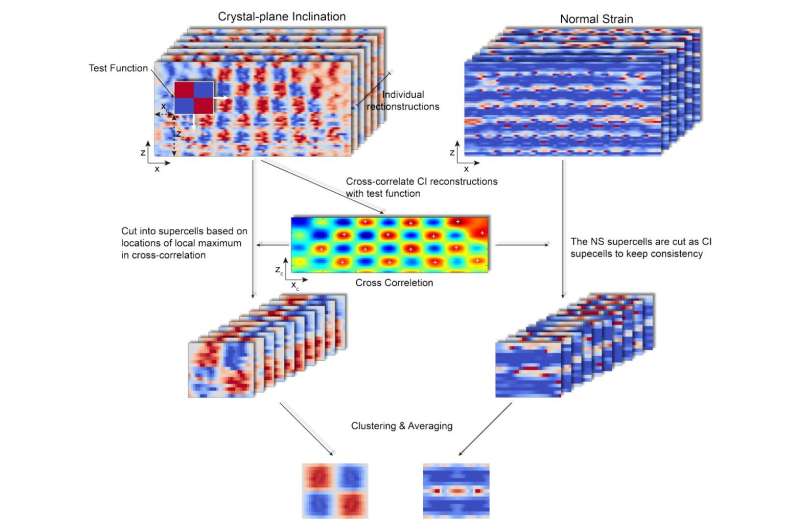
Flow chart of pattern recognition from a set of individual phase retrieval reconstructions with k-means clustering. First, a sinusoidal test function is built with a size determined by mesoscale periodicity length. Then the locations of the supercells are determined by cross correlating the test function with the individual reconstructions. Finally, the separated supercells of the CI are clustered by k-means clustering and then apply the same clusters to average both NS and CI supercells. Credit: Proceedings of the National Academy of Sciences (2023). DOI: 10.1073/pnas.2303312120

Using a combination of high-powered X-rays, phase-retrieval algorithms and machine learning, Cornell researchers revealed the intricate nanotextures in thin-film materials, offering scientists a new, streamlined approach to analyzing potential candidates for quantum computing and microelectronics, among other applications.

Related posts

GROW Project launched to drive green jobs, sustainable construction in Africa – EnviroNews

GROW Project launched to drive green jobs, sustainable construction in Africa – EnviroNews

February 26, 2026
Lilly to give biotech startups access to AI tools

Lilly’s GLP-1 pill tops Novo’s Rybelsus in head-to-head trial

February 26, 2026

Scientists are especially interested in nanotextures that are distributed non-uniformly throughout a thin film because they can give the material novel properties. The most effective way to study the nanotextures is to visualize them directly, a challenge that typically requires complex electron microscopy and does not preserve the sample.

The new imaging technique detailed July 6 in the Proceedings of the National Academy of Sciences overcomes these challenges by using phase retrieval and machine learning to invert conventionally-collected X-ray diffraction data—such as that produced at the Cornell High Energy Synchrotron Source, where data for the study was collected—into real-space visualization of the material at the nanoscale.

The use of X-ray diffraction makes the technique more accessible to scientists and allows for imaging a larger portion of the sample, said Andrej Singer, assistant professor of materials science and engineering and David Croll Sesquicentennial Faculty Fellow in Cornell Engineering, who led the research with doctoral student Ziming Shao.

“Imaging a large area is important because it represents the true state of the material,” Singer said. “The nanotexture measured by a local probe could depend on the choice of the probed spot.”

Another advantage of the new method is that it doesn’t require the sample to be broken apart, enabling the dynamic study of thin films, such as introducing light to see how structures evolve.

“This method can be readily applied to study dynamics in-situ or operando,” Shao said. “For example, we plan to use the method to study how the structure changes within picoseconds after excitation with short laser pulses, which might enable new concepts for future terahertz technologies.”

The technique was tested on two thin films, the first of which had a known nanotexture used to validate the imaging results. Upon testing a second thin film—a Mott insulator with physics associated with superconductivity—the researchers discovered a new type of morphology that had not been observed in the material before—a strain-induced nanopattern that forms spontaneously during cooling to cryogenic temperatures.

“The images are extracted without prior knowledge,” Shao said, “potentially setting new benchmarks and informing novel physical hypotheses in phase-field modeling, molecular dynamics simulations and quantum mechanical calculations.”

More information:
Ziming Shao et al, Real-space imaging of periodic nanotextures in thin films via phasing of diffraction data, Proceedings of the National Academy of Sciences (2023). DOI: 10.1073/pnas.2303312120

Provided by
Cornell University

Citation:
Machine learning enhances X-ray imaging of nanotextures (2023, July 7)
retrieved 7 July 2023
from https://phys.org/news/2023-07-machine-x-ray-imaging-nanotextures.html

This document is subject to copyright. Apart from any fair dealing for the purpose of private study or research, no
part may be reproduced without the written permission. The content is provided for information purposes only.


Source link

Previous Post

Expert discusses open access publishing and the climate crisis

Next Post

Vodacom Earns the Title of ‘Best in Test’ in Independent Umlaut Ranking – IT News Africa

Next Post
Vodacom Earns the Title of ‘Best in Test’ in Independent Umlaut Ranking – IT News Africa

Vodacom Earns the Title of 'Best in Test' in Independent Umlaut Ranking - IT News Africa

Leave a Reply Cancel reply

Your email address will not be published. Required fields are marked *

RECOMMENDED NEWS

SA marks one year on the FATF grey list

SA marks one year on the FATF grey list

2 years ago
Musalia Mudavadi in China on a 3-day official visit

Musalia Mudavadi in China on a 3-day official visit

2 years ago
How a crucial homeless shelter in Boise was obstructed by neighbors

How a crucial homeless shelter in Boise was obstructed by neighbors

11 months ago
“Systemic irregularities” and $300 billion lost, Nigeria’s oil sector faces a terrible problem

“Systemic irregularities” and $300 billion lost, Nigeria’s oil sector faces a terrible problem

4 months ago

POPULAR NEWS

  • Ghana to build three oil refineries, five petrochemical plants in energy sector overhaul

    Ghana to build three oil refineries, five petrochemical plants in energy sector overhaul

    0 shares
    Share 0 Tweet 0
  • The world’s top 10 most valuable car brands in 2025

    0 shares
    Share 0 Tweet 0
  • Top 10 African countries with the highest GDP per capita in 2025

    0 shares
    Share 0 Tweet 0
  • Global ranking of Top 5 smartphone brands in Q3, 2024

    0 shares
    Share 0 Tweet 0
  • Mahama attends Liberia’s 178th independence anniversary

    0 shares
    Share 0 Tweet 0

Get strategic intelligence you won’t find anywhere else. Subscribe to the Limitless Beliefs Newsletter for monthly insights on overlooked business opportunities across Africa.

Subscription Form

© 2026 LBNN – All rights reserved.

Privacy Policy | About Us | Contact

Tiktok Youtube Telegram Instagram Linkedin X-twitter
No Result
View All Result
  • Home
  • Business
  • Politics
  • Markets
  • Crypto
  • Economics
    • Manufacturing
    • Real Estate
    • Infrastructure
  • Finance
  • Energy
  • Creator Economy
  • Wealth Management
  • Taxes
  • Telecoms
  • Military & Defense
  • Careers
  • Technology
  • Artificial Intelligence
  • Investigative journalism
  • Art & Culture
  • LBNN Blueprints
  • Quizzes
    • Enneagram quiz
  • Fashion Intelligence

© 2023 LBNN - All rights reserved.