
• Business
  • Markets
  • Politics
  • Crypto
  • Finance
  • Intelligence
    • Policy Intelligence
    • Security Intelligence
    • Economic Intelligence
    • Fashion Intelligence
  • Energy
  • Technology
  • Taxes
  • Creator Economy
  • Wealth Management
  • LBNN Blueprints
  • Business
  • Markets
  • Politics
  • Crypto
  • Finance
  • Intelligence
    • Policy Intelligence
    • Security Intelligence
    • Economic Intelligence
    • Fashion Intelligence
  • Energy
  • Technology
  • Taxes
  • Creator Economy
  • Wealth Management
  • LBNN Blueprints

Machine learning enhances GNSS signal stability

Simon Osuji by Simon Osuji
June 19, 2024
in Artificial Intelligence
0
Machine learning enhances GNSS signal stability
0
SHARES
1
VIEWS
Share on FacebookShare on Twitter


Predicting space weather: Machine learning enhances GNSS signal stability
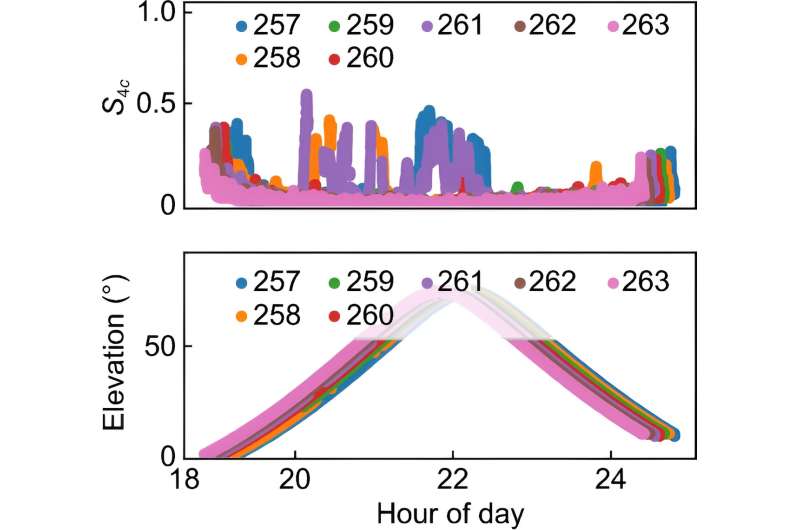
S^4c values for PRN 24 observed by HKOH station from September 14 to September 20, 2014. Credit: Satellite Navigation (2024). DOI: 10.1186/s43020-024-00136-7

Ionospheric scintillation, caused by irregularities in the Earth’s ionosphere, can severely impact Global Navigation Satellite System (GNSS) signal integrity, leading to navigation errors.


Related posts

AI use surges at Travelers as call centre roles reduce

AI use surges at Travelers as call centre roles reduce

January 30, 2026
I’ve Tested 1,000+ Sex Toys. These 8 Are What I Always Recommend

I’ve Tested 1,000+ Sex Toys. These 8 Are What I Always Recommend

January 30, 2026

Traditional detection methods rely on expensive and specialized ionospheric scintillation monitoring receivers (ISMRs). However, with the increasing reliance on GNSS for various applications, there is a pressing need for a more accessible and cost-effective detection method.

Due to these challenges, there is a need for in-depth research on utilizing common GNSS receivers to detect ionospheric scintillation events.

Led by a team of researchers from Hong Kong Polytechnic University, a new study was published in the journal Satellite Navigation on 3 June 2024. The team introduced a novel strategy that uses common geodetic GNSS receivers to identify ionospheric amplitude scintillation events with remarkable precision, potentially transforming GNSS monitoring.

The research focuses on utilizing the vast network of geodetic GNSS receivers to detect ionospheric scintillation events, which are typically identified by specialized ISMRs. The proposed method employs a pre-trained machine learning decision tree algorithm that processes the carrier-to-noise ratio (C/N0) and elevation angle data collected at 1-Hz intervals.

By mitigating multipath effects through detailed analysis of multipath patterns, the study effectively reduces noise and false alarms, ensuring the accuracy of the scintillation detection. The methodology involves computing an alternative scintillation index (S4c) based on C/N0 measurements from geodetic GNSS receivers.

This index shows a high correlation with the traditional S4 index used by ISMRs, despite the higher susceptibility of geodetic receivers to noise and multipath interference. The machine learning algorithm enhances detection accuracy by leveraging the periodic nature of multipath effects, which differ from the irregularities of scintillation.

Experimental results demonstrate that the decision tree algorithm achieves a remarkable 99.9% detection accuracy, surpassing traditional hard and semi-hard threshold methods.

Dr. Yiping Jiang, the lead researcher, stated, “Our study showcases the potential of integrating machine learning with widely available GNSS receivers to revolutionize ionospheric scintillation detection. This method not only provides a cost-effective alternative to specialized equipment but also enhances the accuracy and reliability of space weather monitoring.”

The implications of this research are far-reaching, offering a scalable solution for GNSS users worldwide. By improving the detection of scintillation events, it contributes to the development of more accurate navigation algorithms and techniques.

This advancement is crucial for various applications, including aviation, maritime, and land transportation, where GNSS reliability is paramount.

More information:
Wang Li et al, Amplitude scintillation detection with geodetic GNSS receivers leveraging machine learning decision tree, Satellite Navigation (2024). DOI: 10.1186/s43020-024-00136-7

Provided by
TranSpread

Citation:
Predicting space weather: Machine learning enhances GNSS signal stability (2024, June 19)
retrieved 19 June 2024
from https://techxplore.com/news/2024-06-space-weather-machine-gnss-stability.html

This document is subject to copyright. Apart from any fair dealing for the purpose of private study or research, no
part may be reproduced without the written permission. The content is provided for information purposes only.





Source link

Previous Post

Patria Introduces Pan-European FAMOUS All-Terrain Armored Carrier

Next Post

Press Statement of the Joint ECOWAS-AU-UNOWAS Follow-Up Mission on the ‘‘Agreement for National Unity’’ Signed Between the Government Of Sierra Leone and the All Peoples Congress (APC) Party

Next Post
Press Statement of the Joint ECOWAS-AU-UNOWAS Follow-Up Mission on the ‘‘Agreement for National Unity’’ Signed Between the Government Of Sierra Leone and the All Peoples Congress (APC) Party

Press Statement of the Joint ECOWAS-AU-UNOWAS Follow-Up Mission on the ‘‘Agreement for National Unity’’ Signed Between the Government Of Sierra Leone and the All Peoples Congress (APC) Party

Leave a Reply Cancel reply

Your email address will not be published. Required fields are marked *

RECOMMENDED NEWS

Everything Just Changed, Is a Rally Near?

Everything Just Changed, Is a Rally Near?

3 months ago
VoicePilot framework enhances communication between humans and physically assistive robots

VoicePilot framework enhances communication between humans and physically assistive robots

1 year ago
GABA Receptors Unveiled as Potential Antidepressant Targets

GABA Receptors Unveiled as Potential Antidepressant Targets

2 years ago
Slovakia Announces Halt of Military Aid to Ukraine

Slovakia Announces Halt of Military Aid to Ukraine

2 years ago

POPULAR NEWS

  • Ghana to build three oil refineries, five petrochemical plants in energy sector overhaul

    Ghana to build three oil refineries, five petrochemical plants in energy sector overhaul

    0 shares
    Share 0 Tweet 0
  • The world’s top 10 most valuable car brands in 2025

    0 shares
    Share 0 Tweet 0
  • Top 10 African countries with the highest GDP per capita in 2025

    0 shares
    Share 0 Tweet 0
  • Global ranking of Top 5 smartphone brands in Q3, 2024

    0 shares
    Share 0 Tweet 0
  • When Will SHIB Reach $1? Here’s What ChatGPT Says

    0 shares
    Share 0 Tweet 0

Get strategic intelligence you won’t find anywhere else. Subscribe to the Limitless Beliefs Newsletter for monthly insights on overlooked business opportunities across Africa.

Subscription Form

© 2026 LBNN – All rights reserved.

Privacy Policy | About Us | Contact

Tiktok Youtube Telegram Instagram Linkedin X-twitter
No Result
View All Result
  • Home
  • Business
  • Politics
  • Markets
  • Crypto
  • Economics
    • Manufacturing
    • Real Estate
    • Infrastructure
  • Finance
  • Energy
  • Creator Economy
  • Wealth Management
  • Taxes
  • Telecoms
  • Military & Defense
  • Careers
  • Technology
  • Artificial Intelligence
  • Investigative journalism
  • Art & Culture
  • LBNN Blueprints
  • Quizzes
    • Enneagram quiz
  • Fashion Intelligence

© 2023 LBNN - All rights reserved.