

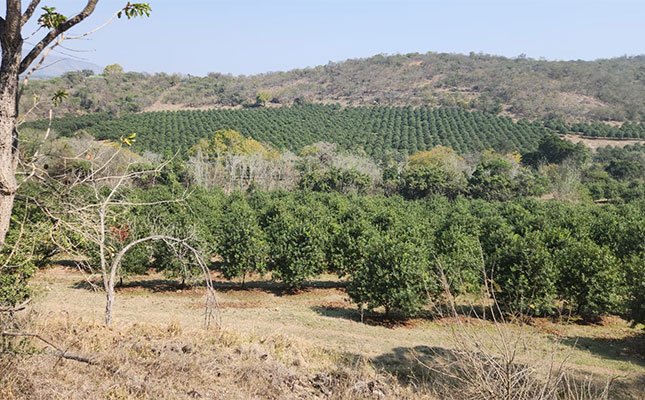
South Africa’s macadamia industry is at a turning point. After a decade of rapid growth and high prices, the sector is now entering a period of consolidation, tighter margins and increased structural risk, particularly concerning the growing export of unshelled nuts to Asia.
– ADVERTISEMENT –
This was the message delivered by Duncan Allen, executive head of Green Farms Nut Co, on 5 February at the Ambermacs Macadamia Expo in White River, Mpumalanga. Addressing growers, processors and service providers, Allen warned that outsourcing cracking and kernel processing abroad could undermine the long-term resilience of the local industry.
A one-way door for processing capacity
Allen cautioned that the increasing export of high-quality in-shell nuts, especially those with strong cracking values, to Asian processors poses a fundamental threat to South Africa’s value chain.
“If we export our nuts with the best cracking values and keep the lower-margin material here, South Africa loses the most valuable part of the value chain,” he said. “We then become just a supplier of an unprocessed commodity,” he said.
South Africa is the world’s largest producer of macadamias, with most of its crop destined for export markets in Asia, Europe and North America. Traditionally, the industry built its competitiveness around local cracking, sorting and kernel exports. However, growing demand from Asian buyers for in-shell nuts has altered that balance.
Allen described the shift as a potential “one-way door”.
“Once local processing capacity becomes underutilised, fixed costs start to bite, factories close, skills disappear, and banks downgrade assets downward. Once buyers get used to in-shell nut prices, kernel margins won’t easily return,” he warned.
South African processors already compete in global kernel markets with suppliers in Vietnam and other Asian countries that purchase South African in-shell nuts, crack them offshore, and then sell kernels into traditional markets previously supplied directly by South African processors.
Allen acknowledged that foreign processing can serve a role as a cyclical pressure-relief mechanism when local capacity is stretched or markets are distorted. But he stressed that it must not become the primary marketing channel.
“For the long-term resilience and bankability of the industry, it is essential to retain kernel processing in South Africa.”
The stakes, he suggested, extend beyond individual factories. Processing facilities anchor regional employment, technical skills and financing models. If throughput declines significantly, entire regional production hubs could weaken.
From price boom to harsh reality
The industry’s vulnerability today is partly a consequence of its extraordinary growth between 2010 and 2022. During that period, global demand surged, prices reached record highs, and financing was readily available.
Africa’s macadamia orchards expanded from roughly 17 000ha to more than 80 000ha over little more than a decade. Billions of rands were invested in new plantings, infrastructure and processing capacity.
“It was a period of easy money and optimistic assumptions about prices and yields,” Allen reminded the audience.
However, the combination of post-COVID-19 market cooling, global economic uncertainty and supply growth has reshaped the landscape. Prices have fallen sharply from their peaks, and many growers are now operating under significant financial strain.
Producers farming at high production costs, orchards planted in marginal areas, and businesses carrying heavy debt loads are now under acute pressure.
“The biggest mistake we can make is to think prices will simply return to the peaks of the past. If that happens, it would be a miracle. In the short term, profits must come from efficiency, not price recovery,” Allen said.
Consolidation on the horizon
Allen predicted that the next few years will see significant consolidation within the sector.
“From 2026 to 2028, consolidation will likely accelerate. Business asset values will be written down, opportunistic farm sales will become common, and many farmers will exit the industry.”
He expects supply growth to stabilise around 2032, leaving a smaller but stronger core group of stakeholders. The winners, in his view, will be producers operating in core production regions, notably KwaZulu-Natal, and parts of Mpumalanga and Limpopo, with strong financing structures, newer cultivars and lower costs per kilogram.
Cost control and yield stability will become decisive competitive factors. Producers with modern orchards, improved cultivar selections and disciplined financial management are likely to weather the storm.
For others, the coming years may force difficult decisions.
Efficiency over ‘brilliant ideas’
Allen argued that the industry’s next phase of growth will not be driven by bold expansion or speculative investments, but by disciplined operational improvement.
“The next phase won’t be driven by brilliant ideas. It will be driven by hard, necessary efficiency gains,” he said.
These gains include precision farming techniques, better irrigation scheduling, improved fertiliser management, and enhanced orchard monitoring. In processing plants, higher cracking percentages of healthy nuts and reduced wastage will be critical.
Technology is playing an increasing role in this shift. Digital traceability systems, data-driven orchard management and improved post-harvest handling are becoming standard in leading operations.
Market development and product innovation, though slow and costly, were identified as equally important.
“We have a world-class product, but people don’t always know it. Market development and product innovation is where the biggest returns for the industry lie,” Allen said.
Expanding demand in established markets while cultivating new consumer segment, particularly for premium kernels and value-added products, could help rebuild margins over time.
Ambermacs Expo reflects industry pivot
Allen’s address formed part of the fifth annual Ambermacs Macadamia Expo, held on 5 and 6 February 2026 at the Ambermacs facility on Old Plaston Road in White River.
The event has become a key fixture on the macadamia calendar, particularly for growers in Mpumalanga, one of South Africa’s major production hubs. This year’s expo attracted more than 150 exhibitors and around 3 000 attendees.
The programme focused heavily on precision farming, pest control, irrigation management, cultivar performance and innovations across the value chain. Exhibitors showcased live demonstrations of sprayers, harvesters and orchard equipment, while seminars explored regenerative practices and traceability technologies such as blockchain.
The event also maintained its family-friendly character, with food vendors, live music performances and networking opportunities reinforcing its role as both a business and community gathering point.
Against this backdrop, Allen’s message resonated with an audience already acutely aware of rising input costs, volatile markets and tightening credit conditions.
Cautious optimism
Despite the sobering outlook, Allen struck a cautiously optimistic tone.
“We rose quickly until 2022, then fell hard,” he said. “Now we must rebuild our industry step by step.”
He believes that if the sector can maintain local processing capacity, embrace strict capital discipline and focus relentlessly on efficiency, it can emerge more robust and future-proof.
The coming five years will test balance sheets, management skill and strategic discipline. But they may also correct excesses accumulated during the boom years.
For South Africa’s macadamia growers, the message from White River was clear: survival will depend less on waiting for price recovery and more on mastering costs, protecting value addition at home, and building markets deliberately and patiently.
In Allen’s view, the industry’s long-term bankability, and its status as a global leader, rests on decisions being made today.
“If we get it right,” he said, “we can build a more resilient macadamia industry.”
For an industry that has grown at remarkable speed, the challenge now is not expansion, but consolidation, and the careful safeguarding of the value chain that underpins it.
Get trusted farming news from Farmers Weekly in Google Top Stories.
➕ Add Farmers Weekly to Google
✔ Takes 10 seconds · ✔ Remove anytime


