A recent report released by the United Nations on Tuesday disclosed that the M23 group intends to create its own autonomous territory within the DRC, despite peace efforts by mediators such as the United States and Qatar.
As per the report seen on Bloomberg, the rebel group has been seizing strategic mines and setting up a parallel government in Congo’s North and South Kivu provinces.
M23 rebels had seized the small town of Uvira in December, marking the third province captured by the rebel group since the commencement of their offensive in January of last year.
Uvira, on the banks of Lake Tanganyika, has functioned as both the regional military camp and the seat of the Kinshasa-appointed administration in South Kivu province since the M23 captured the Congolese town of Bukavu, the province’s capital, in February.
Prior to the group’s attack on Uvira, the United States, under the directive of Donald Trump, had mediated a peace deal between Rwanda and the DRC.


The Washington Accords
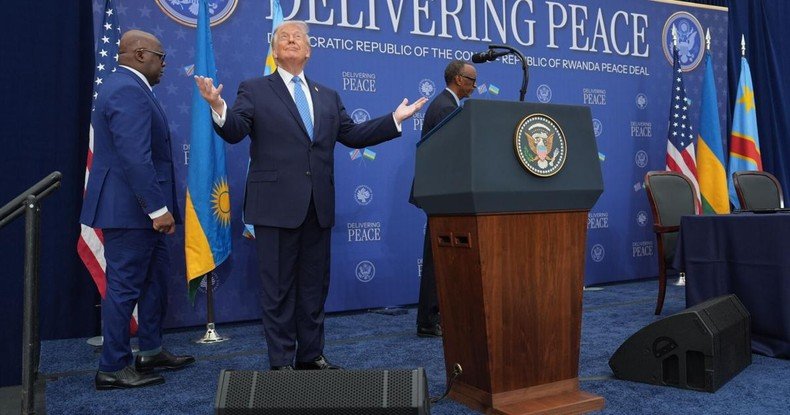
Last month, the leaders of Rwanda and the Democratic Republic of the Congo (DRC), Paul Kagame and Felix Tshisekedi, met with U.S. President Donald Trump in the White House, in an effort to stop the M23 rebels’ attacks in the DRC’s eastern region.
A deal simply referred to as the Washington Accords was reached after almost 30 years of fighting, effectively ending hostilities.
The agreement includes measures for refugees to return to their homes, a new framework for economic development, justice for those who have perpetrated “illegal atrocities,” a permanent peace, and the disarmament of non-state actors.
However, a few days after Rwanda and the DRC signed the Washington Accords, fighting in the Eastern part of Congo resumed.
As soon as the fighting recommenced, the United Nations revealed that more than 200,000 people had been forced to flee the region.
The resurgence of conflict stemmed from mutual accusations of violations of the existing peace agreement.
M23 vs the DRC
The M23, a predominantly Tutsi rebel group that originally emerged in 2012, resurfaced forcefully in eastern DR Congo after years of relative dormancy, launching a major offensive that has reshaped the security landscape of the region.
A watershed moment came in late January 2025 when M23 launched a rapid offensive that culminated in the capture of Goma, the capital of North Kivu and a major urban and logistical hub.
Reports show that thousands of fighters, with alleged support from Rwanda, pushed government forces back and took control of key positions in the city.
The advance marked the greatest territorial gain by the group since its revival and underscored the weakness of government defenses.
Following the fall of Goma, M23 turned its attention southward.
In February 2025, the group entered Bukavu, the provincial capital of South Kivu, following the withdrawal of government troops.
This move extended M23’s influence deep into the eastern DRC and was widely seen as an unprecedented expansion of territory under its control.
During this period, violence intensified, and civilians suffered greatly.
Reports documented large displacement flows and human rights abuses, including summary executions and threats against journalists and activists in occupied zones.